The Need for Quantization
Chem 3240 · Lecture 1.2
What is the nature of light?
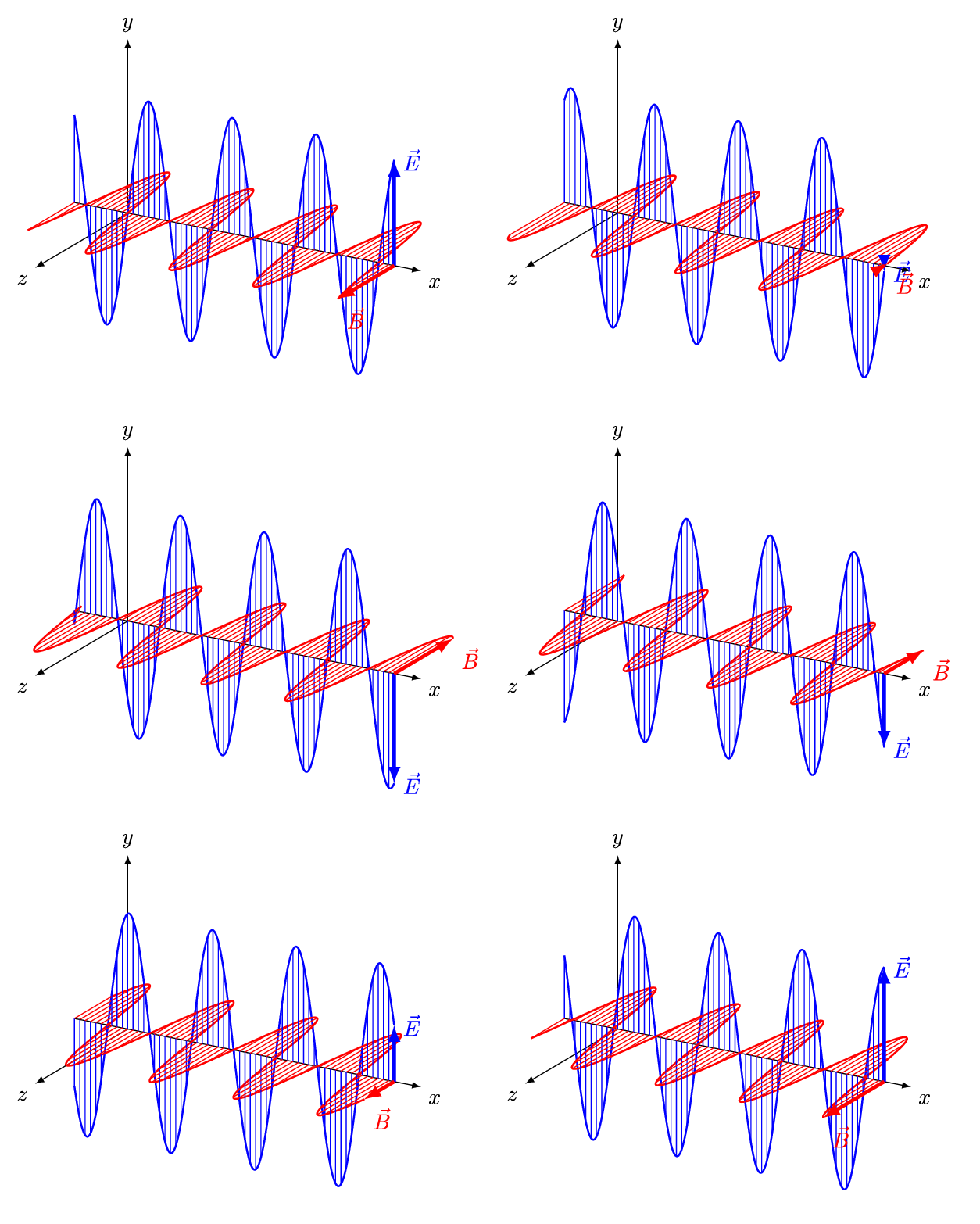
- Light as a traveling electromagnetic wave
- Perpendicular electric and magnetic components
- Needs no medium, travels in vacuum at speed c
- This wave picture is not the whole story
The electromagnetic spectrum
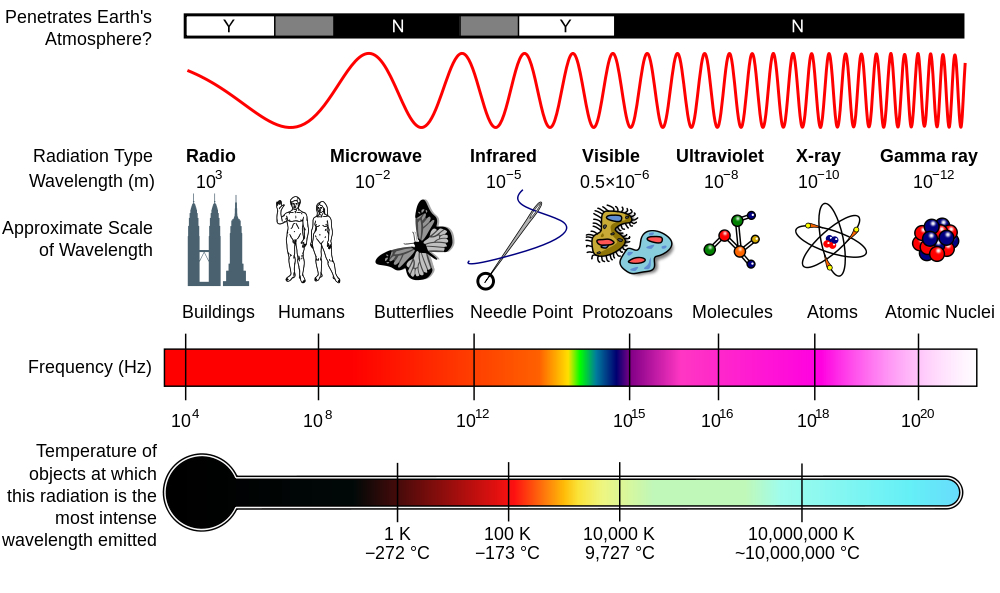
- Visible light is a narrow band
- High frequency carries more energy (X-rays, gamma)
- Low frequency carries less energy (microwave, radio)
- Clear link between an object’s temperature and its radiation
Frequency, wavelength, speed of light
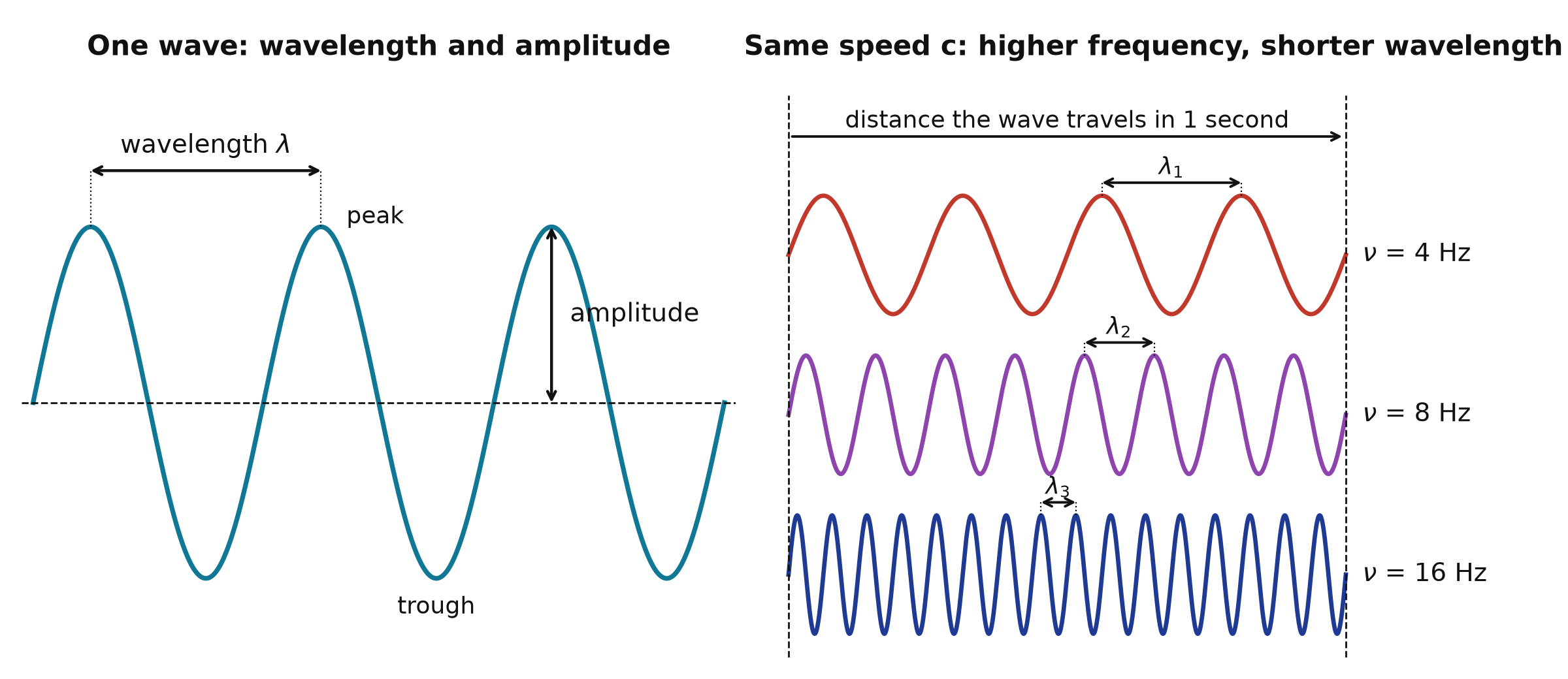
\lambda \nu = c \qquad c = 3 \cdot 10^8 \, \text{m/s}
- Key question: how does the energy E of light relate to its frequency \nu?
How a light bulb started quantum mechanics
- 1887: Siemens and Helmholtz found the PTR in Berlin, the first national standards lab, to serve German industry
- Its customer: the electric lighting business. How much light does a glowing filament give per watt, and at what temperature?
- 1890s: Lummer, Pringsheim, Rubens, Kurlbaum measure black body spectra with unmatched precision, deep into the infrared
- October 1900: Wien’s formula fails at long wavelengths; Rubens tells Planck on a Sunday; Planck has the right formula by evening
- December 1900: the only derivation that works needs E = h\nu. Planck: “an act of desperation”
- The full story, with the people and instruments (video)
The black body
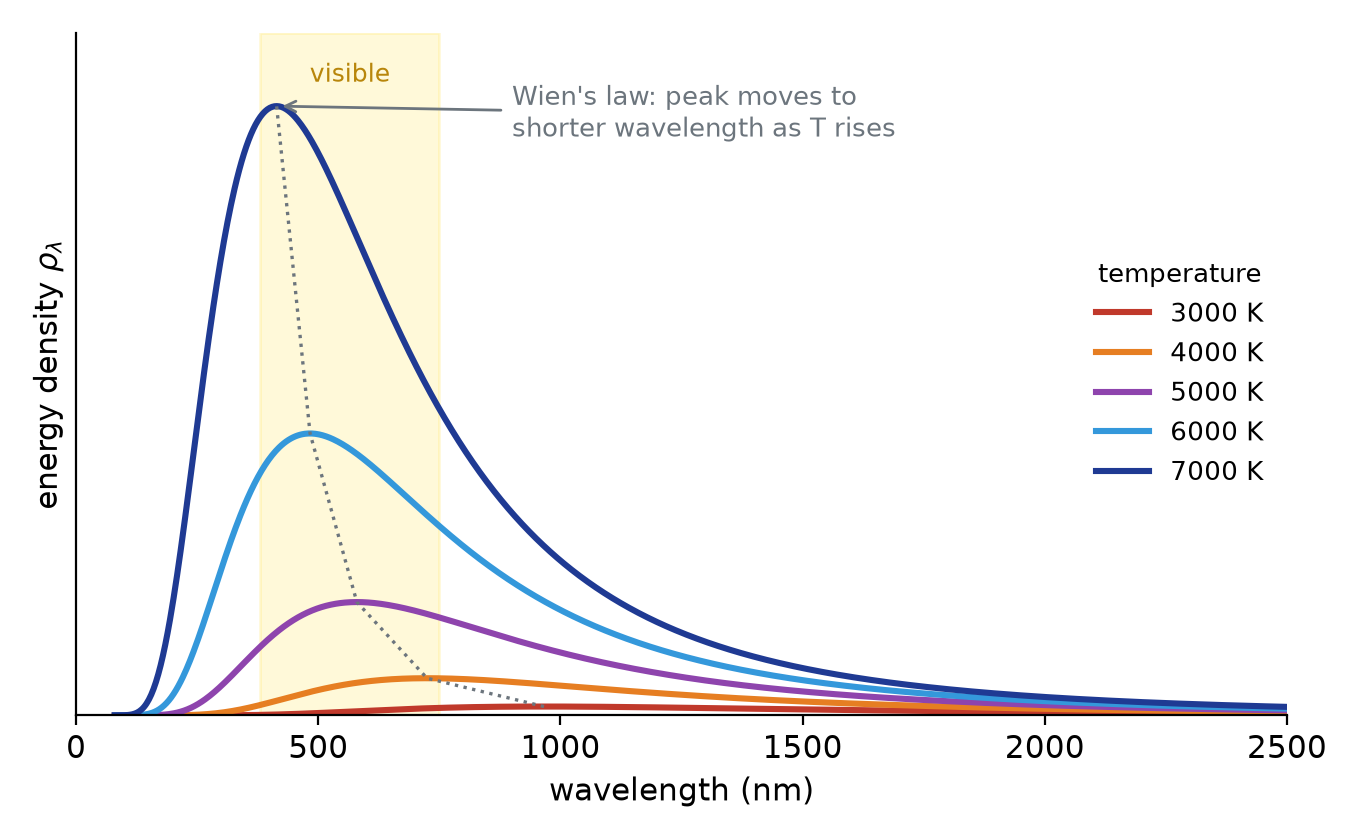
- Idealized model: absorbs and emits every wavelength
- In thermal equilibrium at temperature T
- Emitted spectrum set only by T
- Heating up: intensity rises, peak shifts to shorter \lambda, color goes red to white to blue
Average mode energy, the classical way
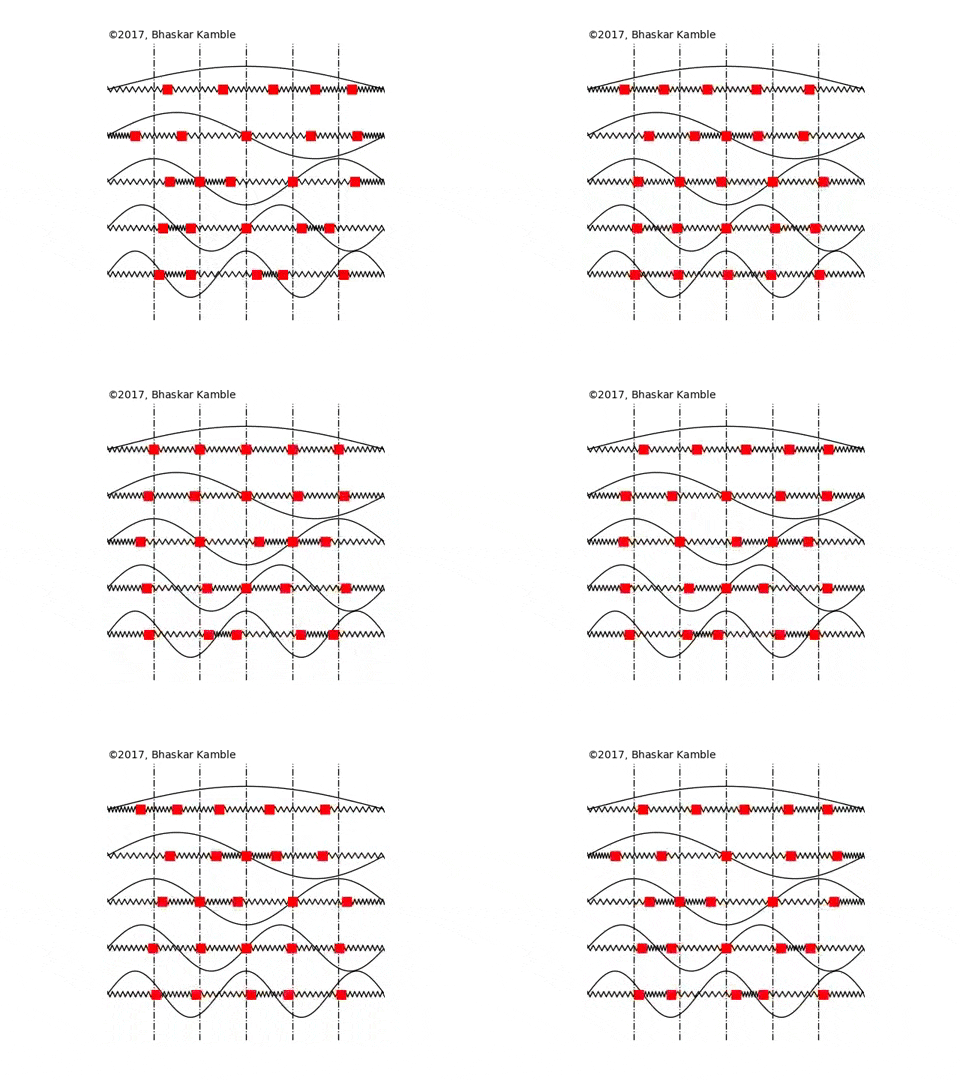
- Heated atoms vibrate like springs, radiating at frequency \nu
- Equipartition: every oscillator gets the same energy, whatever its frequency \langle E\rangle = k_BT
- The same k_BT for a slow, long wave and a fast, short one. Hold that thought
Number of modes: counting the waves in a box
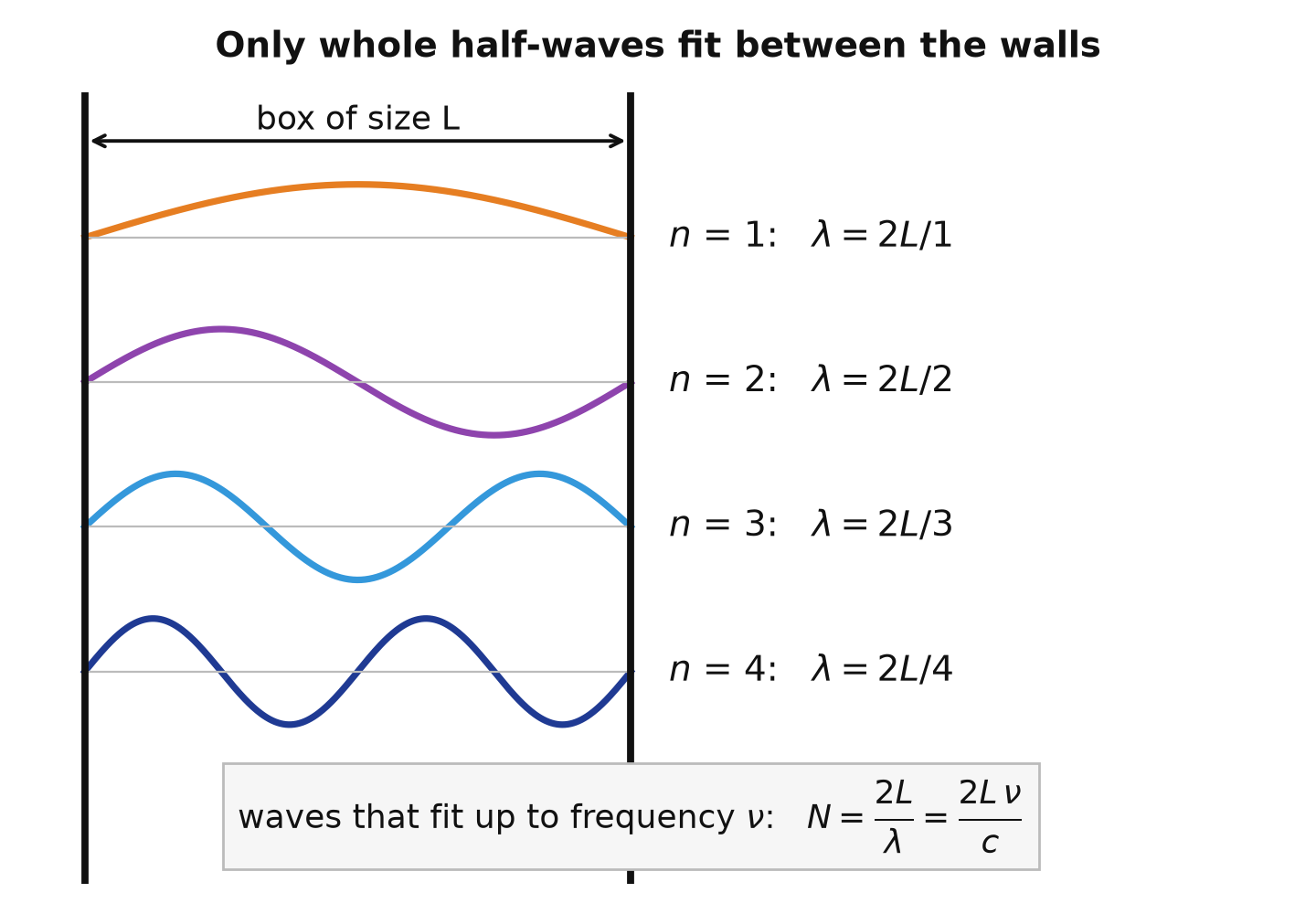
- Only whole half-waves fit: \lambda_n = 2L/n
- Shorter waves fit more easily: N \sim L/\lambda \sim \nu in 1D
- In 3D the wave must fit along each direction, so N \sim \nu^3
- A thin slice of frequency holds dN_{\nu} = \frac{8\pi}{c^3}\,\nu^2\, d\nu
The ultraviolet catastrophe
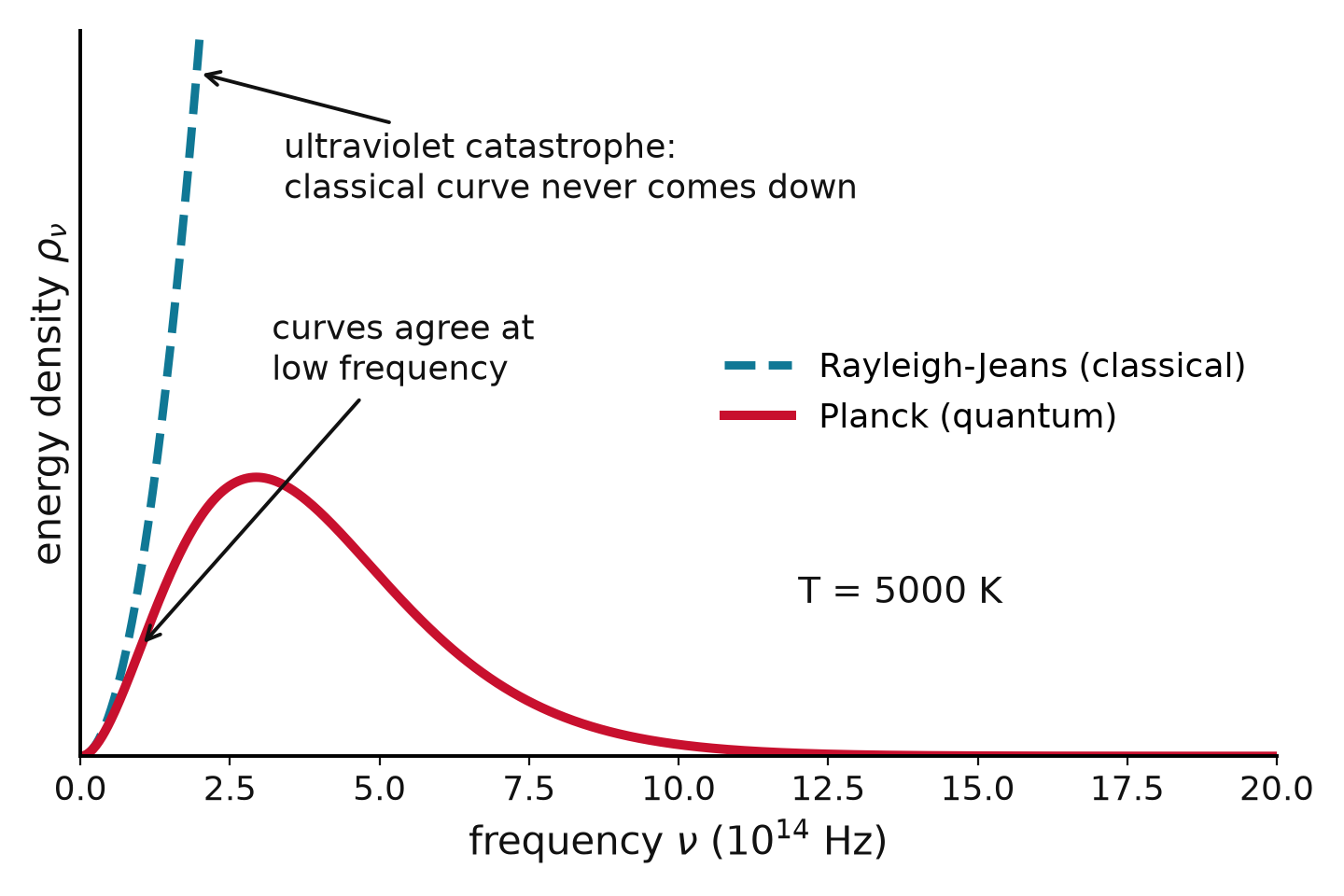
- Energy per mode \times modes, the Rayleigh-Jeans law: \rho(\nu) = k_B T \cdot \frac{8\pi}{c^3}\nu^2
- It shoots to infinity at high \nu: a light bulb could destroy the universe
- The mode count is solid geometry, so the average energy must be wrong
Wien’s displacement law
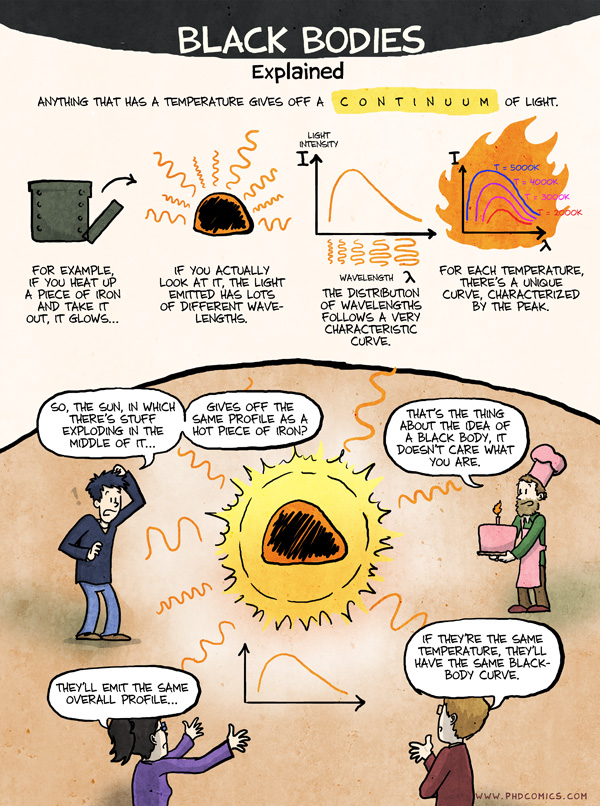
- Peak wavelength is inversely proportional to temperature:
\lambda_{max} = \frac{b}{T}
- b = 2.898 \cdot 10^{-3} \, m \cdot K
- Connects an object’s temperature to its color
- Hotter object: shorter \lambda_{max} (bluer)