The Photoelectric Effect

Chem 3240 · Lecture 1.3

Davit Potoyan

The Puzzle

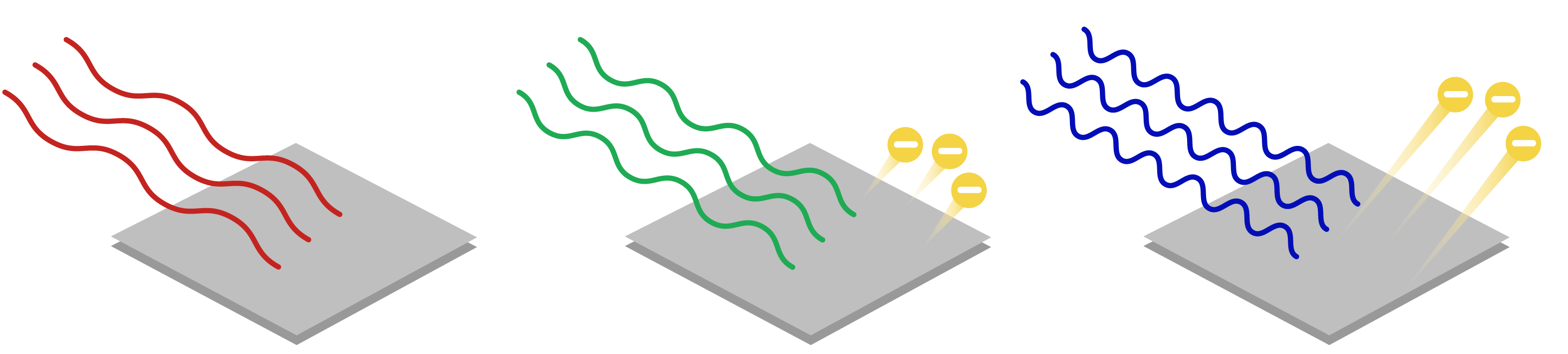
  • Shine radiation on a metal: electrons fly off
  • Only above a threshold frequency \(\nu_0\)
  • Below \(\nu_0\): no electrons, no matter how bright
  • Frequency increases left to right

Why Classical Physics Fails
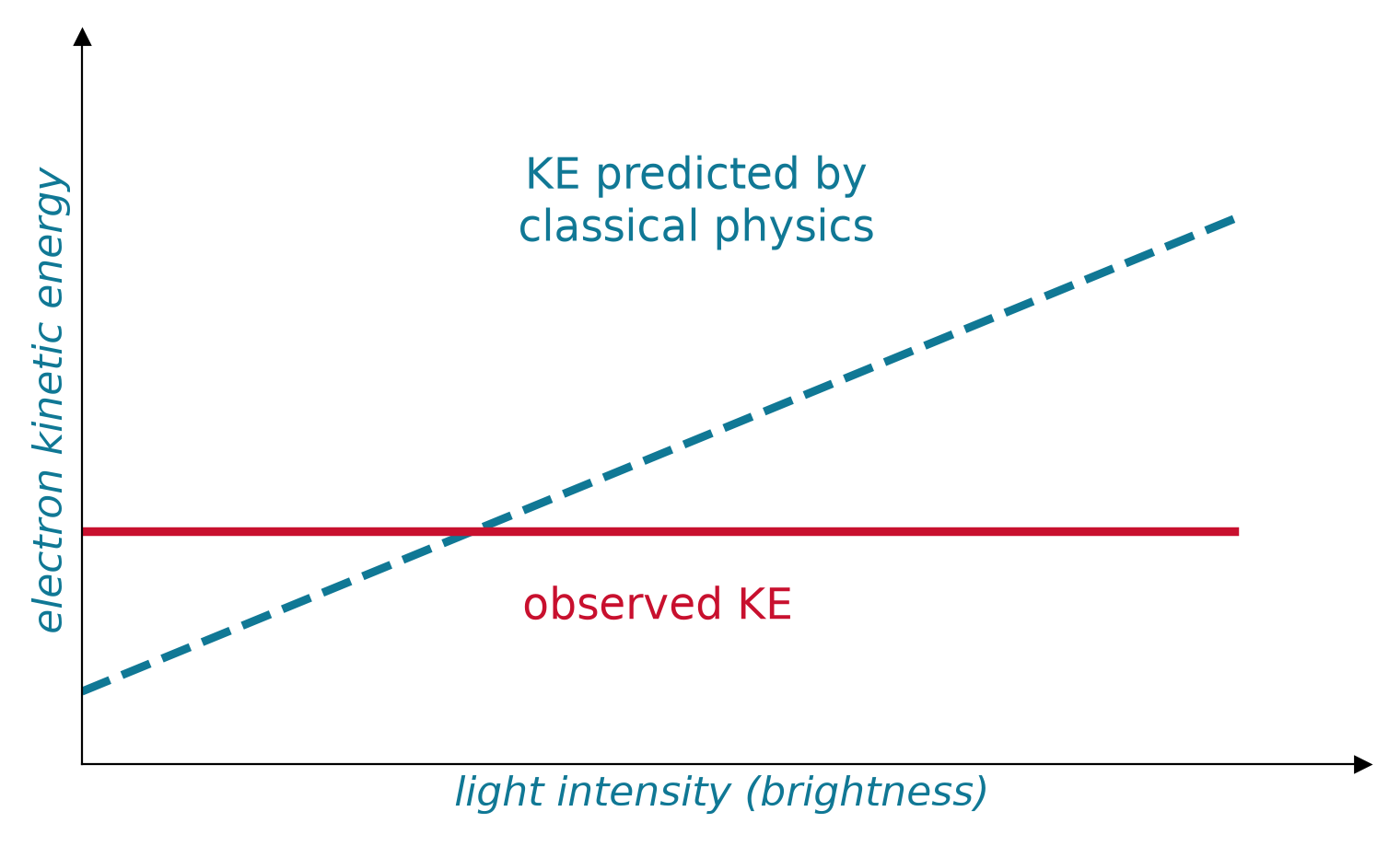
  • Classically, energy of a wave scales with amplitude (intensity, brightness)
  • ::: {.fragment} So a bright enough light should always eject electrons :::
  • ::: {.fragment} Experiment says no: dim high-frequency light works, intense low-frequency light does not :::
  • ::: {.fragment} Intensity is the wrong knob. Frequency is the gatekeeper. :::

Enter the Photon

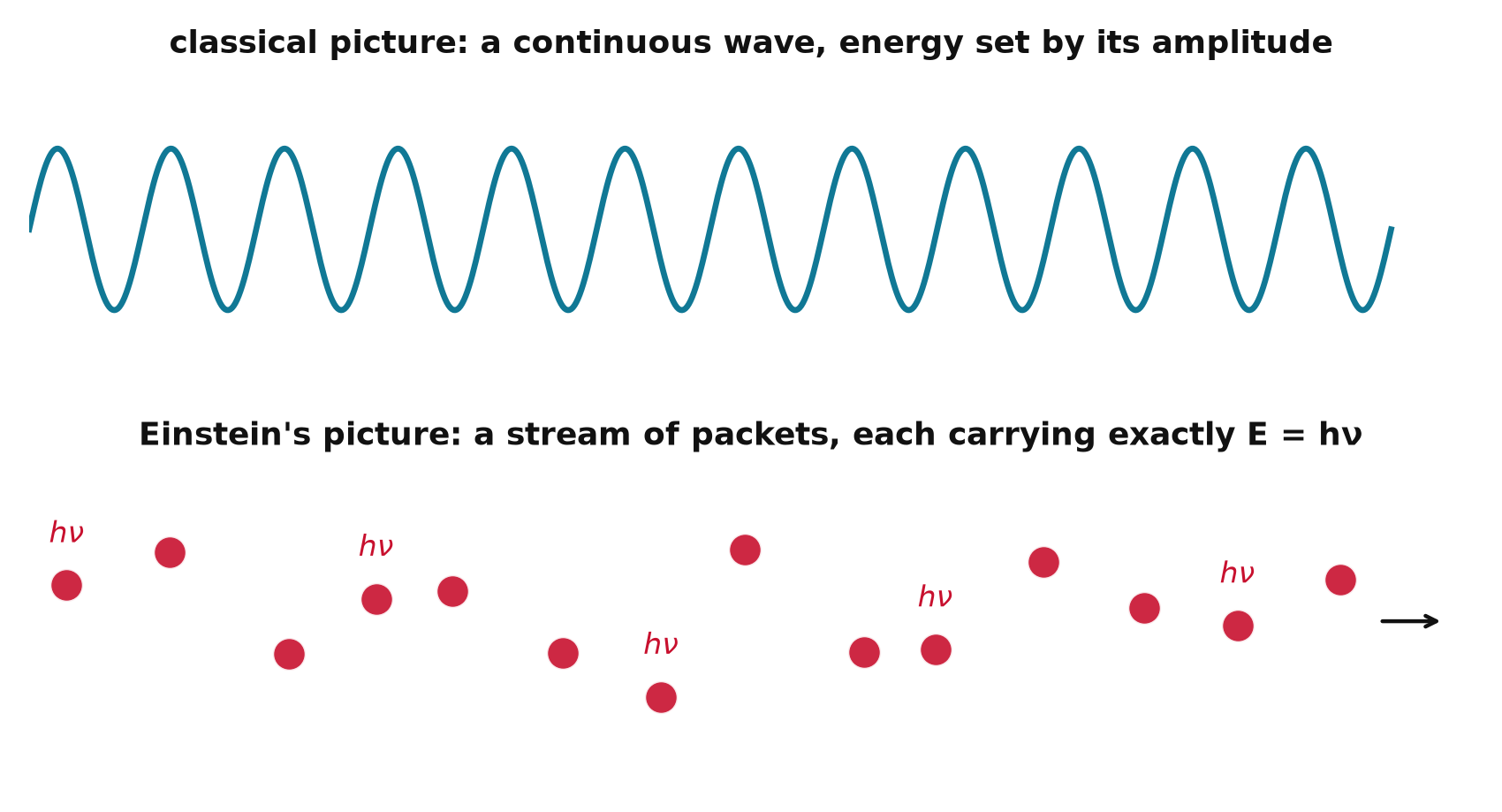
  • ::: {.fragment} Planck quantized oscillators: energies \(0, h\nu, 2h\nu, 3h\nu, \ldots\) (seen then as a math trick) :::
  • ::: {.fragment} Einstein: light itself is a stream of discrete energy packets, photons :::
  • ::: {.fragment} This bold step explains the experiment :::

Energy of a Photon

\[ E_{photon} = h\nu = \frac{hc}{\lambda} \]

  • ::: {.fragment} \(E_{photon}\): energy of one photon :::
  • ::: {.fragment} \(\nu\): frequency of that photon :::
  • ::: {.fragment} Both matter and radiation are quantized, by the same relation: energy = (Planck constant) times frequency :::

Kinetic Energy: Frequency vs Intensity
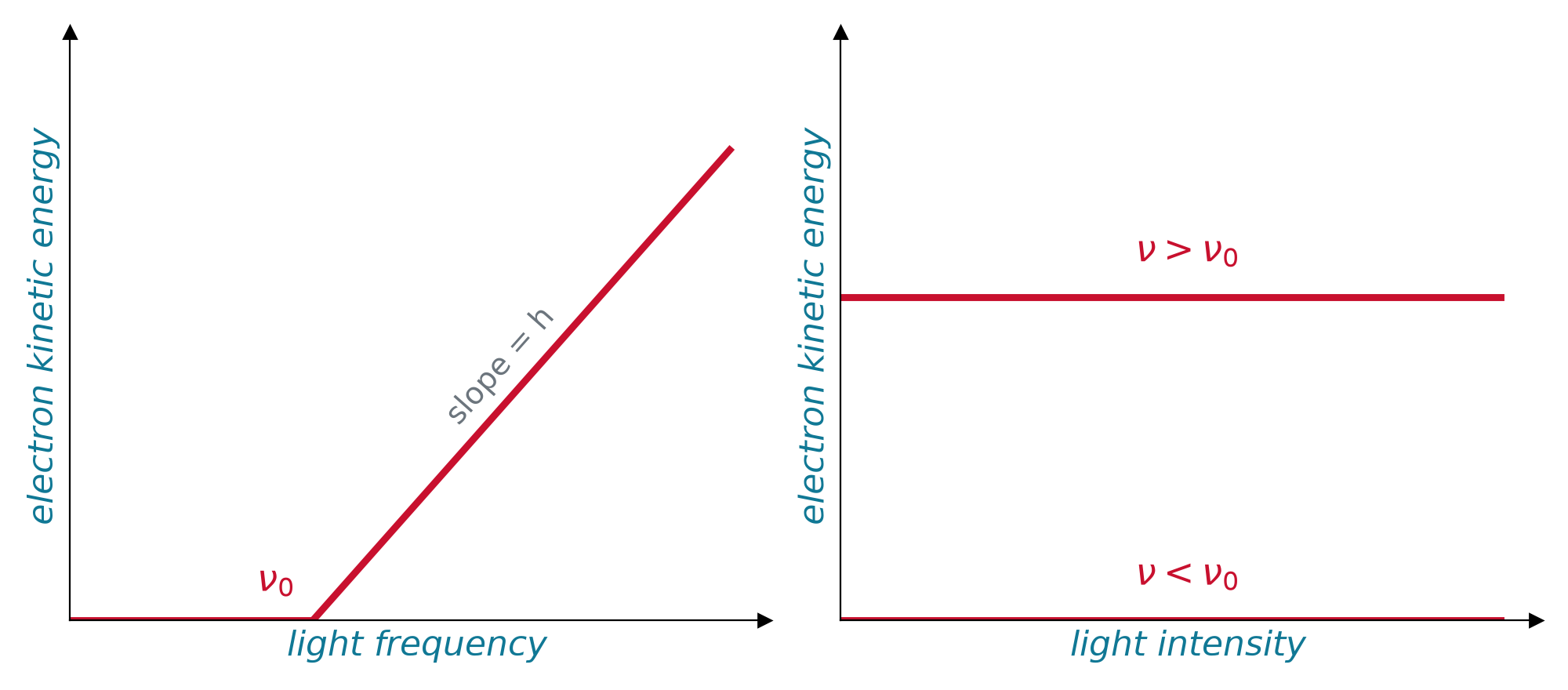
  • Need \(\nu > \nu_0\) to eject at all
  • KE grows linearly with frequency: \(KE \sim \nu\)
  • KE does not depend on intensity
  • Below \(\nu_0\): brighter light still ejects nothing

Electric Current: Frequency vs Intensity
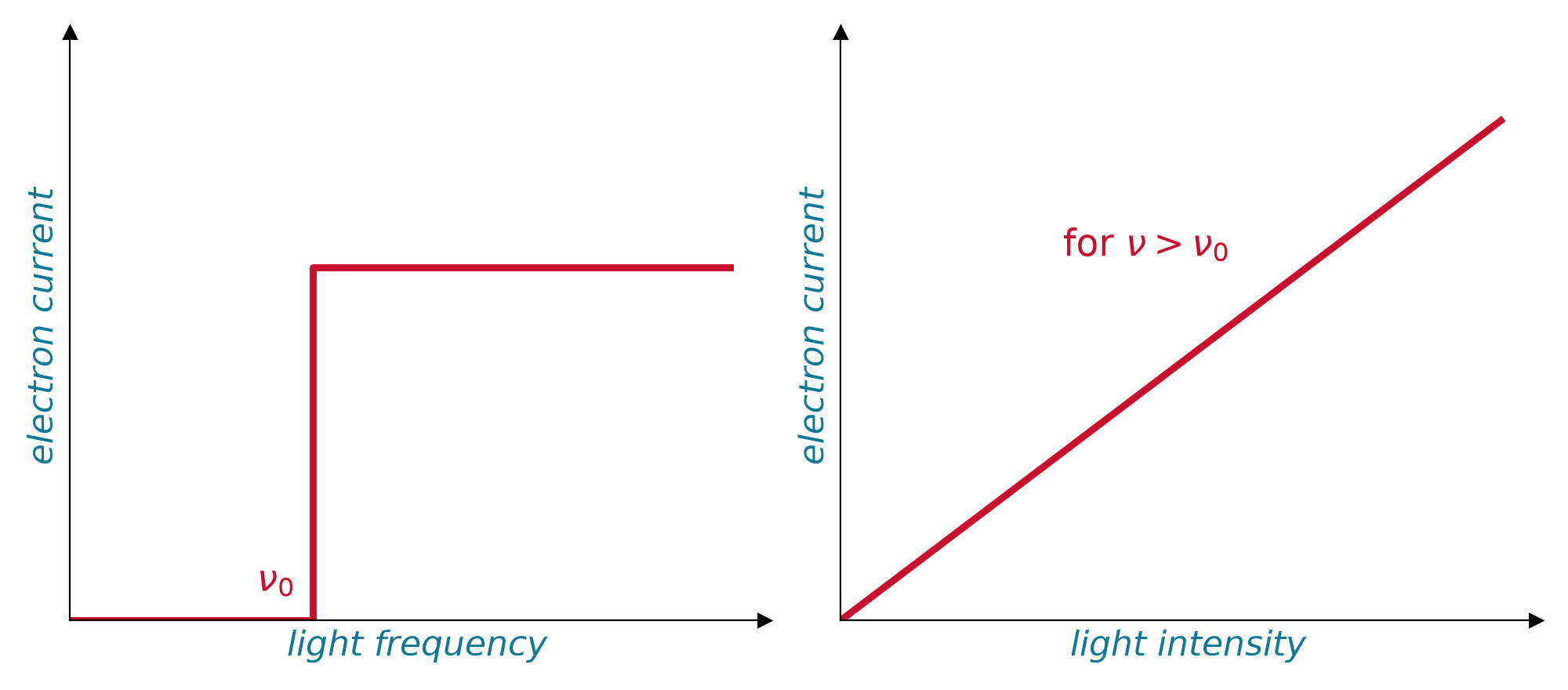
  • Above threshold, frequency does not change current
  • Intensity sets the current: more photons, more electrons
  • Current rises linearly with intensity

How Photons Explain It All

  • ::: {.fragment} Intensity = number of photons (sets the current) :::
  • ::: {.fragment} Frequency = energy per photon (sets the KE) :::
  • ::: {.fragment} \(n\) photons per second carry total energy \(nh\nu\) :::
  • ::: {.fragment} One photon ejects one electron, if it carries enough energy :::

The Photoelectric Equation

\[E_{photon} = W_0 + KE\]

\[h\nu = h\nu_0 + \frac{mv_e^2}{2}\]

  • ::: {.fragment} Work function \(W_0 = h\nu_0\): minimum energy to free an electron (material dependent) :::
  • ::: {.fragment} \(\nu_0\): threshold frequency; below it, no energy transfers :::
  • ::: {.fragment} Excess energy becomes electron kinetic energy \(KE = mv_e^2/2\) :::

Why It Matters

  • Cornerstone of quantum theory
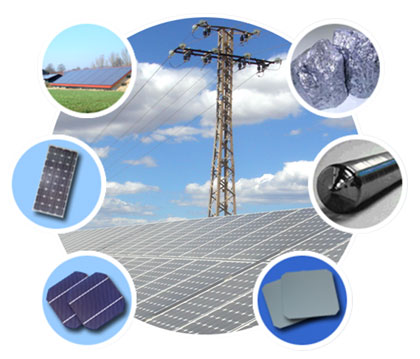
  • Solar cells and photovoltaics
  • Photoelectron spectroscopy
  • Night vision and detectors

Takeaway

Light is quantized into photons: frequency sets each photon’s energy (and the ejected electron’s kinetic energy), while intensity sets only how many electrons fly off.