Atomic Spectra
Chem 3240 · Lecture 1.5
Spectroscopy: Light as a Fingerprint
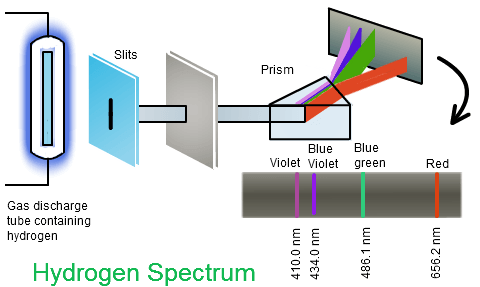
- Spectroscopy: interaction of matter and light
- Heated atoms emit at characteristic frequencies
- Spectrum is unique per element: an atomic fingerprint
- Reveals structure and composition
Discrete Lines, Not a Continuum
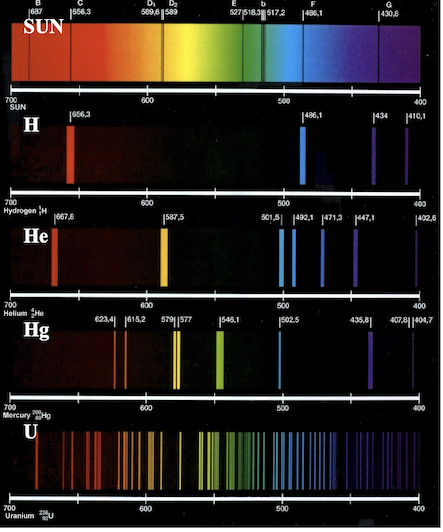
- Solar spectrum shows dark and bright lines
- Lines identify elements in the Sun’s atmosphere
- Discrete lines are impossible in classical mechanics
- A puzzle awaiting a new physics
Spectral Series
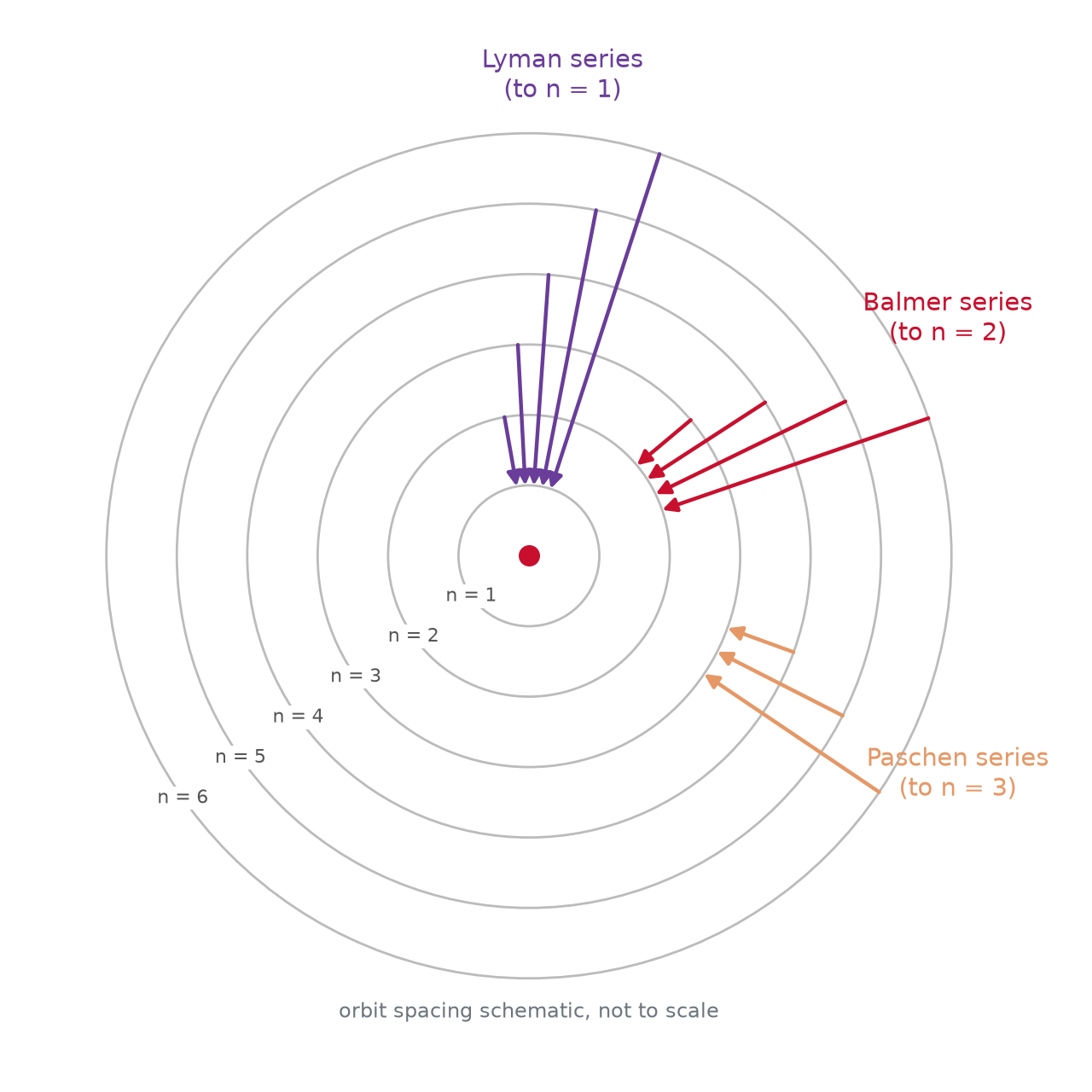
- Each series = all transitions to one lower level
- Lyman: n_1=1
- Balmer: n_1=2
- Paschen: n_1=3
- Named after their discoverers
Bohr’s Model (1913)
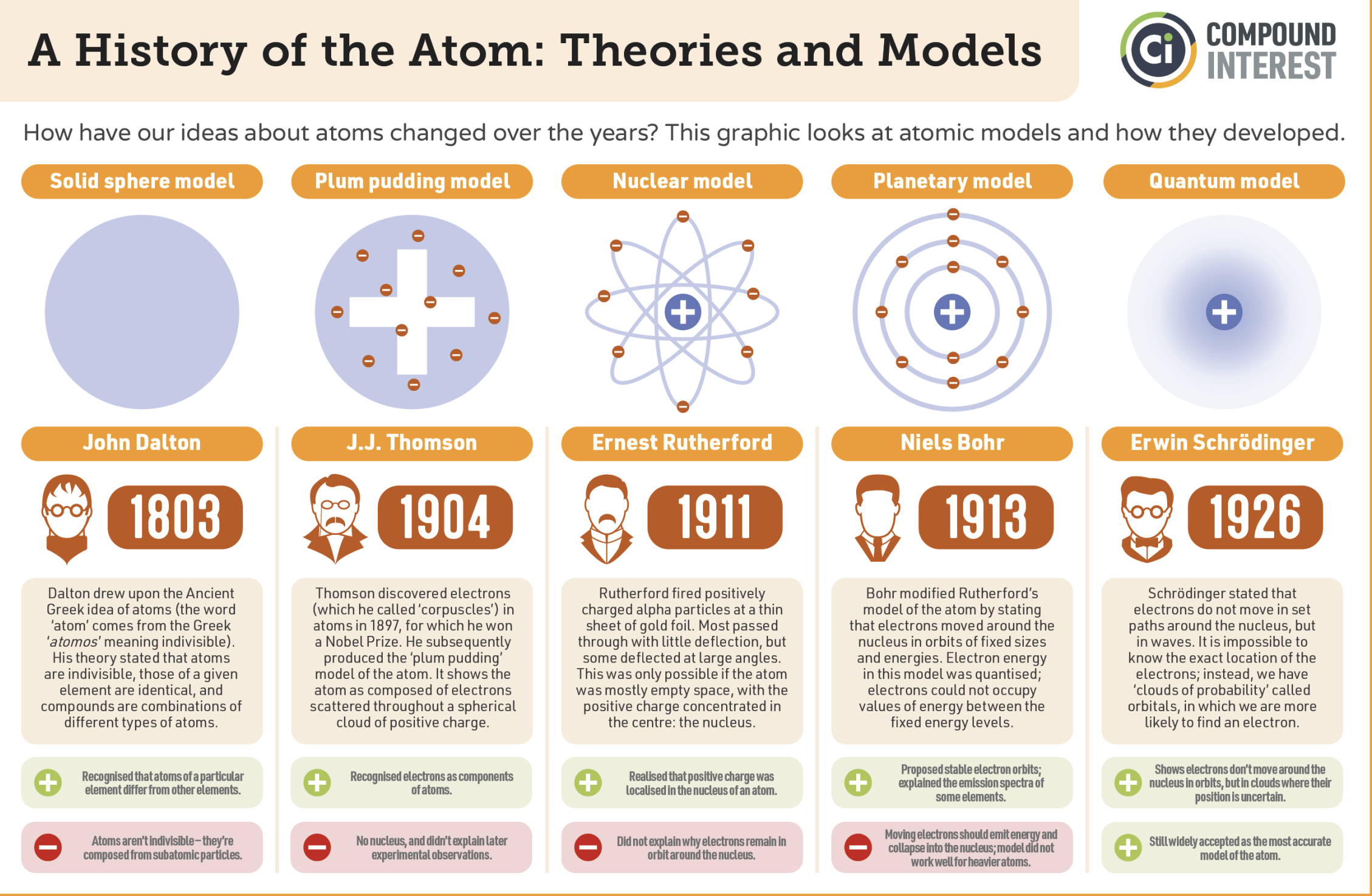
- Electron in circular orbits around a fixed proton
- New quantization rule stops the spiral into the nucleus
- Orbit must hold an integer number of standing waves, n=1,2,3,...
- Yields discrete energy levels labeled by n
Circular Motion: What Actually Balances
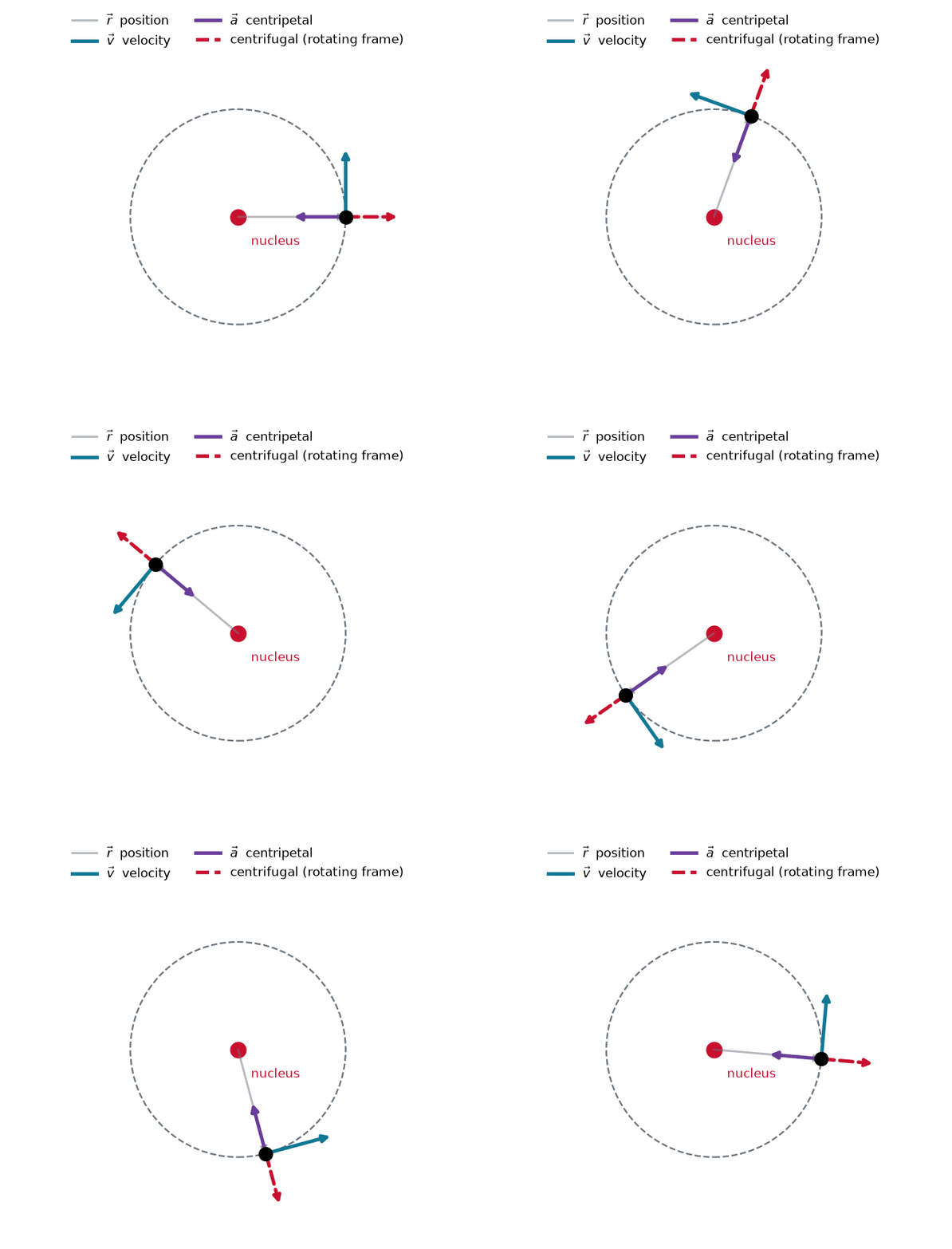
- \vec{v} always tangent, \vec{a} always inward
- Magnitudes fixed, only directions turn
- Lab frame: Coulomb pull is unbalanced, it supplies a = v^2/r
- Rotating frame: centrifugal cancels it
- Each component is simple harmonic motion
Lines are Jumps Between Levels
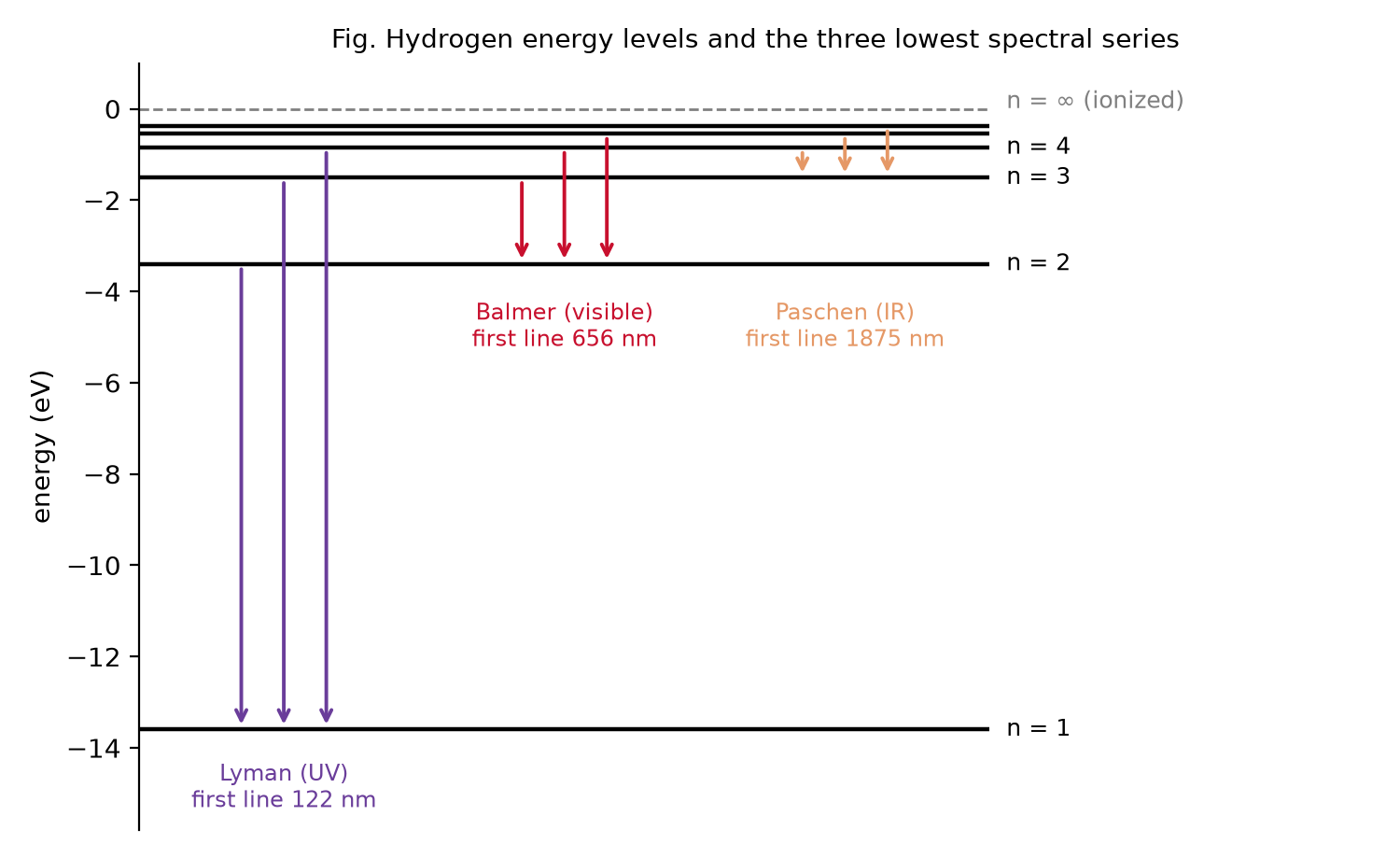
- A photon carries away exactly E_{n_2} - E_{n_1} = h\nu
- Each series shares its lower level
- Lyman ends on n=1 (UV), Balmer on n=2 (visible), Paschen on n=3 (IR)
- Lines pile up at the series limit, the ionization edge