The Schrödinger Equation and the Wavefunction
Chem 3240 · Lecture 3.1
Two facts in search of an equation
Chapter 1: what experiments demand
E = h\nu = \hbar\omega \qquad\qquad p = \frac{h}{\lambda} = \hbar k
Chapter 2: the language of waves
u(x,t) = A\,e^{i(kx - \omega t)}
- Schrödinger, 1926: which wave equation does the matter wave obey?
- A fundamental law: motivated and tested, never derived
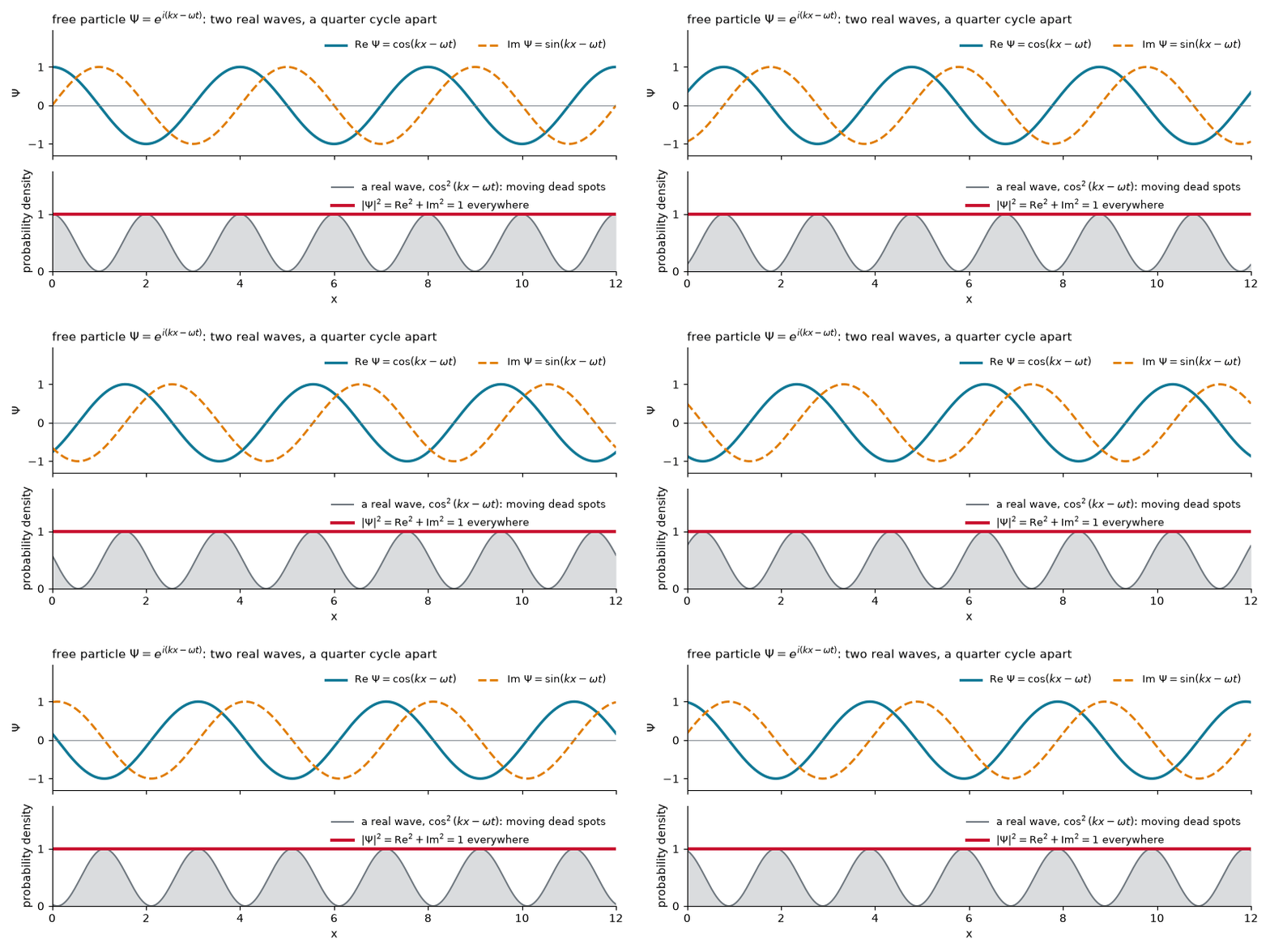
The wave of a free particle
\Psi(x,t) = A\,e^{\frac{i}{\hbar}(px - Et)}
- Re and Im run a quarter cycle apart
- |\Psi|^2 is flat: definite momentum, no preferred position
- A real wave would have moving dead spots
Example: does the string’s equation work?
Put \Psi = A\,e^{i(kx-\omega t)} into the string’s wave equation. What must E and p obey?
\frac{\partial^2 \Psi}{\partial x^2} = \frac{1}{v^2}\frac{\partial^2 \Psi}{\partial t^2} \quad\Longrightarrow\quad -k^2 = -\frac{\omega^2}{v^2} \quad\Longrightarrow\quad E = v\,p
Right for light, E = pc. Wrong for an electron, E = p^2/2m.
We need an equation that brings down E once and p twice: one time derivative, two space derivatives.
Derivatives read off E and p
Each derivative of \Psi = A\,e^{\frac{i}{\hbar}(px - Et)} brings down the factor in the exponent:
\begin{aligned}
i\hbar\,\frac{\partial \Psi}{\partial t} &= i\hbar\left(-\frac{iE}{\hbar}\right)\Psi = -i^2E\,\Psi = E\,\Psi \\[6pt]
-i\hbar\,\frac{\partial \Psi}{\partial x} &= -i\hbar\left(\frac{ip}{\hbar}\right)\Psi = p\,\Psi \\[6pt]
-\frac{\hbar^2}{2m}\frac{\partial^2 \Psi}{\partial x^2} &= -\frac{\hbar^2}{2m}\left(\frac{ip}{\hbar}\right)^{2}\Psi = \frac{p^2}{2m}\,\Psi
\end{aligned}
- The i’s cancel, since i^2 = -1: out come the real numbers E, p, p^2/2m
- Left sides: what to do to \Psi to ask for its energy or momentum
The time-dependent Schrödinger equation
Multiply \;E = \dfrac{p^2}{2m} + V\; by \Psi and swap each number for its derivative:
\underbrace{-\frac{\hbar^2}{2m} \frac{\partial^2 \Psi}{\partial x^2}}_{\text{kinetic}} \;+\; \underbrace{V(x)\,\Psi\vphantom{\frac{\partial^2}{\partial x^2}}}_{\text{potential}} \;=\; \underbrace{i \hbar \frac{\partial \Psi}{\partial t}\vphantom{\frac{\partial^2}{\partial x^2}}}_{\text{total energy}}
- Kinetic energy as p^2/2m, not \frac{1}{2}mv^2: the wave knows p through \lambda = h/p
- V(x) defines the system; the postulate is that this holds for any \Psi and any V
Separation of variables
Try \Psi(x,t) = \psi(x)\,T(t) and divide by \psi T:
i\hbar\,\frac{1}{T}\frac{dT}{dt} = \frac{1}{\psi}\left[-\frac{\hbar^2}{2m}\frac{d^2\psi}{dx^2} + V\psi\right] = E
- A function of t equals a function of x: both are one constant, the energy
Time part: an imaginary root, so pure rotation T = e^{-iEt/\hbar}. Space part:
-\frac{\hbar^2}{2m} \frac{d^2 \psi}{d x^2} + V(x)\, \psi = E\, \psi
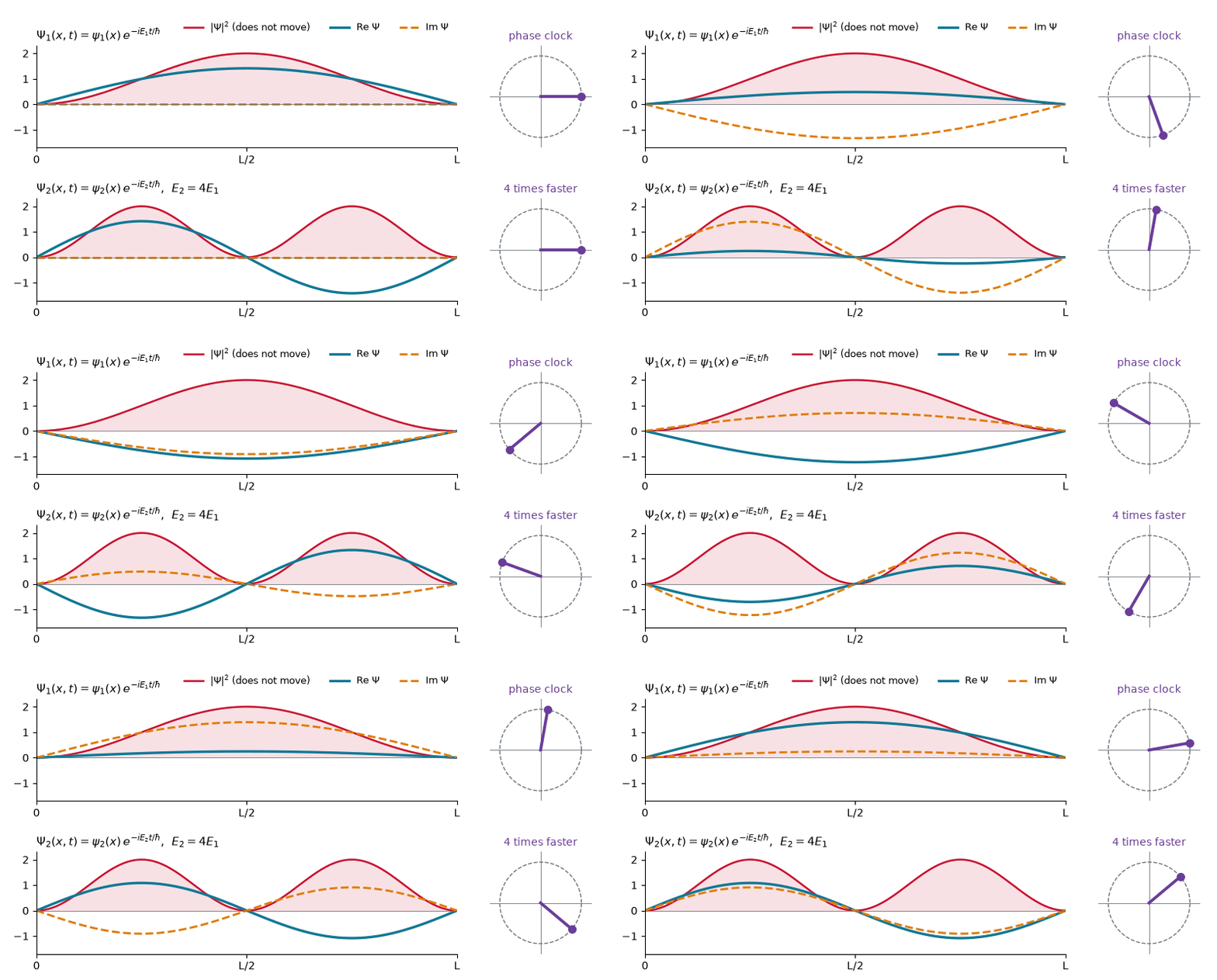
Stationary states
\Psi(x,t) = \psi(x)\,e^{-iEt/\hbar}
- The phase clock turns at E/\hbar
- |\Psi|^2 = |\psi|^2: the density does not move
- Four times the energy, four times the clock rate
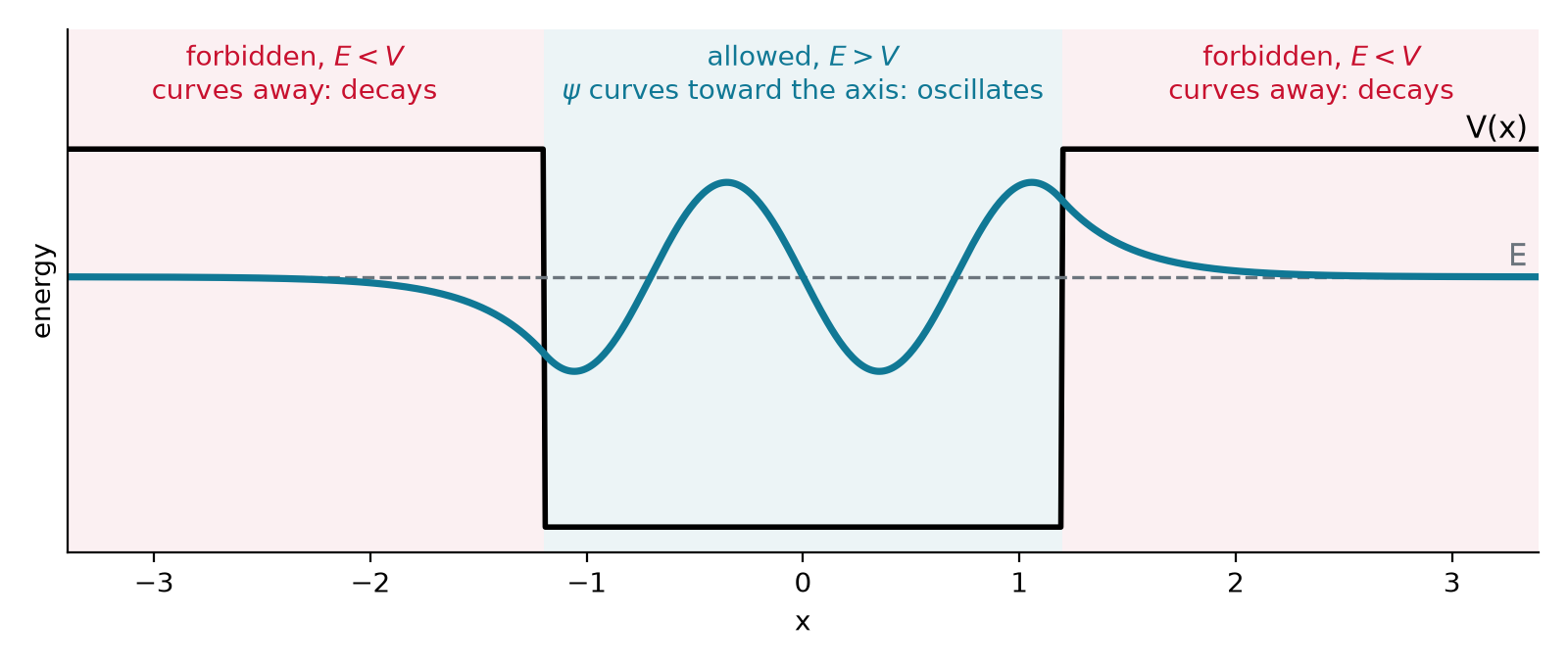
A curvature equation
\frac{d^2\psi}{dx^2} = -\frac{2m}{\hbar^2}\,\big[E - V(x)\big]\,\psi
- The string’s X'' = KX again: the sign of E - V picks sines or exponentials
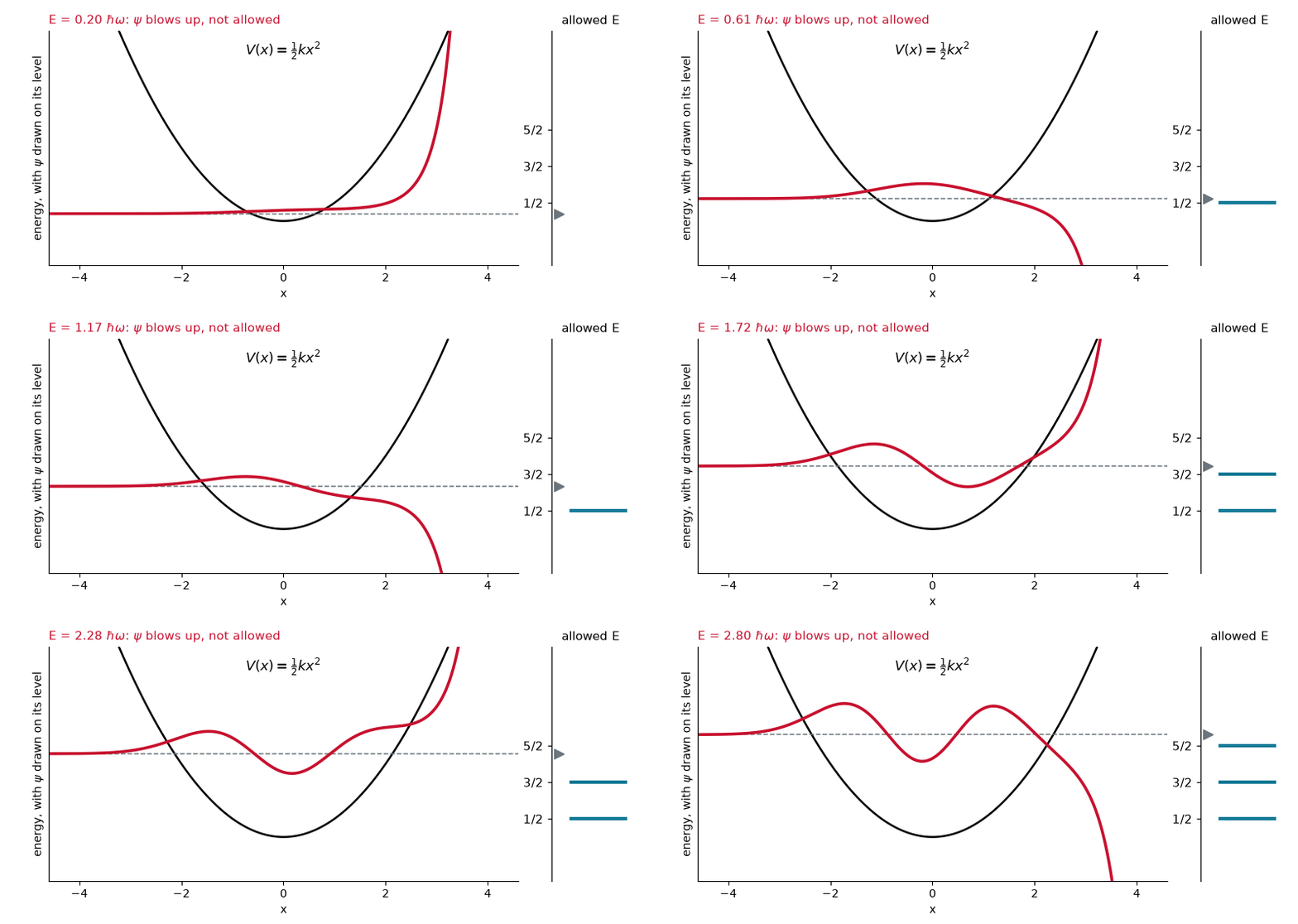
Only some energies fit
- \psi must stay finite: at most energies the tail blows up
- Boundary conditions quantize, as the clamps did for the string
The Born rule
p(x) = \psi^{*}\psi = |\psi(x)|^2
- \psi is complex: not measurable
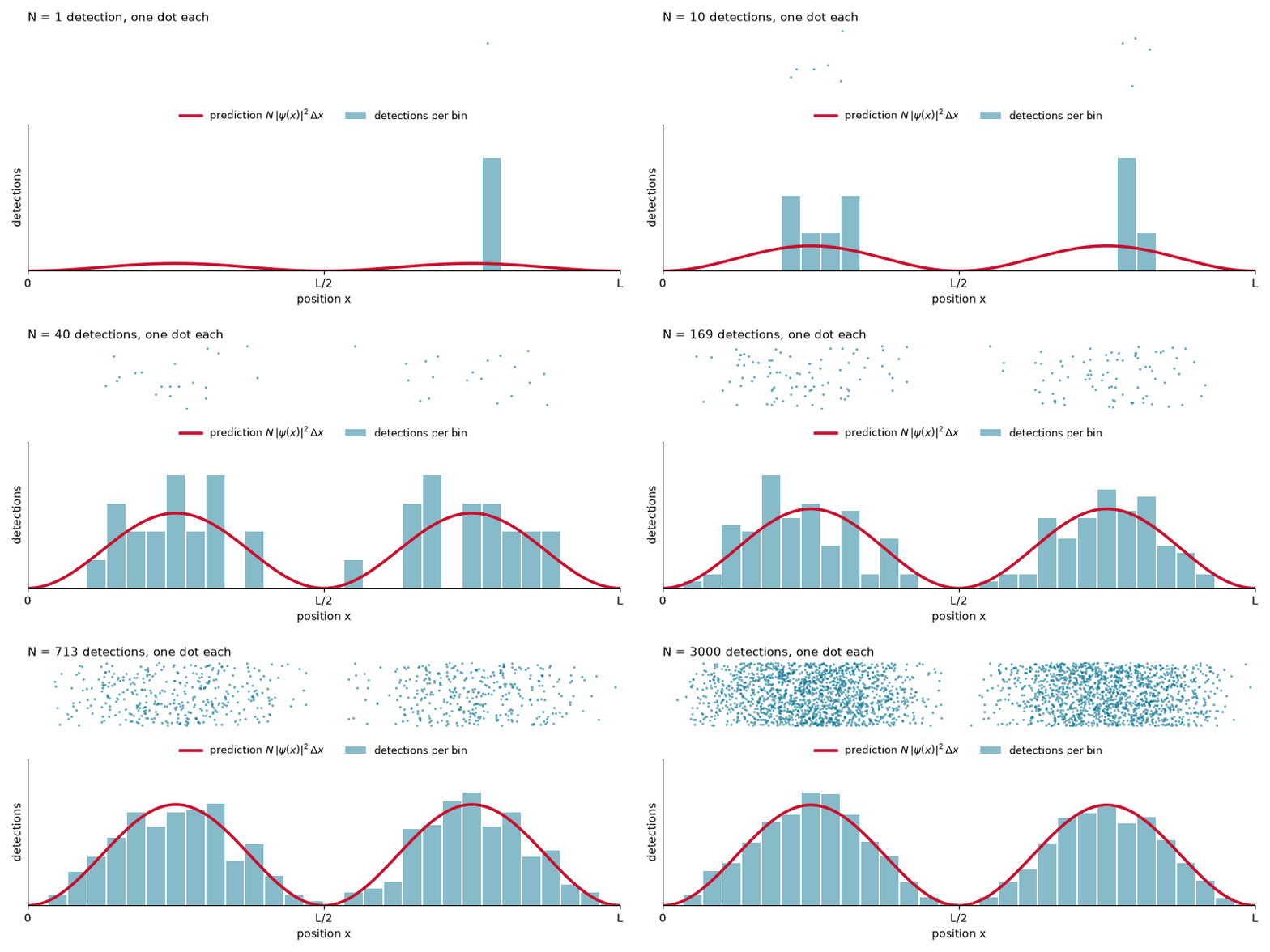
- One detection is random; many trace out |\psi|^2
- At a node no particle is ever found
Example: normalize and locate
A particle on [0,1] has \psi = N x. Find N, then the probability of finding it between 0.3 and 0.6.
\int_0^1 N^2x^2\,dx = \frac{N^2}{3} = 1 \quad\Rightarrow\quad N = \sqrt{3}
P = \int_{0.3}^{0.6} 3x^2\,dx = 0.6^3 - 0.3^3 = 0.189
- The linear equation leaves the size of \psi open; total probability one fixes it
Averages of many measurements
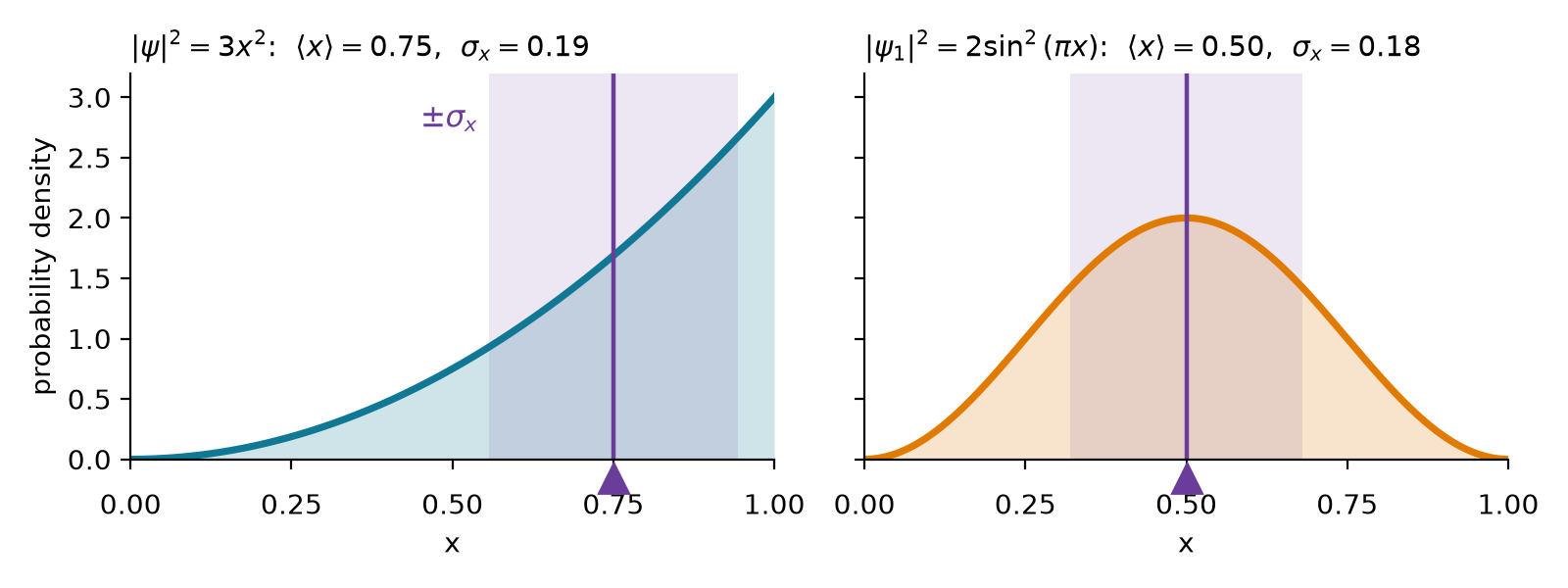
Average N detections. As N grows, the fraction landing near x becomes |\psi(x)|^2\,dx:
\textstyle\frac{1}{N}\sum_{i} x_i \;\xrightarrow{\;N\to\infty\;}\; \langle x \rangle = \displaystyle\int x\,|\psi(x)|^2\,dx
- The balance point of |\psi|^2; the band shows the spread \sigma_x
- Any function of x averages the same way: \langle x^2 \rangle, \langle V \rangle
What is an operator?
An operator turns one function into another. It wears a hat:
\hat{x}\;e^{-x^2} = x\,e^{-x^2} \qquad\qquad \frac{d}{dx}\,\sin(ax) = a\cos(ax)
- Two kinds: multiply by a function (\hat{x}, \hat{V}) or differentiate (\hat{p}, \hat{K})
- We have met them already: the derivatives that read off E and p
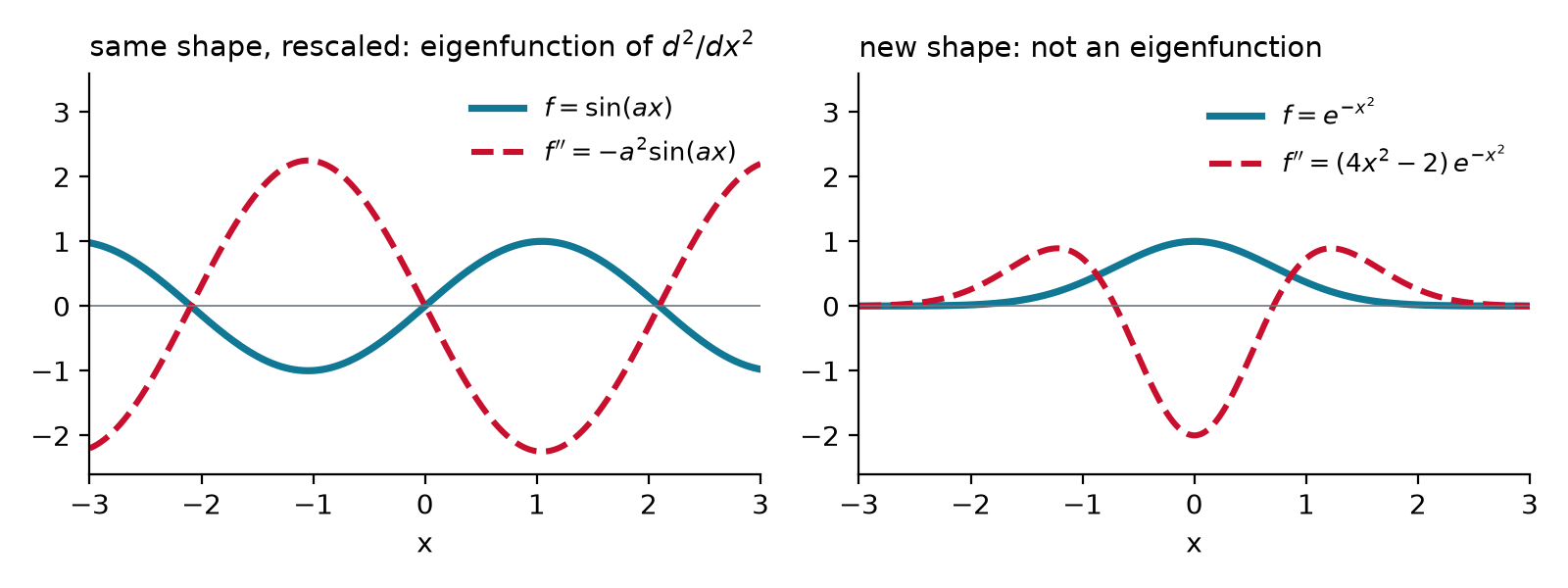
- Usually the function changes shape; the rare ones that do not come next
Observables become operators
Recipe: write the classical quantity with x and p, then replace p by -i\hbar\,\dfrac{d}{dx}
| position |
x |
\hat{x} = x |
| momentum |
p |
\hat{p} = -i\hbar\,\dfrac{d}{dx} |
| kinetic energy |
\dfrac{p^2}{2m} |
\hat{K} = -\dfrac{\hbar^2}{2m}\dfrac{d^2}{dx^2} |
| potential energy |
V(x) |
\hat{V} = V(x) |
\hat{H} = -\frac{\hbar^2}{2m}\frac{d^2}{dx^2} + V(x)
- Total energy: the Hamiltonian
- Systems differ only in V: free particle, bond \frac{1}{2}kx^2, H atom -\frac{e^2}{4\pi\epsilon_0 r}
Eigenfunctions and eigenvalues
![]()
\hat{A}\,f = a\,f
- Same function back, times a number: eigenfunction f, eigenvalue a
- In such a state every measurement of A gives a: a definite value
\hat{H}\,\psi_n = E_n\,\psi_n
- \psi_n: the stationary states; E_n: the allowed energies
Example: is it an eigenfunction?
Test \psi = A\sin(ax) against the momentum and the kinetic energy operators.
\hat{p}\,\psi = -i\hbar\,a\,A\cos(ax) \qquad \text{a new function: no}
\hat{K}\,\psi = \frac{\hbar^2a^2}{2m}\,A\sin(ax) \qquad \text{the same function: yes}
- Definite kinetic energy, no definite momentum: an equal mix of left and right movers
What about momentum?
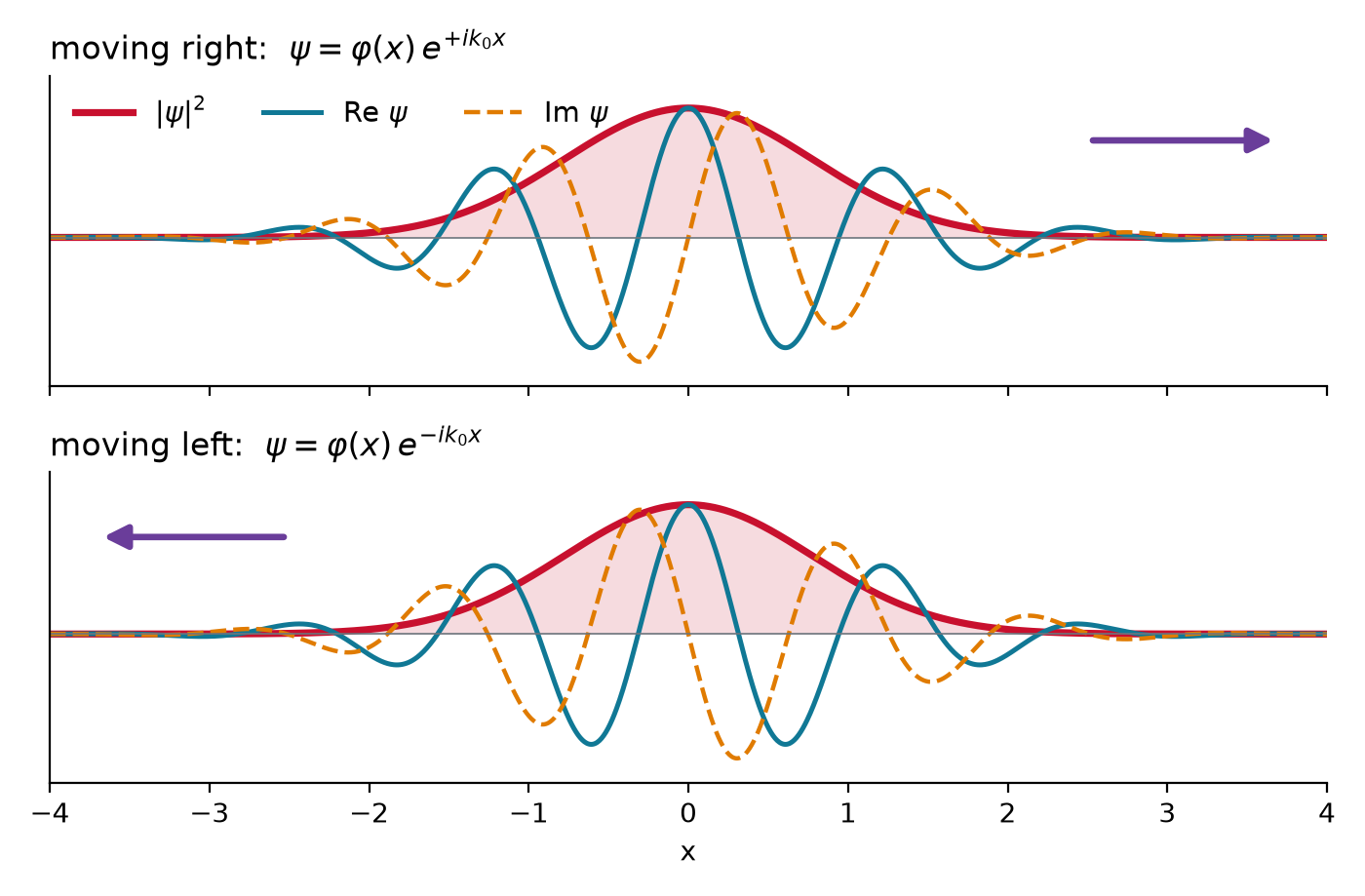
- Recall the free particle: |\Psi|^2 was flat whatever p was
- Moving right or left: the same |\psi|^2
- The direction lives in the phase of \psi, and squaring erases it
- So \hat{p} must act on \psi before we multiply by \psi^*
Expectation values
Position: x is just a number, so it can sit in the middle:
\langle x \rangle = \int x\,|\psi|^2\,dx = \int \psi^{*}\,x\,\psi\,dx
Any observable: put its operator where x was, acting on \psi:
\langle A \rangle = \int \psi^{*}(x)\,\hat{A}\,\psi(x)\,dx
Check: a state with a definite value, \hat{A}\psi = a\psi, returns it: \;\langle A \rangle = a\displaystyle\int \psi^{*}\psi\,dx = a
Example: which way is it moving?
\psi = \varphi(x)\,e^{ik_0x}, with \varphi real and normalized. Find \langle p \rangle.
\hat{p}\,\psi = -i\hbar\,\big(\varphi' + ik_0\,\varphi\big)\,e^{ik_0x}
\langle p \rangle = \underbrace{-i\hbar\int \varphi\,\varphi'\,dx}_{[\varphi^2/2]\;=\;0} \;+\; \hbar k_0\underbrace{\int \varphi^2\,dx}_{1} \;=\; \hbar k_0
- Flip k_0 and \langle p \rangle flips, while |\psi|^2 stays the same: the operator reads the phase
Takeaway
Energy conservation written for matter waves gives the Schrödinger equation. It separates into a turning phase and \hat{H}\psi = E\psi, whose finite solutions exist only at quantized energies. |\psi|^2 gives probabilities; because momentum lives in the phase, averages need the operator acting on \psi itself: \langle A \rangle = \int\psi^{*}\hat{A}\psi\,dx.