Applications of the Particle in a Box

Chem 3240 · Lecture 3.3 · color from confinement

Davit Potoyan

\pi electrons live in a box

  • Light is absorbed when h\nu matches a gap; visible light needs about 2 to 3 eV
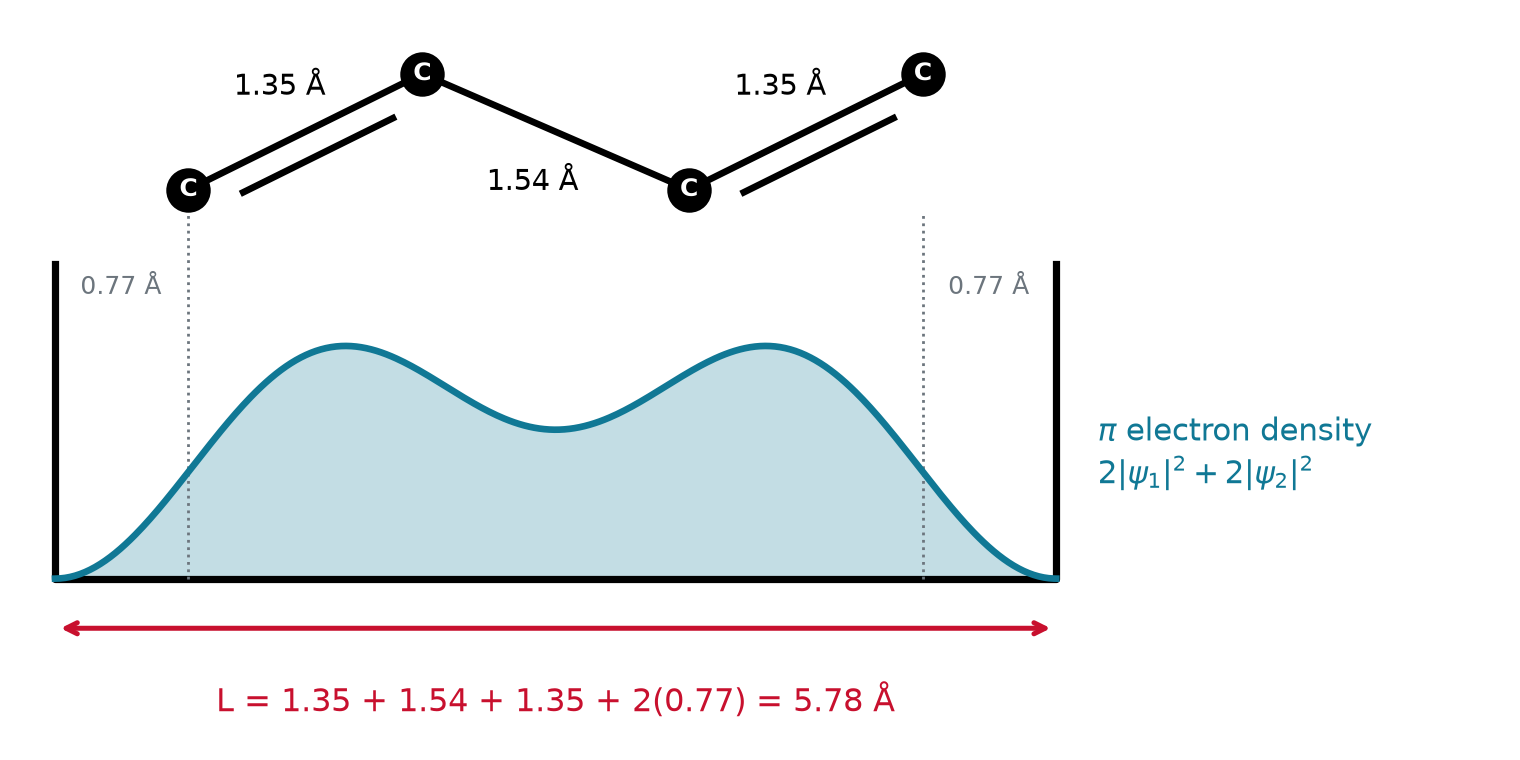
  • In a conjugated chain the \pi electrons spread over the whole chain: a 1D box
  • The box runs one carbon radius past each end carbon

Fill the levels, then jump
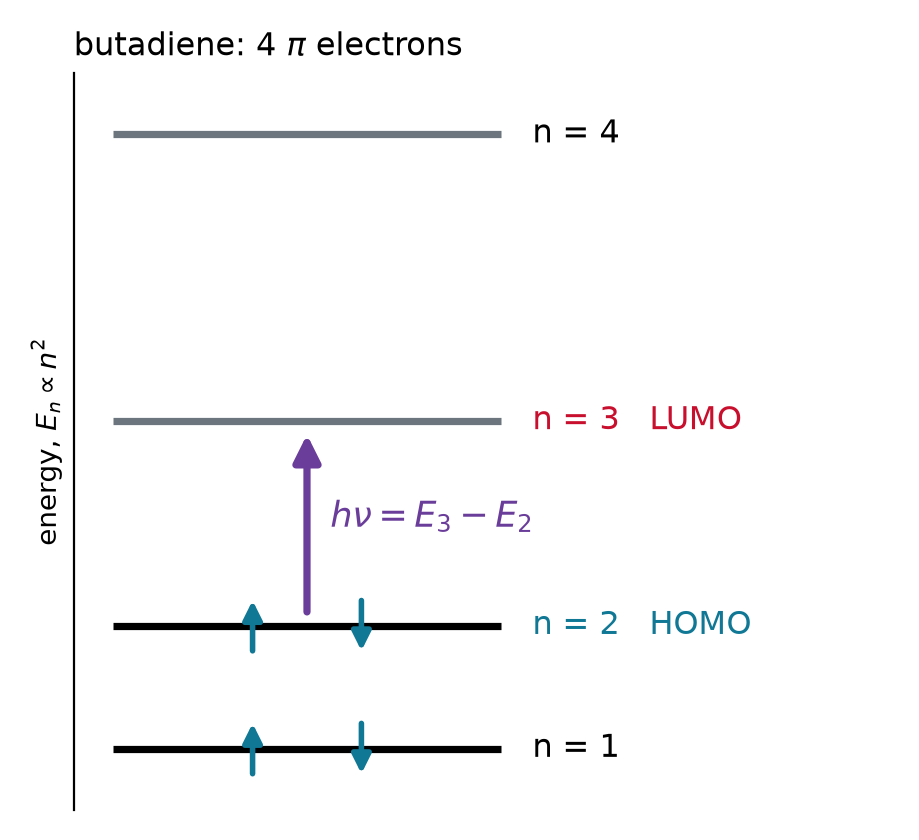
  • Each level holds two electrons, spin up and spin down
  • N \pi electrons fill n = 1 to N/2
  • HOMO: n = N/2, the highest filled level
  • LUMO: n = N/2 + 1, the lowest empty one
  • The lowest-energy absorption lifts one electron from HOMO to LUMO

From gap to wavelength

The HOMO to LUMO gap:

\Delta E = \left[\left(\tfrac{N}{2}+1\right)^2 - \left(\tfrac{N}{2}\right)^2\right]\frac{h^2}{8mL^2} = (N+1)\,\frac{h^2}{8mL^2}

Set \Delta E = hc/\lambda:

\lambda = \frac{8mc}{h}\,\frac{L^2}{N+1} \qquad\Longrightarrow\qquad \lambda\ (\text{nm}) \approx 33\,\frac{\big[L\ (\text{Å})\big]^2}{N+1}

  • Longer chain: L^2 grows faster than N + 1, so \lambda grows

Example: butadiene

Butadiene, CH_2=CH–CH=CH_2, has 4 \pi electrons (C=C 1.35 Å, C–C 1.54 Å). Estimate \lambda with the box ending (a) at the end carbons, (b) one carbon radius, 0.77 Å, beyond them.

\text{(a)}\quad L = 1.35 + 1.54 + 1.35 = 4.24\ \text{Å}: \qquad \lambda = 33\,\frac{(4.24)^2}{5} \approx 119\ \text{nm}

\text{(b)}\quad L = 4.24 + 2(0.77) = 5.78\ \text{Å}: \qquad \lambda = 33\,\frac{(5.78)^2}{5} \approx 220\ \text{nm}

Measured: 217 nm. The \pi cloud does not stop at the end carbons.

  • No fitting: L comes from bond lengths alone

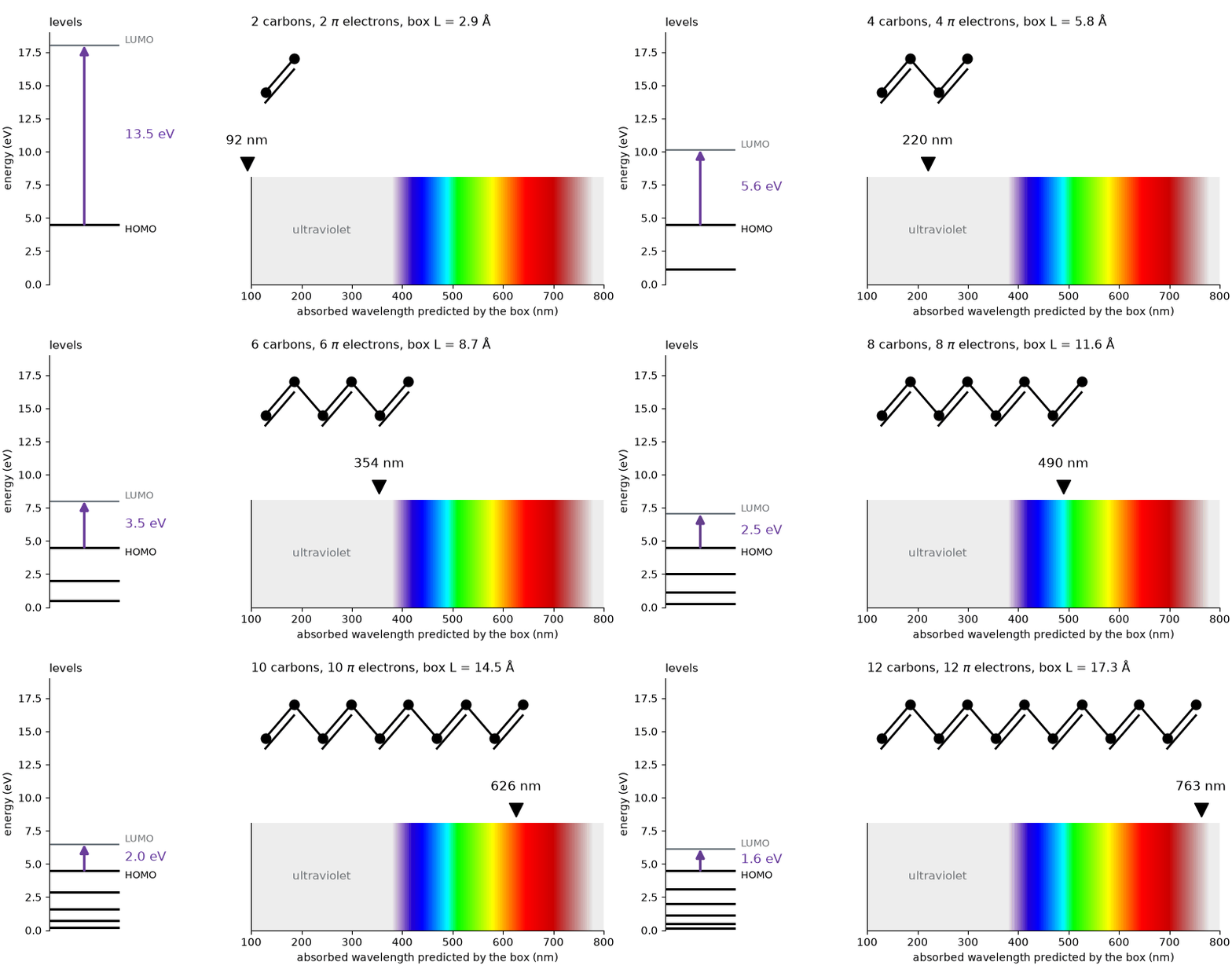
Longer chain, redder light

  • Each C=C adds 2 electrons and 2.9 Å of box: the gap closes roughly as 1/N
  • The trend is right. Are the numbers, for a long chain?

Example: β-carotene

β-carotene, the orange of carrots, has 22 conjugated carbons and 22 \pi electrons. With the butadiene rule, L = 1.445\,N Å, predict \lambda.

L = 1.445 \times 22 = 31.8\ \text{Å}: \qquad \lambda = 33\,\frac{(31.8)^2}{23} \approx 1450\ \text{nm, infrared}

Measured: about 450 nm. It absorbs blue, so it looks orange. The box overshoots threefold.

  • Real polyenes alternate short and long bonds: the floor of the box is bumpy, and that keeps a gap open
  • Dyes with equal bond lengths (cyanines) follow the box far better

Quantum dots: a box in 3D

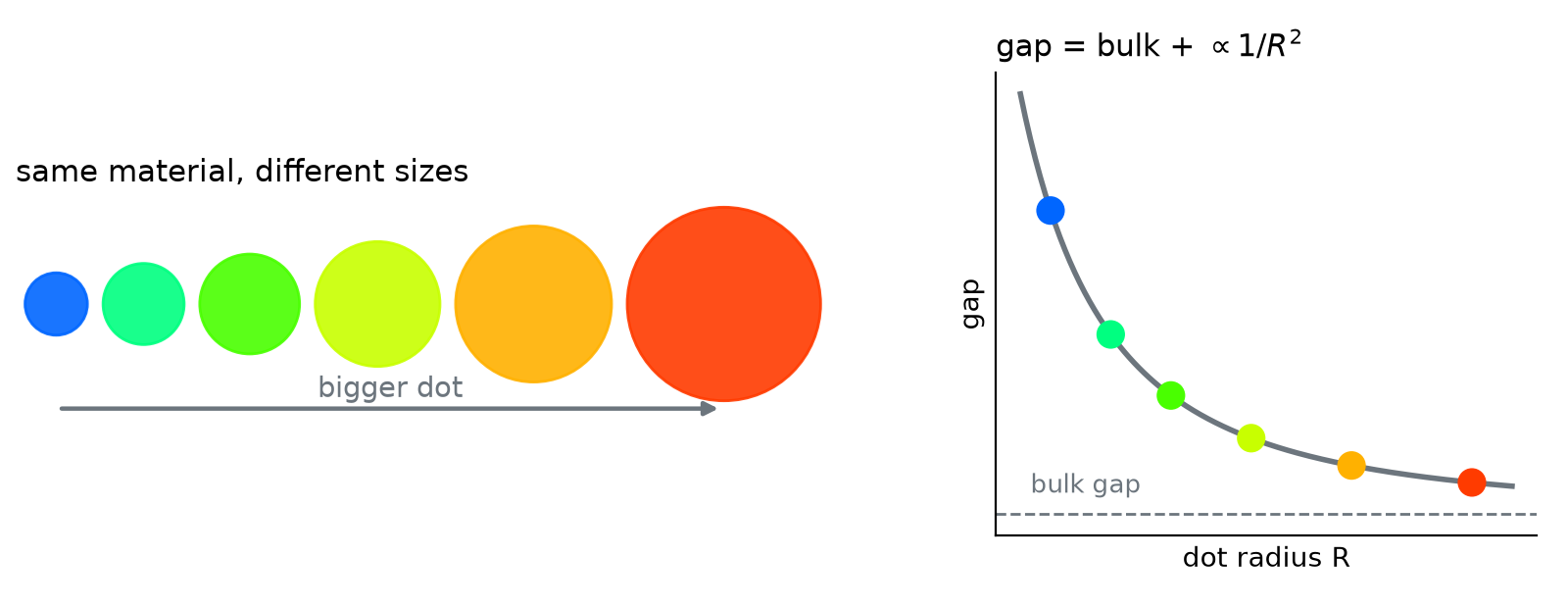
  • Semiconductor crystals a few nm across: the electron is confined in three dimensions
  • Gap = bulk gap + confinement \propto 1/R^2: shrink the dot, bluer light
  • 2023 Nobel Prize in Chemistry: Bawendi, Brus, and Ekimov

Example: an electron in a helium bubble

An electron in liquid helium pushes the atoms away and sits in a cavity about 36 Å across. Treat it as a cube of side 36 Å: find the zero-point energy and the gap to the first excited level.

E_{111} = \frac{3h^2}{8mL^2} = 3\,(4.65\times10^{-21}\ \text{J}) = 1.39\times10^{-20}\ \text{J} = 87\ \text{meV}

E_{211} - E_{111} = \frac{(6 - 3)\,h^2}{8mL^2} = 87\ \text{meV}, \quad \text{to a 3-fold degenerate level}

Measured gap: about 105 meV.

  • A crude cube, yet within 20% of experiment

Takeaway

A length and an electron count predict a color: N \pi electrons in a box of length L absorb at \lambda = 8mcL^2/h(N+1). The model gets butadiene within a few percent and the trend right for longer chains, overshoots when bond alternation roughens the box, and carries over to 3D, where the size of a quantum dot sets its color.