Tunneling and the Finite Square Well

Chem 3240 · Lecture 3.4

Davit Potoyan

A ball bounces back, a wave gets through
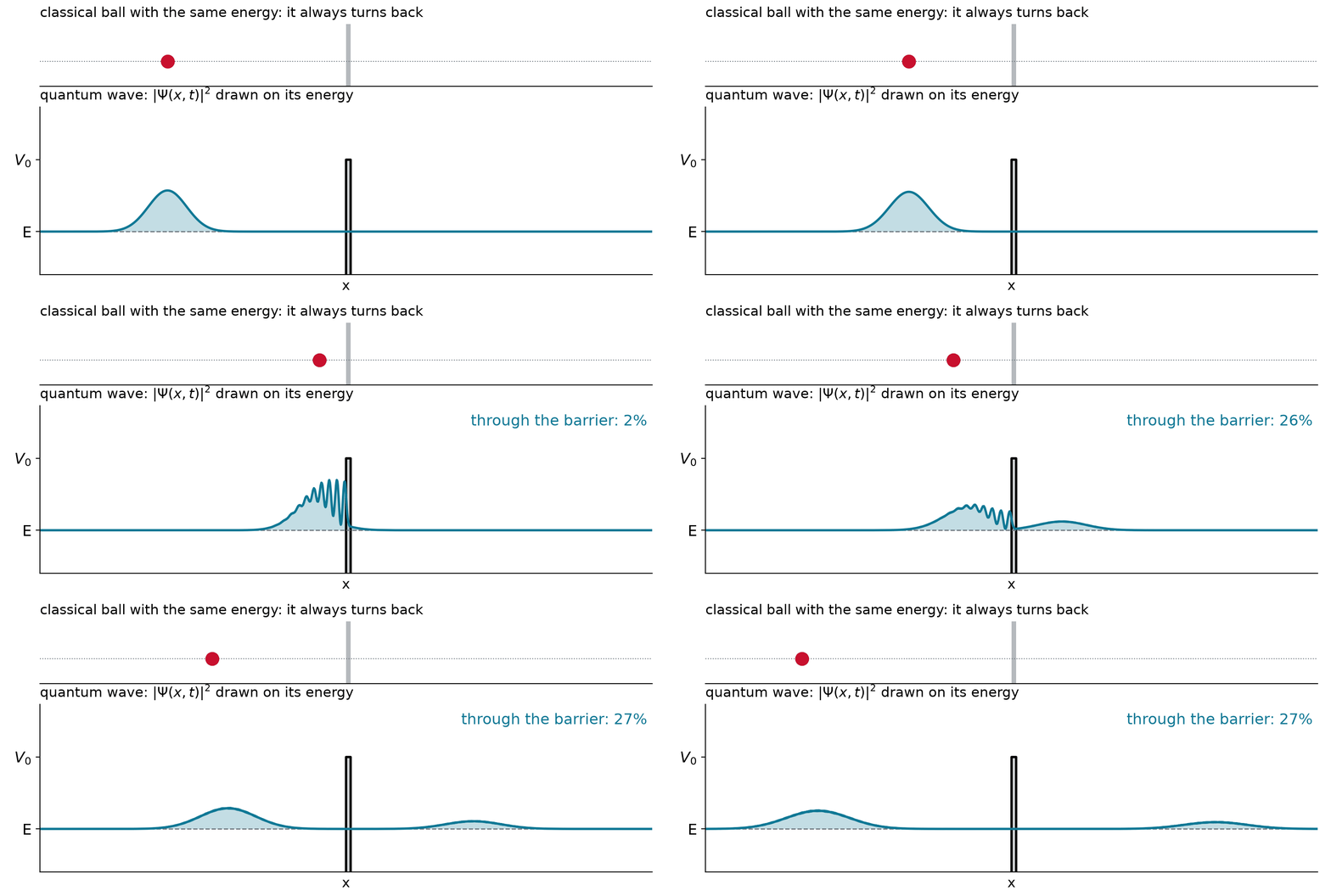
  • The energy is below the barrier top: a classical ball always turns around
  • Inside the barrier the wave decays, but a thin barrier leaves some on the far side: tunneling

The sign of V - E sets the shape

\frac{d^2\psi}{dx^2} = \frac{2m}{\hbar^2}\,\big(V - E\big)\,\psi
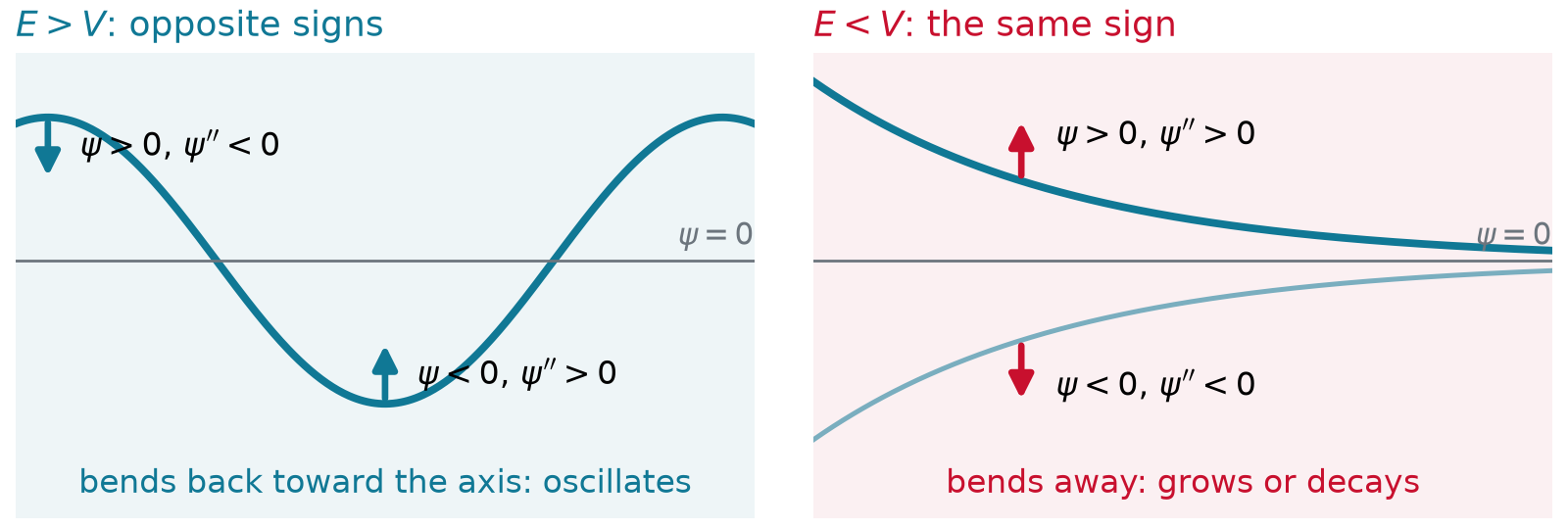
  • E > V: \psi'' opposite to \psi, so it bends back toward the axis: oscillates
  • E < V: \psi'' the same sign as \psi, so it bends away: grows or decays

Reading \psi from V(x)
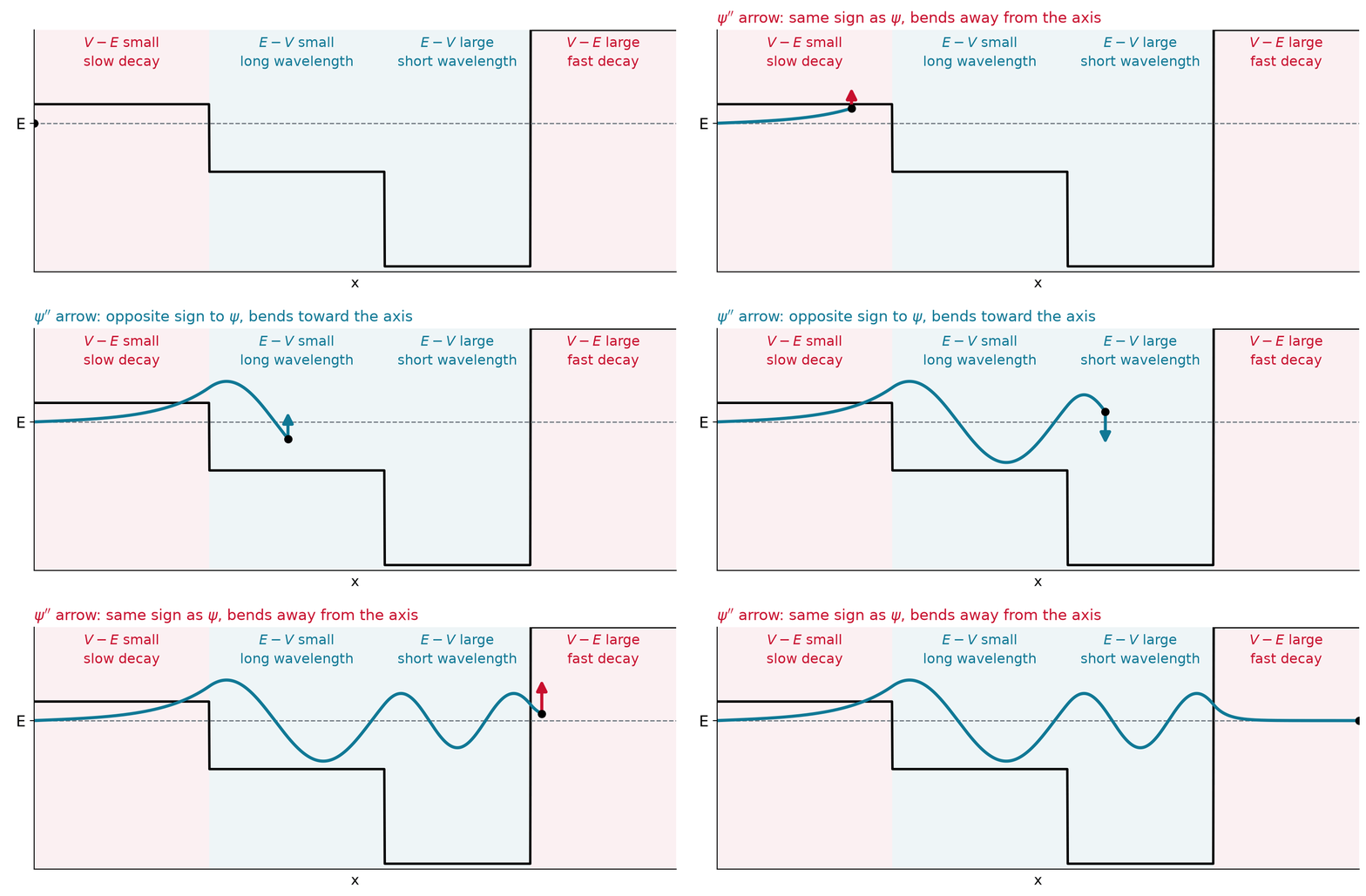
  • The arrow is \psi'': teal bends toward the axis (the dashed line), red bends away
  • Bigger |E - V|, harder bending: shorter wavelength, faster decay

Real walls are finite
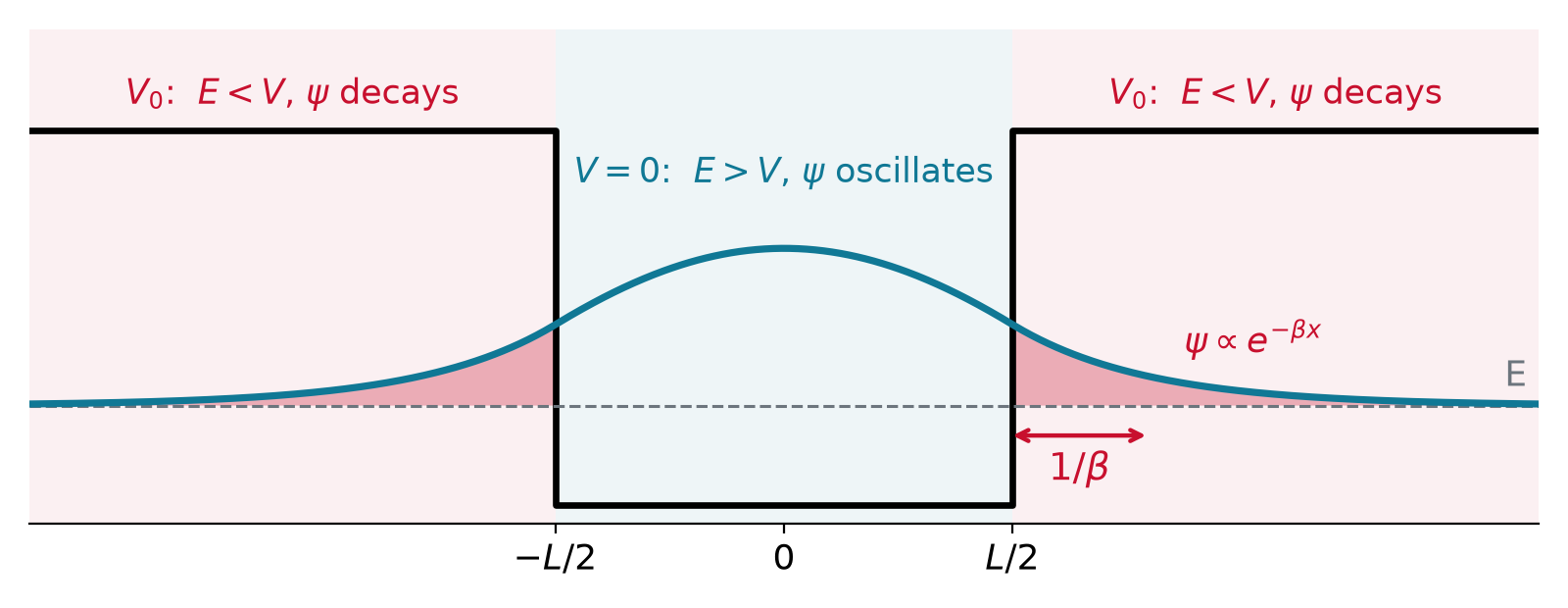
\begin{aligned} \text{well:}\quad \psi'' &= -k^2\psi, & k &= \sqrt{2mE}\,/\,\hbar \\ \text{walls:}\quad \psi'' &= +\beta^2\psi, & \beta &= \sqrt{2m(V_0-E)}\,/\,\hbar \end{aligned}

  • The wave leaks a distance of about 1/\beta into the wall: the penetration depth

Three regions

\begin{array}{lll} \text{I:} & x < -\tfrac{L}{2} & \psi_{I} = A\,e^{\beta x} \\[6pt] \text{II:} & |x| < \tfrac{L}{2} & \psi_{II} = B\cos kx + C\sin kx \\[6pt] \text{III:} & x > \tfrac{L}{2} & \psi_{III} = D\,e^{-\beta x} \end{array}

  • In each wall keep only the exponential that decays away from the well
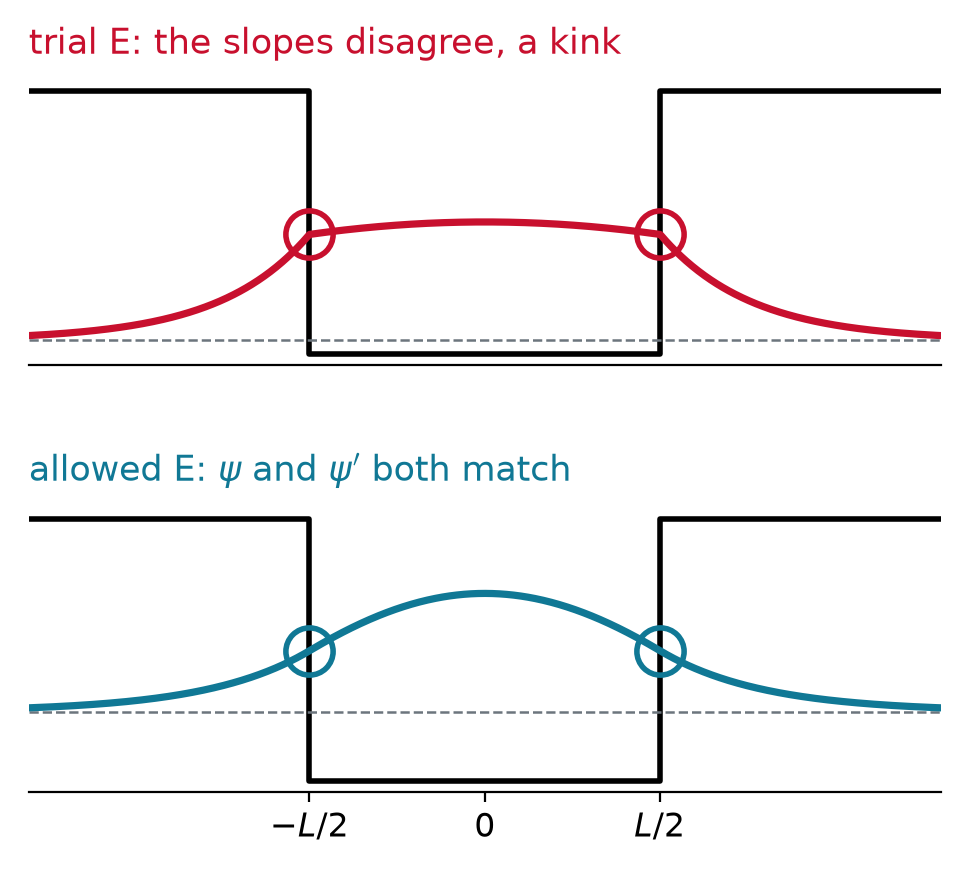
  • At each wall join both \psi and \psi': a kink would make \psi'', the kinetic energy, infinite
  • Two conditions per wall can be met only at special energies

Matching at the wall

Even state: differentiate each piece

\begin{aligned} \text{inside:}\quad \psi &= B\cos kx, & \psi' &= -kB\sin kx \\ \text{wall:}\quad \psi &= D\,e^{-\beta x}, & \psi' &= -\beta D\,e^{-\beta x} \end{aligned}

Set them equal at x = L/2:

\begin{aligned} \text{value:}\quad B\cos\tfrac{kL}{2} &= D\,e^{-\beta L/2} \\ \text{slope:}\quad kB\sin\tfrac{kL}{2} &= \beta D\,e^{-\beta L/2} \end{aligned}

\frac{\text{slope}}{\text{value}}: \quad \beta = k\tan\frac{kL}{2} \qquad (B,\ D \text{ cancel})
Even and odd: one circle

The same steps with C\sin kx give the odd states:

\text{even: } \beta = k\tan\frac{kL}{2} \qquad\qquad \text{odd: } \beta = -k\cot\frac{kL}{2}

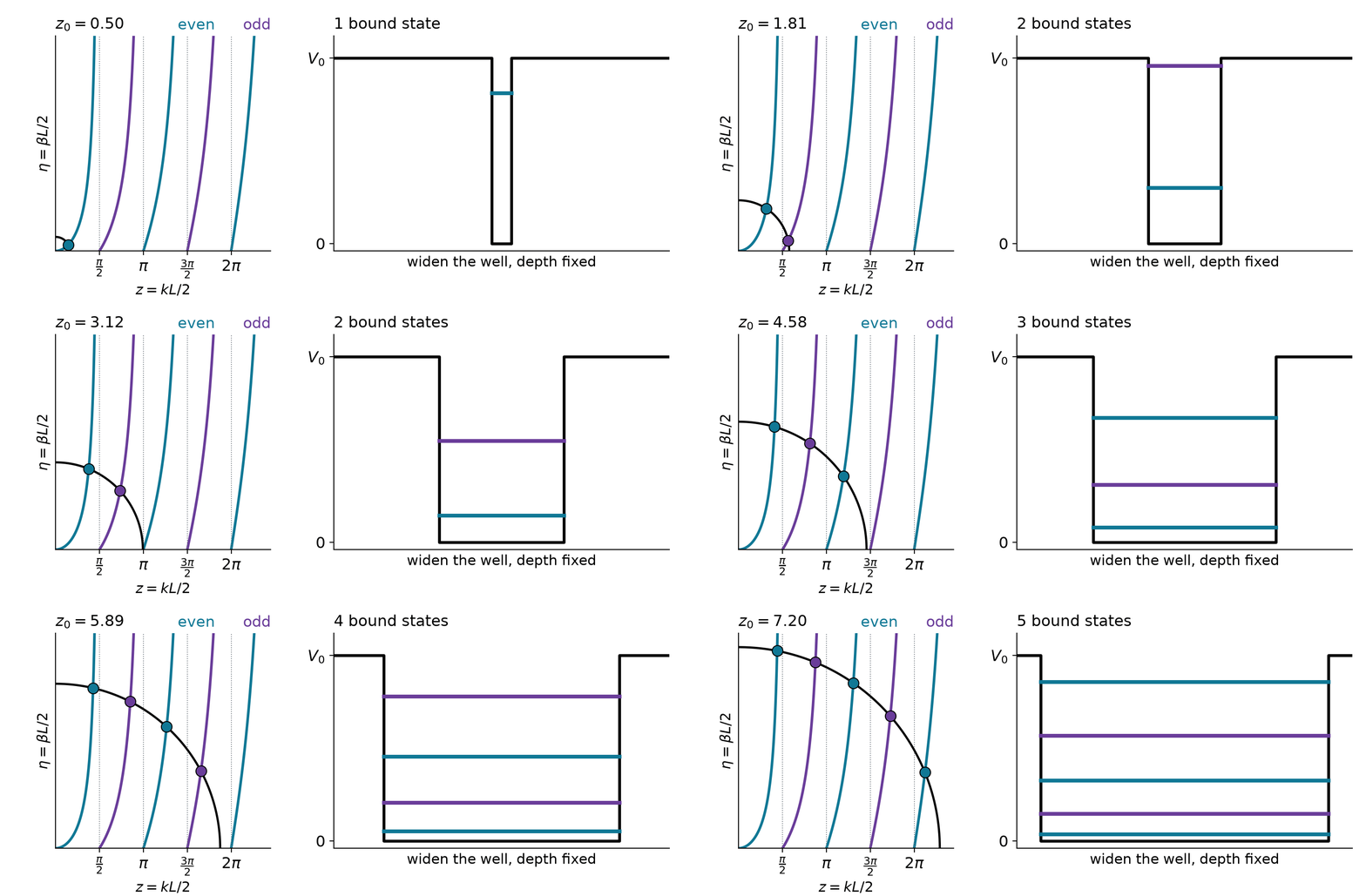
\text{even: } \eta = z\tan z, \qquad \text{odd: } \eta = -z\cot z, \qquad z^2 + \eta^2 = z_0^2

z = \frac{kL}{2}, \qquad \eta = \frac{\beta L}{2}, \qquad z_0 = \frac{L}{2}\,\frac{\sqrt{2mV_0}}{\hbar}

  • k^2 + \beta^2 = 2mV_0/\hbar^2 for every E, so (z, \eta) lies on a circle of radius z_0, the well strength

Solve graphically

  • Each crossing is a bound state, with E = V_0\,(z/z_0)^2. A new state appears each time z_0 passes a multiple of \pi/2
  • Even a weak well holds one state, and no finite well holds infinitely many

The states leak
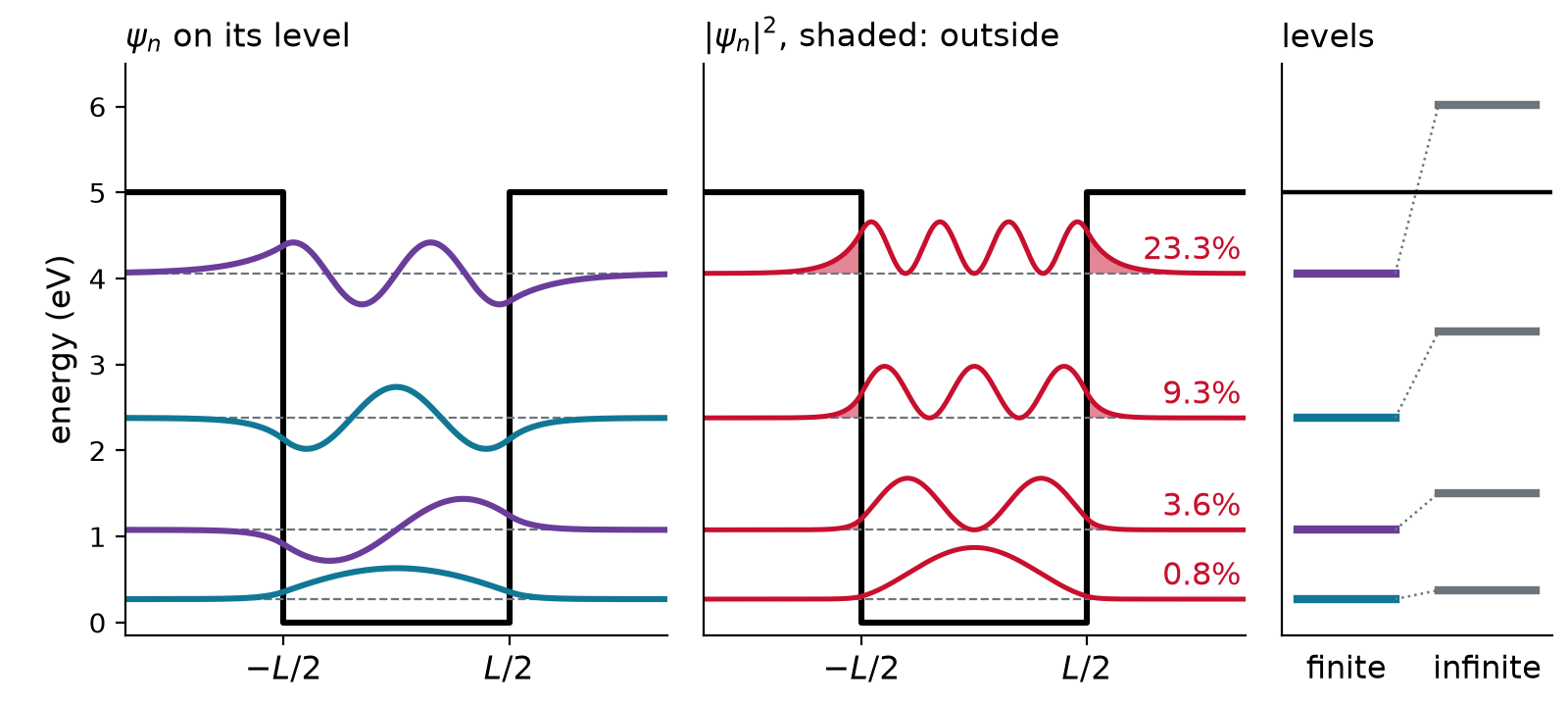
  • Electron, 10 Å wide, 5 eV deep: 4 states; the top one is 23% outside
  • Each level sits below its infinite-box partner: more room, longer wavelength

Example: how far does it leak?

An electron sits 1 eV below the top of a wall. How far into the wall does \psi reach? And a proton?

\frac{1}{\beta} = \frac{\hbar}{\sqrt{2m(V_0 - E)}} = \begin{cases} 1.95\ \text{Å} & \text{electron} \\[4pt] 0.046\ \text{Å} & \text{proton: } \sqrt{1836} = 43 \text{ times shorter} \end{cases}

An electron leaks about the radius of an atom. A proton barely leaks at all.

  • 1/\beta is largest for light particles near the top of the wall

What the transmission coefficient means
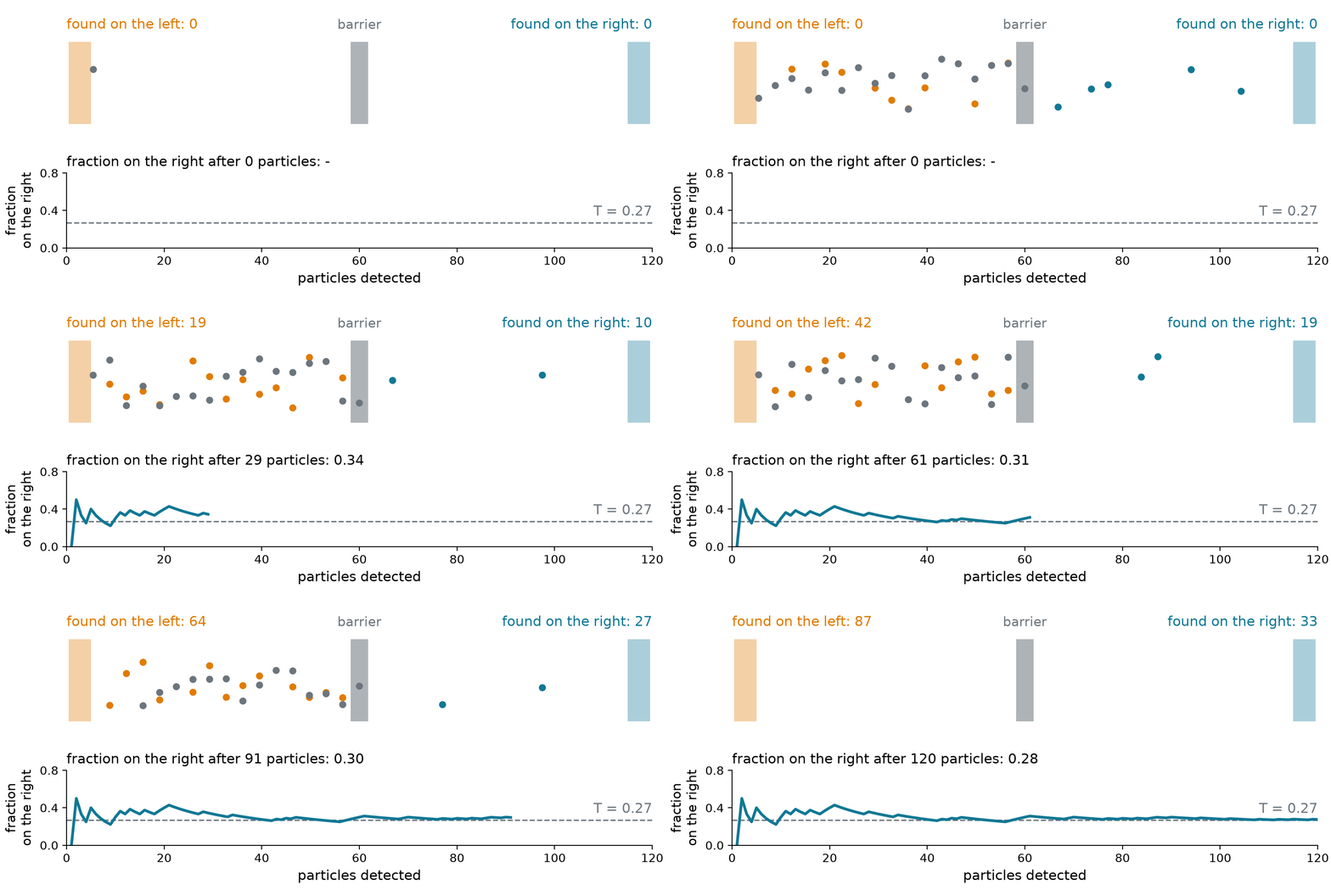
  • Particles arrive one at a time; each is found either on the left or on the right
  • T = the fraction found on the right = the probability that one particle gets through

T from the wave
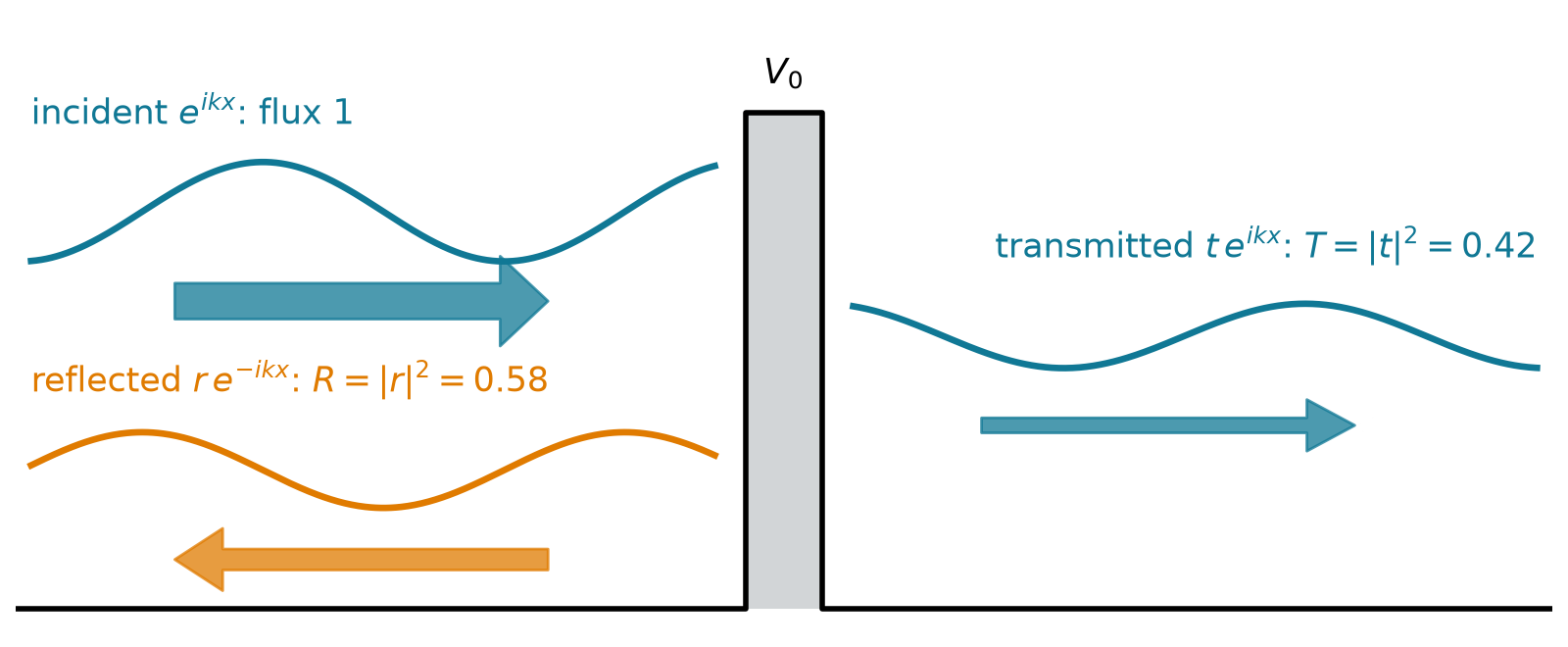
T = \frac{\text{transmitted flux}}{\text{incident flux}} = |t|^2, \qquad R = |r|^2, \qquad R + T = 1

  • Flux = density |A|^2 times speed, and the speed is equal on both sides

Computing T for a barrier
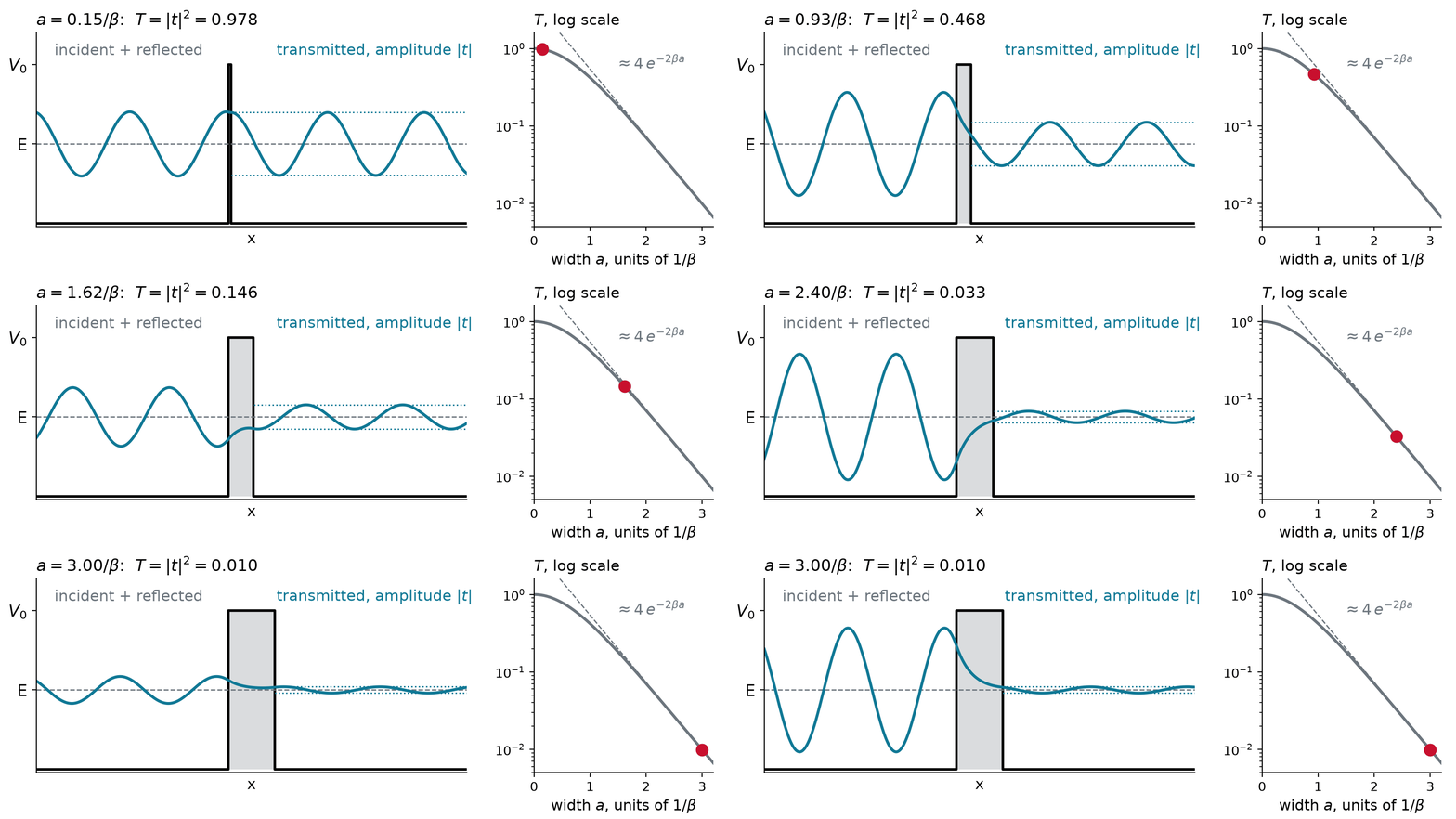
Matching \psi and \psi' at x = 0 and x = a gives t. For a thick barrier:

T = |t|^2 \approx 16\,\frac{E}{V_0}\left(1 - \frac{E}{V_0}\right)e^{-2\beta a} \qquad (\beta a \gg 1)

Width and mass sit in the exponent
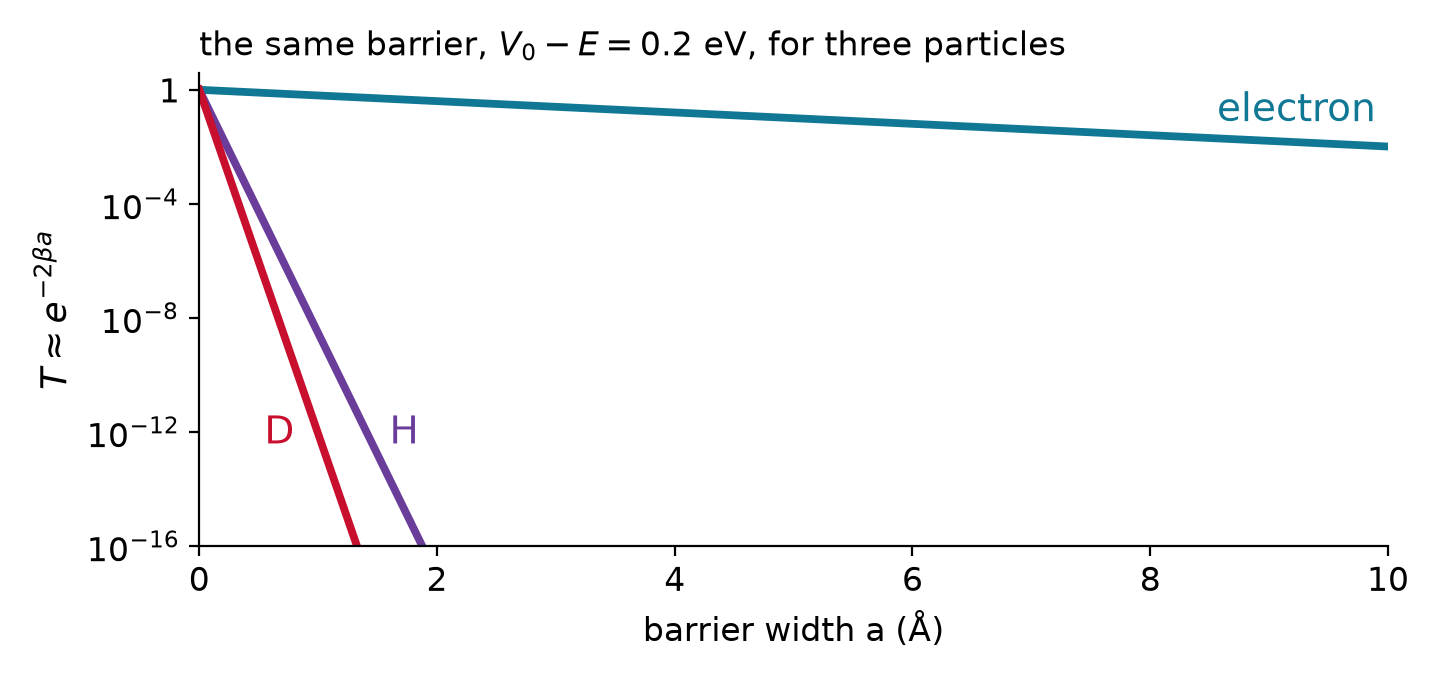
  • \beta \propto \sqrt{m}: a proton’s \beta is 43 times an electron’s
  • Electrons tunnel through nanometers, protons through fractions of an ångström

Example: hydrogen or deuterium?

An H atom transfers through a barrier 0.2 eV above its energy and 0.5 Å wide. Compare T for H and D.

\begin{aligned} \text{H:}\quad 2\beta_H a &= 9.82 & T_H &\approx e^{-9.82} = 5.4\times10^{-5} \\ \text{D:}\quad 2\beta_D a &= \sqrt{2}\,(9.82) = 13.9 & T_D &\approx e^{-13.9} = 9.4\times10^{-7} \end{aligned}

\frac{T_H}{T_D} = e^{(\sqrt{2}-1)(9.82)} = 58 \approx 60

Doubling the mass multiplies \beta by \sqrt{2}, and the exponent does the rest.

  • Without tunneling k_H/k_D stays below about 7; lipoxygenase shows about 80

Live: tune the barrier

T \approx e^{-2\beta a} for an electron, a proton and a deuteron facing the same barrier

The scanning tunneling microscope

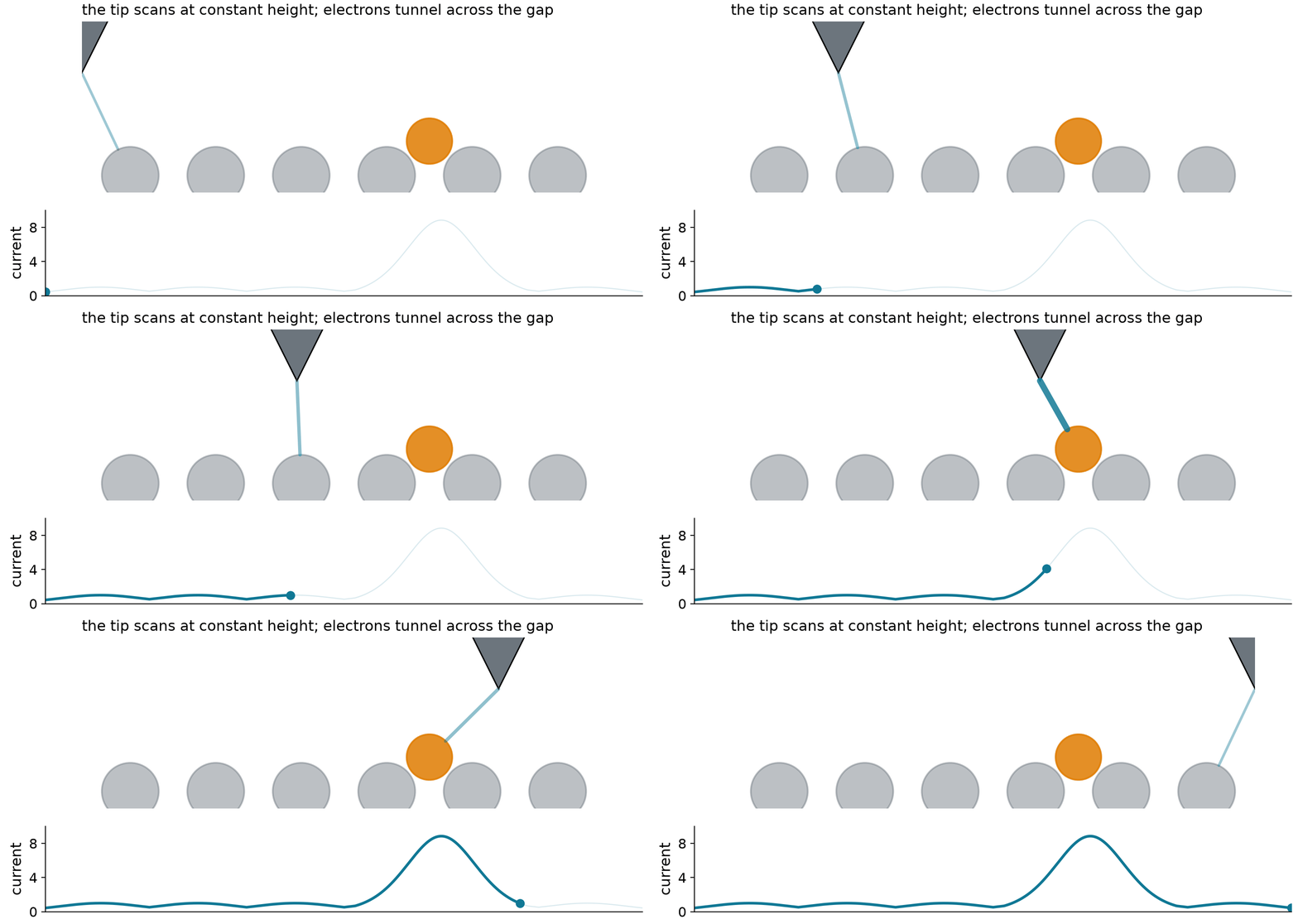
  • Electrons tunnel across the gap d: the current falls as e^{-2\beta d} and maps the atoms
  • The orange adatom is only 1 Å taller. Binnig and Rohrer, 1981; Nobel Prize 1986

Example: why the STM sees atoms

For a metal with work function \phi = 4.5 eV, by what factor does the current grow when the tip moves 1 Å closer?

\beta = \frac{\sqrt{2m_e\phi}}{\hbar} = 1.09\ \text{Å}^{-1} \quad\Longrightarrow\quad \frac{I(d - 1\,\text{Å})}{I(d)} = e^{2\beta\,(1\,\text{Å})} = e^{2.17} \approx 9

A height change of 0.01 Å moves the current by 2%, which the electronics read easily.

  • About a factor of ten per ångström: the exponential turns height into a huge signal

Ammonia turns inside out

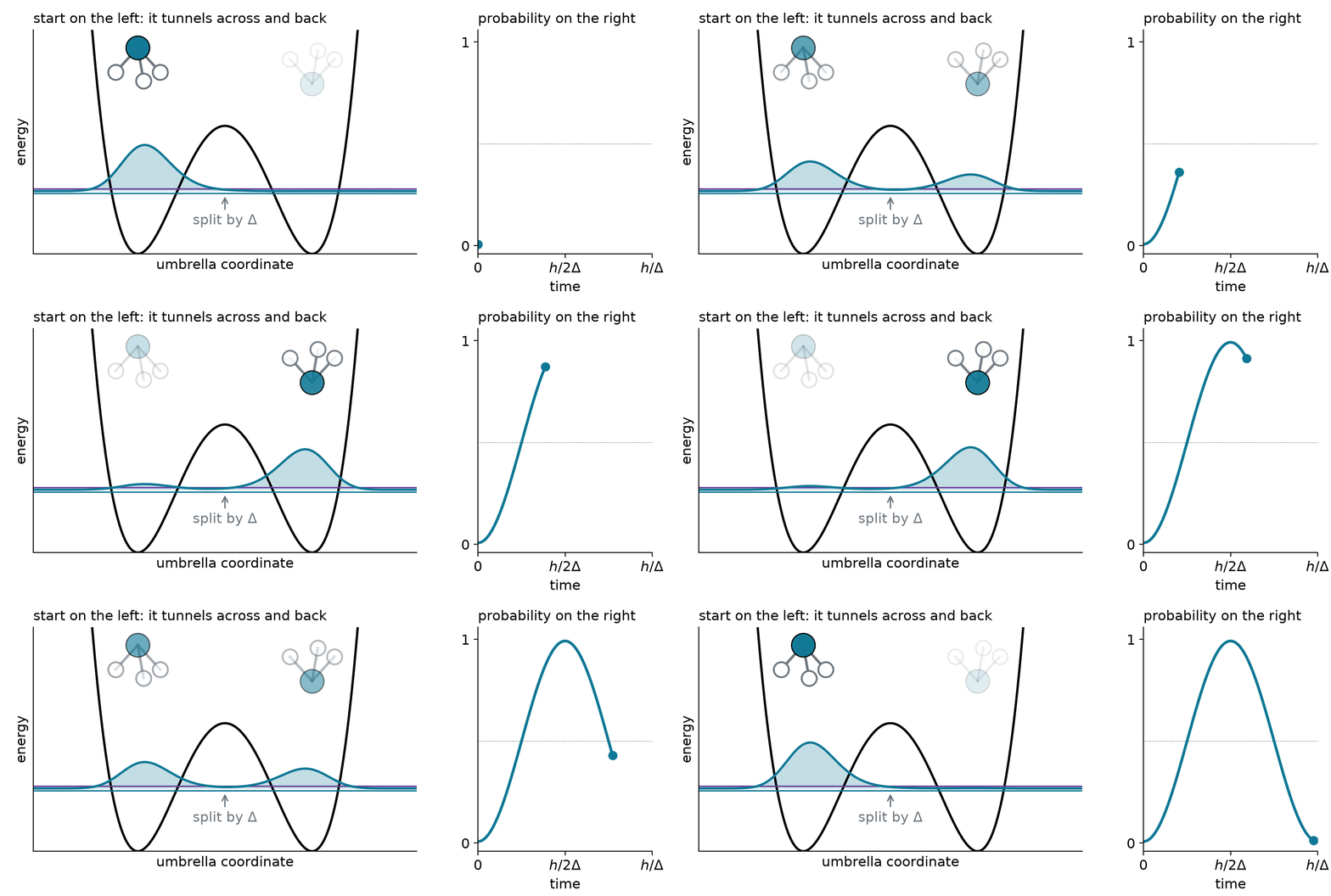
  • The lowest level splits by Δ = 0.79 cm⁻¹: a flip and back every h/\Delta = 42 ps
  • ND₃ is 15 times slower. The 24 GHz line ran the first maser (1954)

Takeaway

Where E > V the wavefunction bends toward the axis and oscillates; where E < V it bends away and decays over about 1/\beta. Joining \psi and \psi' at the walls allows a finite well only a limited set of levels, each a little lower than in the infinite box. A barrier passes the fraction T = |t|^2 of the incident flux, T \approx e^{-2\beta a}, exponential in the width and in \sqrt{m}: electrons tunnel nanometers, protons fractions of an ångström, the STM sees atoms, and ammonia turns inside out.