Chem 3240 · Lecture 3.5b

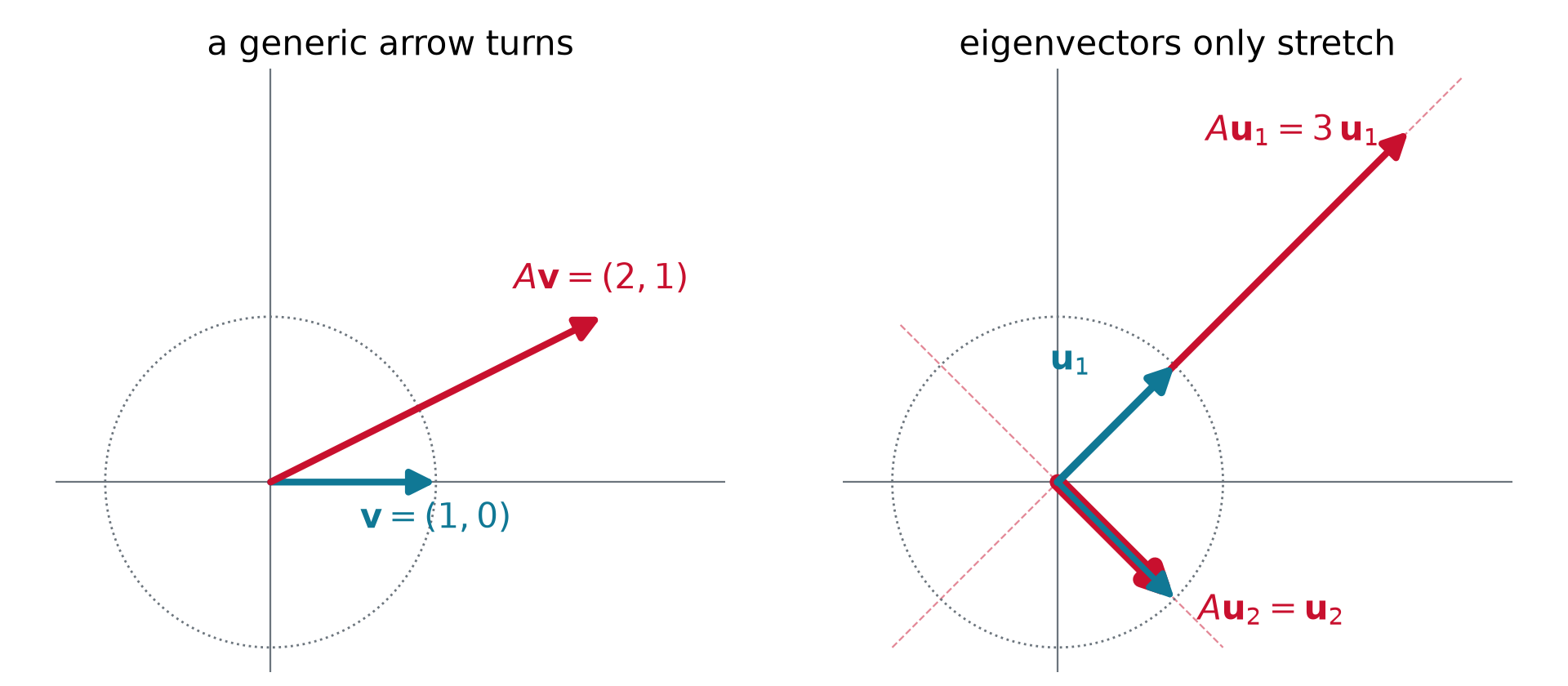
A\mathbf{v} = \lambda\mathbf{v}\ \text{ with }\ \mathbf{v} \neq 0 \qquad\Longleftrightarrow\qquad \det(A - \lambda I) = 0
| numbers | matrices |
|---|---|
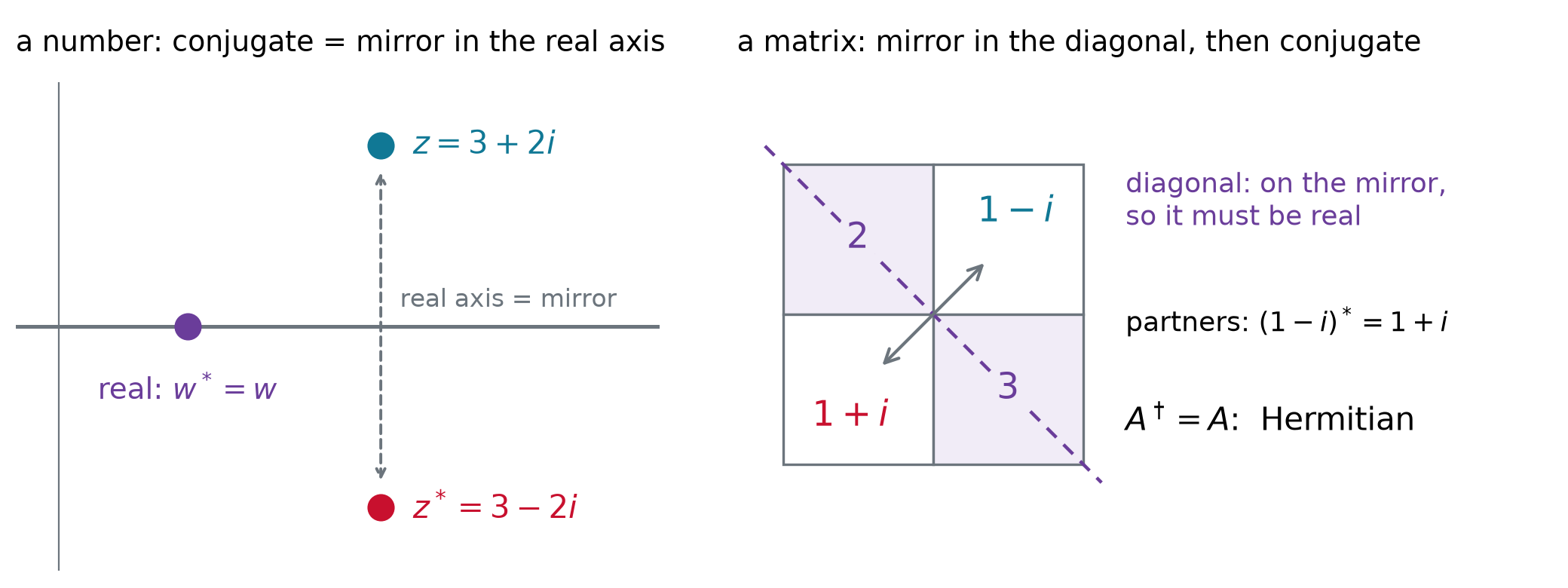
| conjugate z^*: flip the sign of i | adjoint A^\dagger: swap rows and columns, then conjugate |
| real: z^* = z | Hermitian: A^\dagger = A |
\langle \phi \vert \hat{A}\psi \rangle = \langle \hat{A}^\dagger\phi \vert \psi \rangle
\begin{aligned} &\text{integral:}\qquad & \int \phi^*\,\big(\hat{A}\psi\big)\,dx &= \int \big(\hat{A}\phi\big)^*\,\psi\,dx \\ &\text{Dirac:} & \langle \phi \vert \hat{A}\psi \rangle &= \langle \hat{A}\phi \vert \psi \rangle \\ &\text{matrix:} & A_{jk} &= A_{kj}^* \end{aligned}
A = \begin{pmatrix} 2 & 1-i \\ 1+i & 3 \end{pmatrix} \quad B = \begin{pmatrix} 1 & 2 \\ 3 & 4 \end{pmatrix} \quad C = \begin{pmatrix} i & 0 \\ 0 & 1 \end{pmatrix} \quad D = \begin{pmatrix} 0 & -i \\ i & 0 \end{pmatrix}
A measurement needs three things from its operator:
\hat{A}\phi_n = a_n\phi_n \quad\Longrightarrow\quad \begin{aligned} &a_n = a_n^* \\ &\langle \phi_m \vert \phi_n \rangle = \delta_{mn} \\ &\psi = \textstyle\sum_n c_n\,\phi_n \end{aligned}
Show that every Hermitian 2\times 2 matrix \begin{pmatrix} a & b \\ b^* & d \end{pmatrix}, with a and d real, has real eigenvalues.
(a - \lambda)(d - \lambda) - b\,b^* = 0 \qquad\Longrightarrow\qquad \lambda = \frac{a + d}{2} \pm \sqrt{\Big(\frac{a - d}{2}\Big)^2 + \lvert b\rvert^2}
Under the root sits a sum of squares, never negative, so \lambda is real. Matrix A above: \lambda = \tfrac{5}{2} \pm \tfrac{3}{2} = 4 and 1.
Let \hat{A}\phi = a\phi with \langle \phi \vert \phi \rangle = 1 and \hat{A} Hermitian. Show that a is real.
\langle \phi \vert \hat{A}\phi \rangle = \langle \phi \vert a\phi \rangle = a, \qquad\qquad \langle \hat{A}\phi \vert \phi \rangle = \langle a\phi \vert \phi \rangle = a^*
Hermitian says the two are equal, so a = a^*.
\langle a\phi \vert \psi \rangle = \int (a\phi)^*\,\psi\,dx = a^*\!\int \phi^*\,\psi\,dx = a^*\,\langle \phi \vert \psi \rangle


On two grid points \dfrac{d}{dx} \to D_1 = \dfrac{1}{2\Delta x}\begin{pmatrix} 0 & 1 \\ -1 & 0 \end{pmatrix}. Find the eigenvalues of D_1 and of P = -i\hbar D_1.
\begin{aligned} \det(D_1 - \lambda I) &= \lambda^2 + \frac{1}{4\Delta x^2} = 0 &&\Rightarrow\quad \lambda = \pm\frac{i}{2\Delta x} \\ P = -i\hbar D_1 &= \frac{\hbar}{2\Delta x}\begin{pmatrix} 0 & -i \\ i & 0 \end{pmatrix} &&\Rightarrow\quad p = \pm\frac{\hbar}{2\Delta x} \end{aligned}
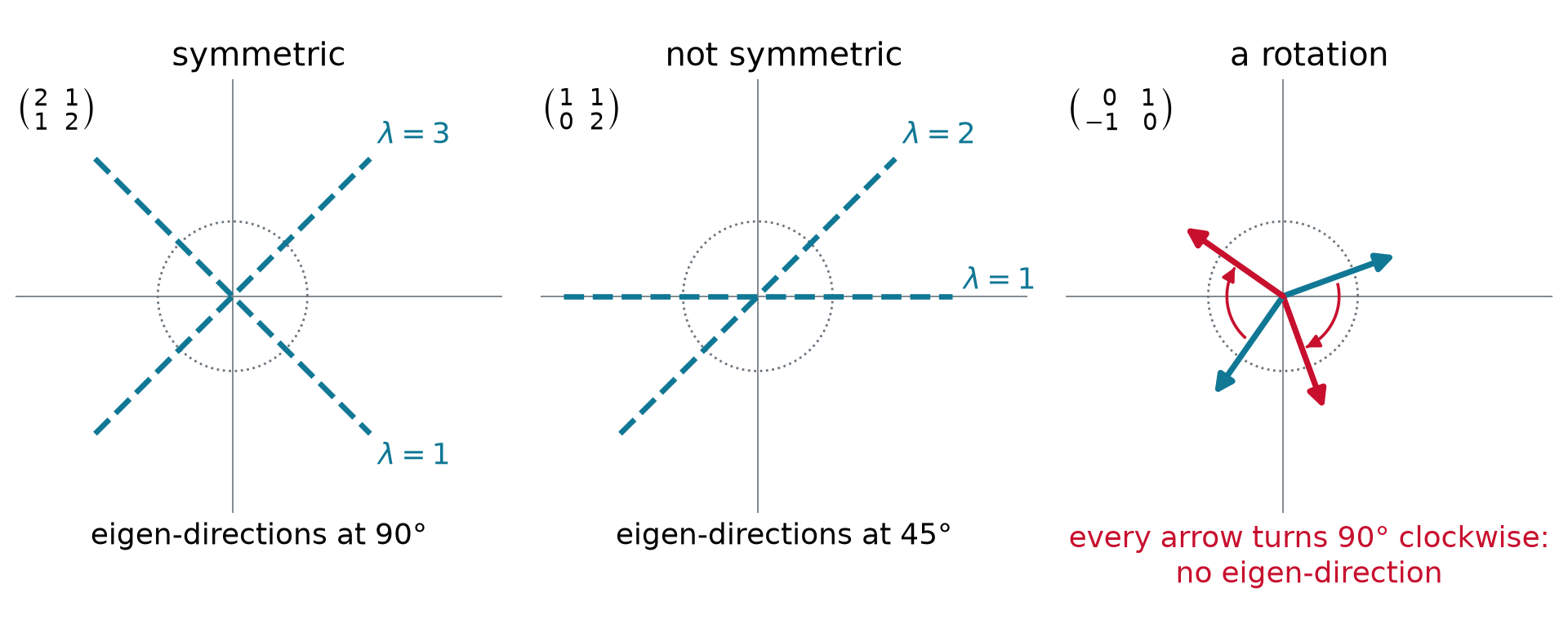
D_1 is the rotation of the last figure: imaginary eigenvalues. Times -i\hbar they turn real; P is \tfrac{\hbar}{2\Delta x} times matrix D above.
Show that \hat{p} = -i\hbar\,d/dx satisfies \int \phi^*\,(\hat{p}\psi)\,dx = \int (\hat{p}\phi)^*\,\psi\,dx.
Integrate by parts. The boundary term vanishes because physical \phi, \psi go to zero:
\begin{aligned} \int\phi^*\big(-i\hbar\,\psi'\big)\,dx &= \Big[-i\hbar\,\phi^*\psi\Big]_{-\infty}^{\infty} + i\hbar\int\phi'^*\,\psi\,dx \\ &= 0 + \int\big(-i\hbar\,\phi'\big)^*\,\psi\,dx \quad\checkmark \end{aligned}
Without the i the sign comes out wrong, (d/dx)^\dagger = -d/dx; the -i turns it around.
[\hat{A},\hat{B}] = \hat{A}\hat{B} - \hat{B}\hat{A}
\hat{A}\hat{B}\,\psi = \hat{A}\,(b\psi) = ab\,\psi \qquad\qquad \hat{B}\hat{A}\,\psi = \hat{B}\,(a\psi) = ba\,\psi
\big[\hat{A},\hat{B}\big]\,\psi = \big(\hat{A}\hat{B} - \hat{B}\hat{A}\big)\,\psi = 0 \quad \text{on the shared } \psi

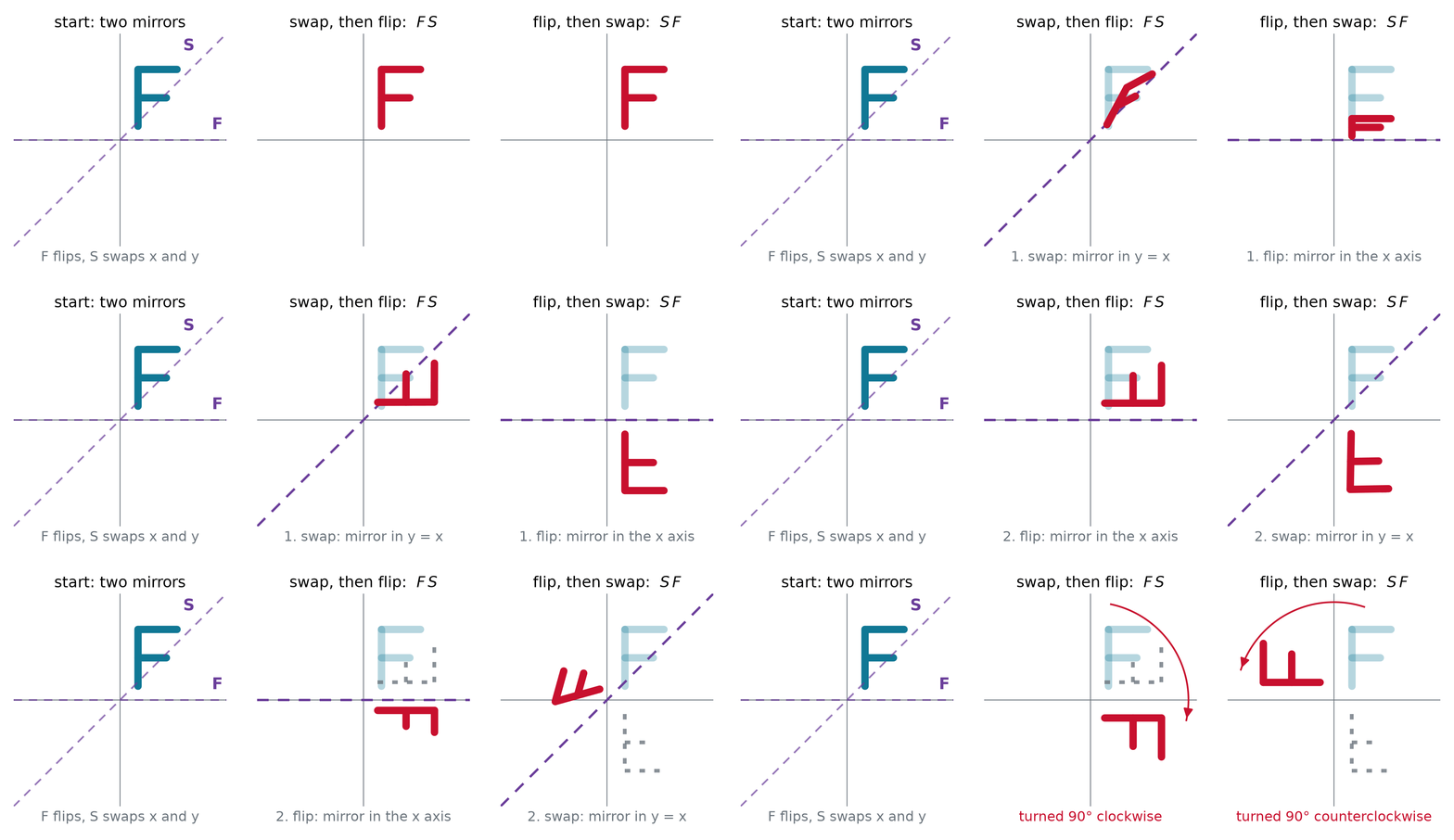
F = \begin{pmatrix} 1 & 0 \\ 0 & -1 \end{pmatrix}, \quad S = \begin{pmatrix} 0 & 1 \\ 1 & 0 \end{pmatrix}: \qquad [F, S] = FS - SF = \begin{pmatrix} 0 & 2 \\ -2 & 0 \end{pmatrix} \neq 0
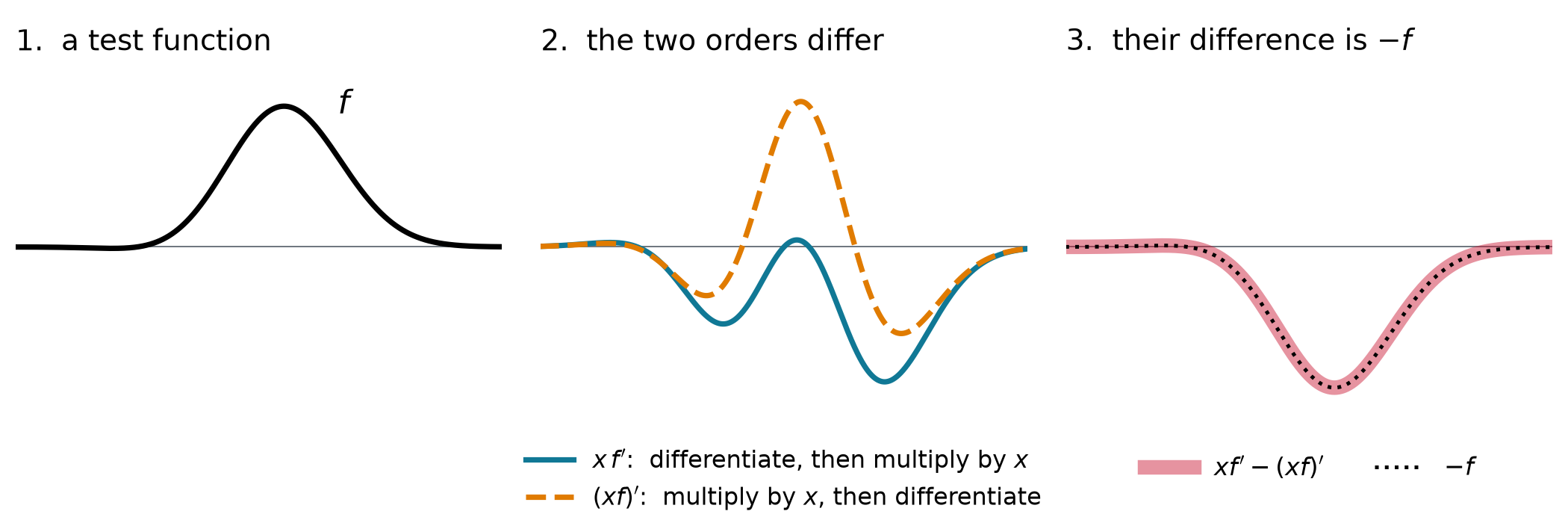
Find [x, d/dx] by acting on an arbitrary test function f.
x\,\frac{df}{dx} - \frac{d}{dx}\big(xf\big) = xf' - f - xf' = -f \qquad\Longrightarrow\qquad \left[x,\frac{d}{dx}\right] = -1
Multiply by -i\hbar: [\hat{x},\hat{p}] = i\hbar. The product rule leaves one term, for every f.

\left[x,\frac{d}{dx}\right] = -1 \qquad\xrightarrow{\ \times\,(-i\hbar)\ }\qquad [\hat{x},\hat{p}] = i\hbar
Three grid points spaced \Delta x apart: X = \operatorname{diag}(x_1, x_2, x_3), and P = -i\hbar D_1 has P_{j,j\pm 1} = \mp\dfrac{i\hbar}{2\Delta x}. Find XP - PX.
Entry by entry, (XP - PX)_{jk} = (x_j - x_k)\,P_{jk} with x_j - x_{j\pm 1} = \mp\Delta x:
XP - PX = \frac{i\hbar}{2}\begin{pmatrix} 0 & 1 & 0 \\ 1 & 0 & 1 \\ 0 & 1 & 0 \end{pmatrix} \qquad \text{averages the neighbors: } \approx i\hbar\,\psi
Its trace is 0, not 3i\hbar: no finite grid gives exactly i\hbar I.
For a free particle \hat{H} = \hat{p}^2/2m. Is e^{ikx} an eigenfunction of \hat{p}? Of \hat{H}?
\begin{aligned} \hat{p}\,e^{ikx} &= -i\hbar\,(ik)\,e^{ikx} = \hbar k\,e^{ikx} \\ \hat{H}\,e^{ikx} &= \frac{1}{2m}\,\hat{p}\,\big(\hbar k\,e^{ikx}\big) = \frac{\hbar^2k^2}{2m}\,e^{ikx} \end{aligned}
Yes, both: this state has a sharp momentum and a sharp energy.
[\hat{A},\hat{B}] = 0 \quad\Longrightarrow\quad \hat{A}\phi_n = a_n\phi_n, \quad \hat{B}\phi_n = b_n\phi_n
Why, in three steps (if no other function has the same a):
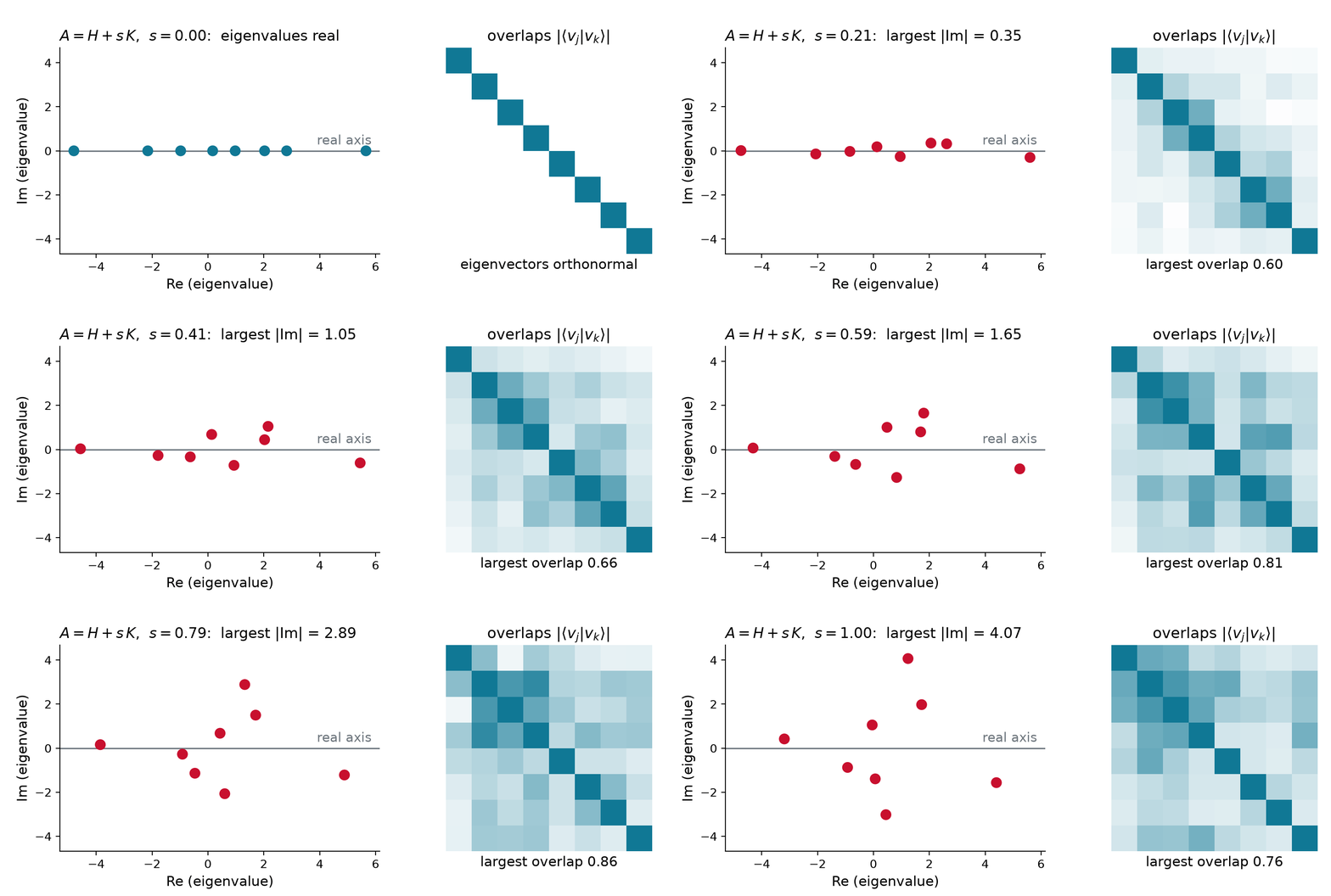
Observables are Hermitian operators, the matrix version of real numbers: equal to their own conjugate transpose, with real eigenvalues and orthogonal eigenvectors. Two observables can be sharp together only when their operators commute, and [\hat{x},\hat{p}] = i\hbar says position and momentum never are.
Chem 3240 · Quantum Mechanics