Molecular Degrees of Freedom and Classical Vibrations
Chem 3240 · Lecture 4.1
A molecule is four motions at once
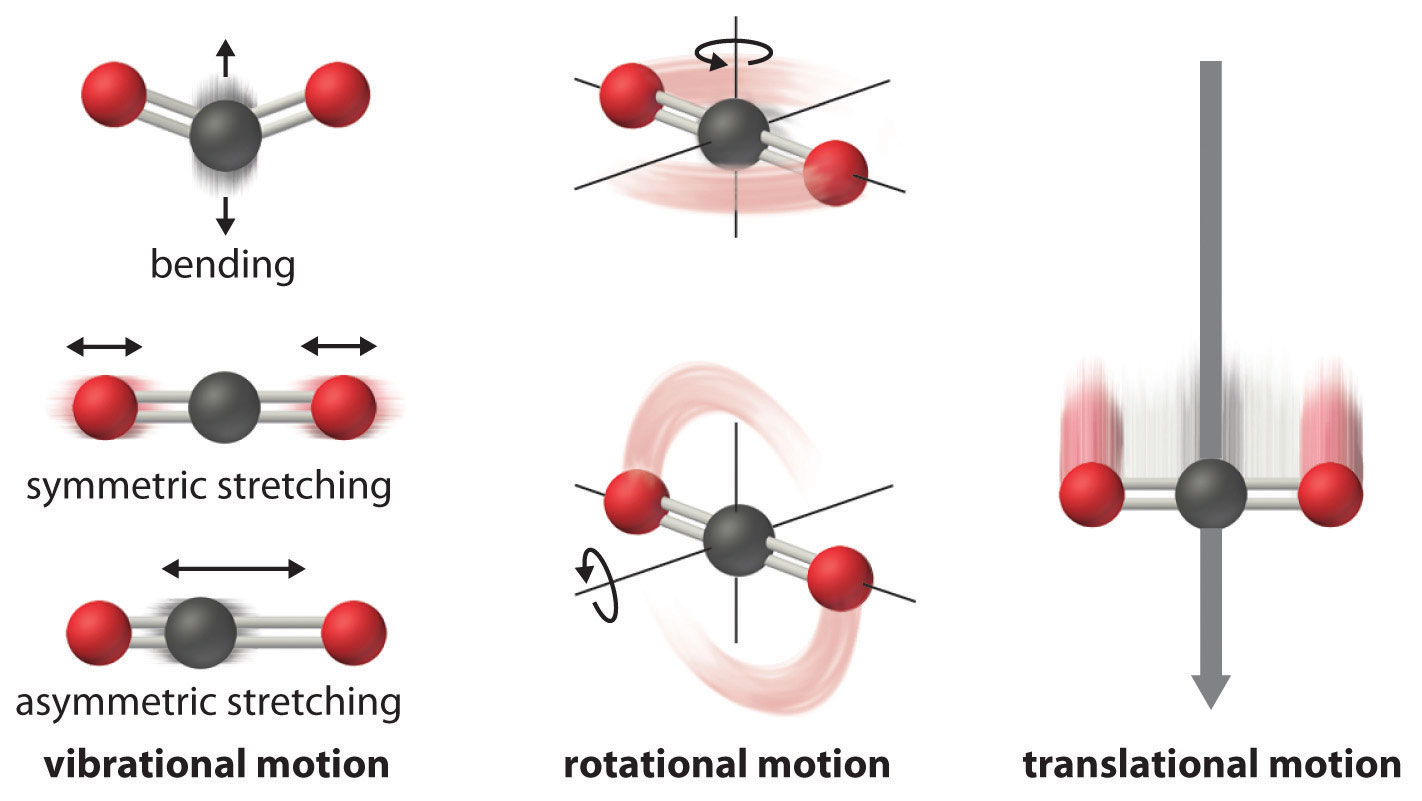
- Translation: the molecule flies
- Rotation: it tumbles
- Vibration: bonds stretch and bend
- Electronic: electrons rearrange
Each motion has its own energy ladder
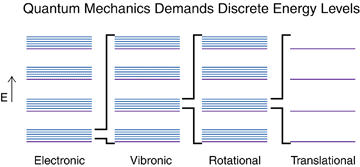
\[E= \epsilon_{trans}+ \epsilon_{rot}+ \epsilon_{vib}+\epsilon_{elec}\]
- Level spacings differ by orders of magnitude
- That is why different spectroscopies exist: microwave for rotation, infrared for vibration, UV-Vis for electrons
The classical harmonic oscillator
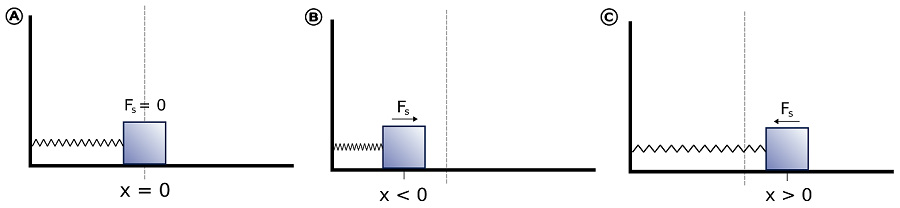
- Bead on a spring: displacement \(x\) meets a restoring force
\[F=-kx\]
- Hooke’s law; \(k\) is the spring stiffness
Energy sloshes but is conserved
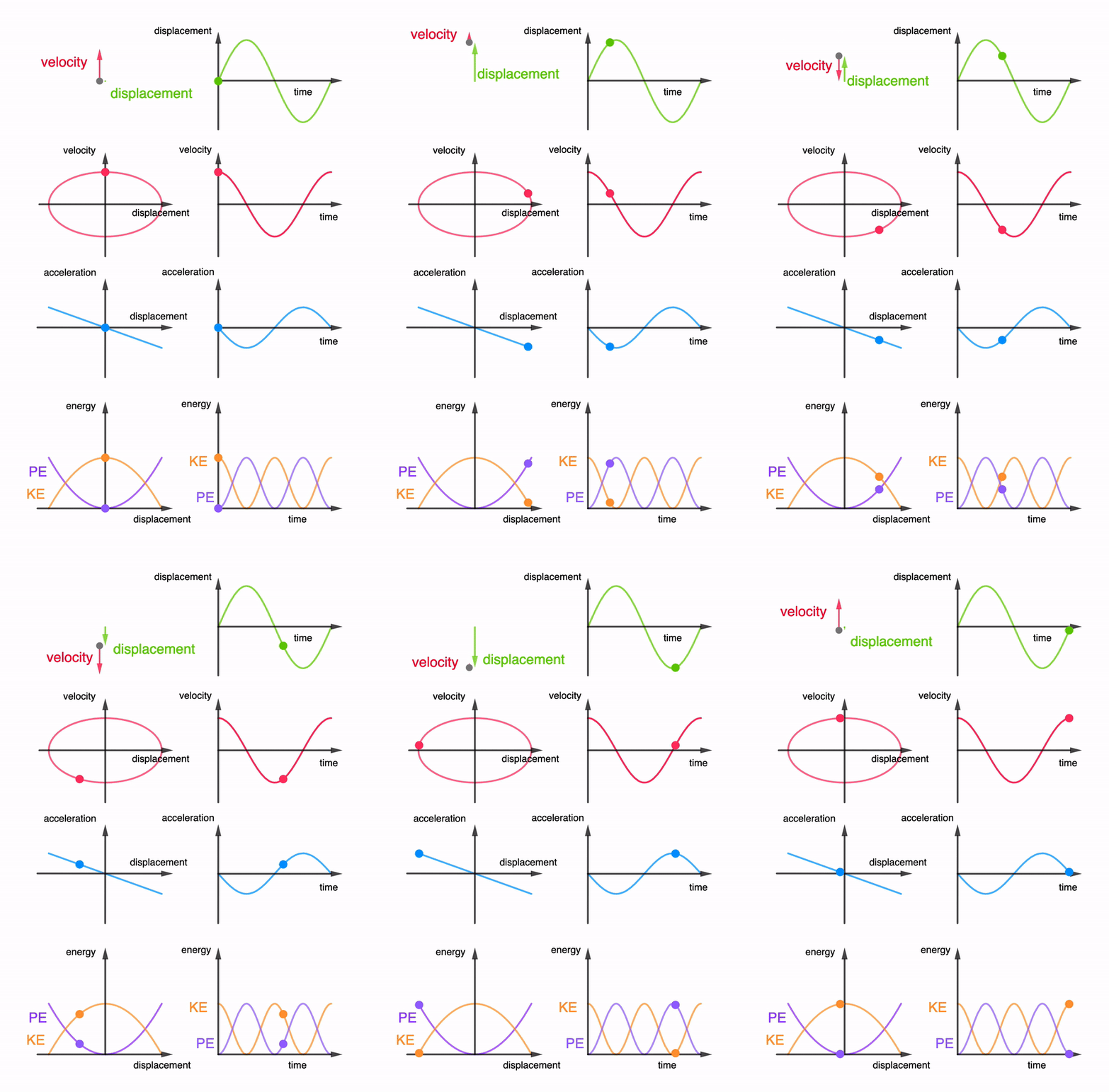
\[V(x) = \frac{kx^2}{2}, \qquad E=\frac{p^2}{2m} + \frac{kx^2}{2}\]
- Kinetic and potential energy interconvert at frequency \(\omega\)
- This total energy becomes the quantum Hamiltonian next lecture
A diatomic is one bead in disguise
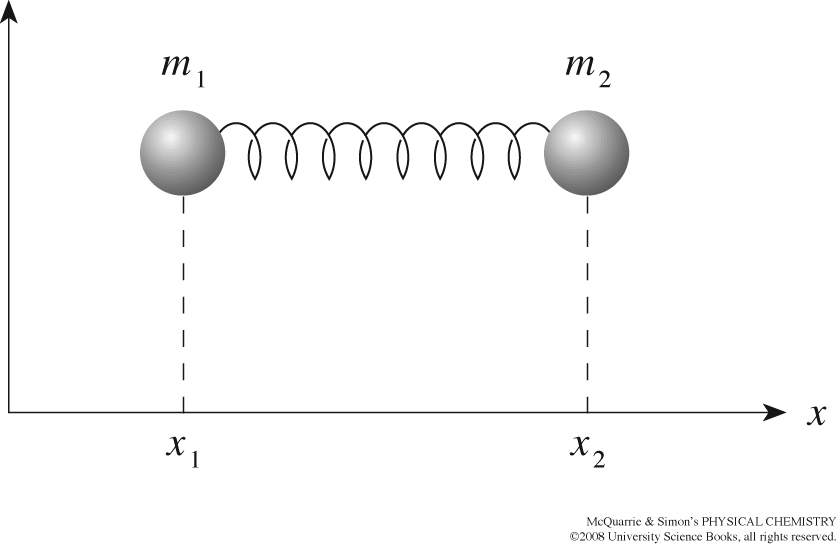
- Two masses, one spring: the center of mass moves freely
- Relative coordinate obeys the one-bead equation with the reduced mass
\[\mu=\frac{m_1 m_2}{m_1+m_2}, \qquad \omega = \sqrt{\frac{k}{\mu}}\]
Why harmonic? Taylor says so
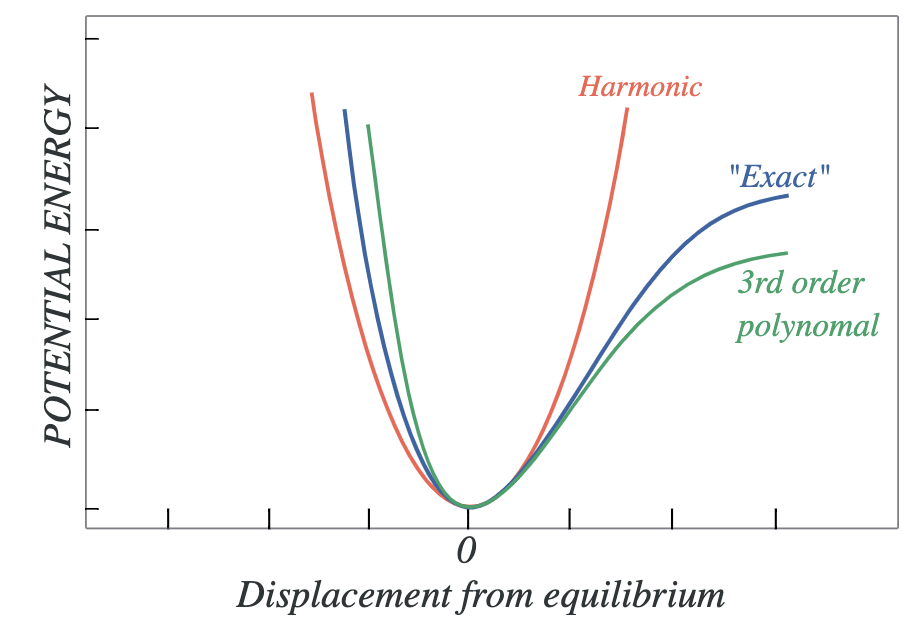
\[U(x) = \frac{1}{2}k(x-x_0)^2+\frac{\gamma}{3!}(x-x_0)^3+...\]
- Near any minimum the quadratic term dominates
- \(k = U''(x_0)\): curvature of the true potential
- Higher terms are the anharmonicity