Molecular Vibrations
Chem 3240 · Lecture 4.3
Bonds as Springs
A vibrating bond is a quantized harmonic oscillator.
- Energy levels are evenly spaced: \[\tilde{E}_v = \tilde{\nu}\left(v + \frac{1}{2}\right), \qquad v = 0,1,2,\dots\]
- A single transition energy, the fundamental: \[\Delta \tilde{E}_v = \tilde{E}_{v+1} - \tilde{E}_{v} = \tilde{\nu}\]
Vibrations are quantized: this underlies infrared and Raman spectroscopy.
Frequency, Mass, and Bond Strength
\[\tilde{\nu} = \frac{1}{2\pi c}\sqrt{\frac{k}{\mu}}\]
Force constant \(k\): stiffness of the bond
Reduced mass \(\mu\) of the diatomic
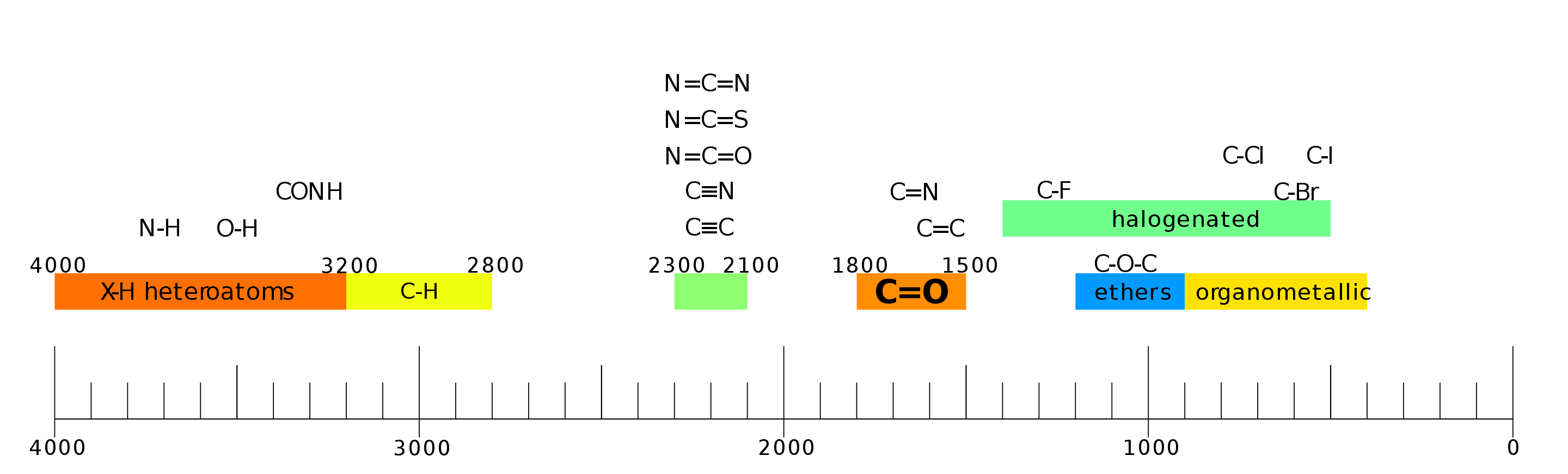
Typical range 500 to 4000 cm\(^{-1}\)
Strong, stiff bonds vibrate at higher frequency
Heavy atoms vibrate at lower frequency
Harmonic Approximation
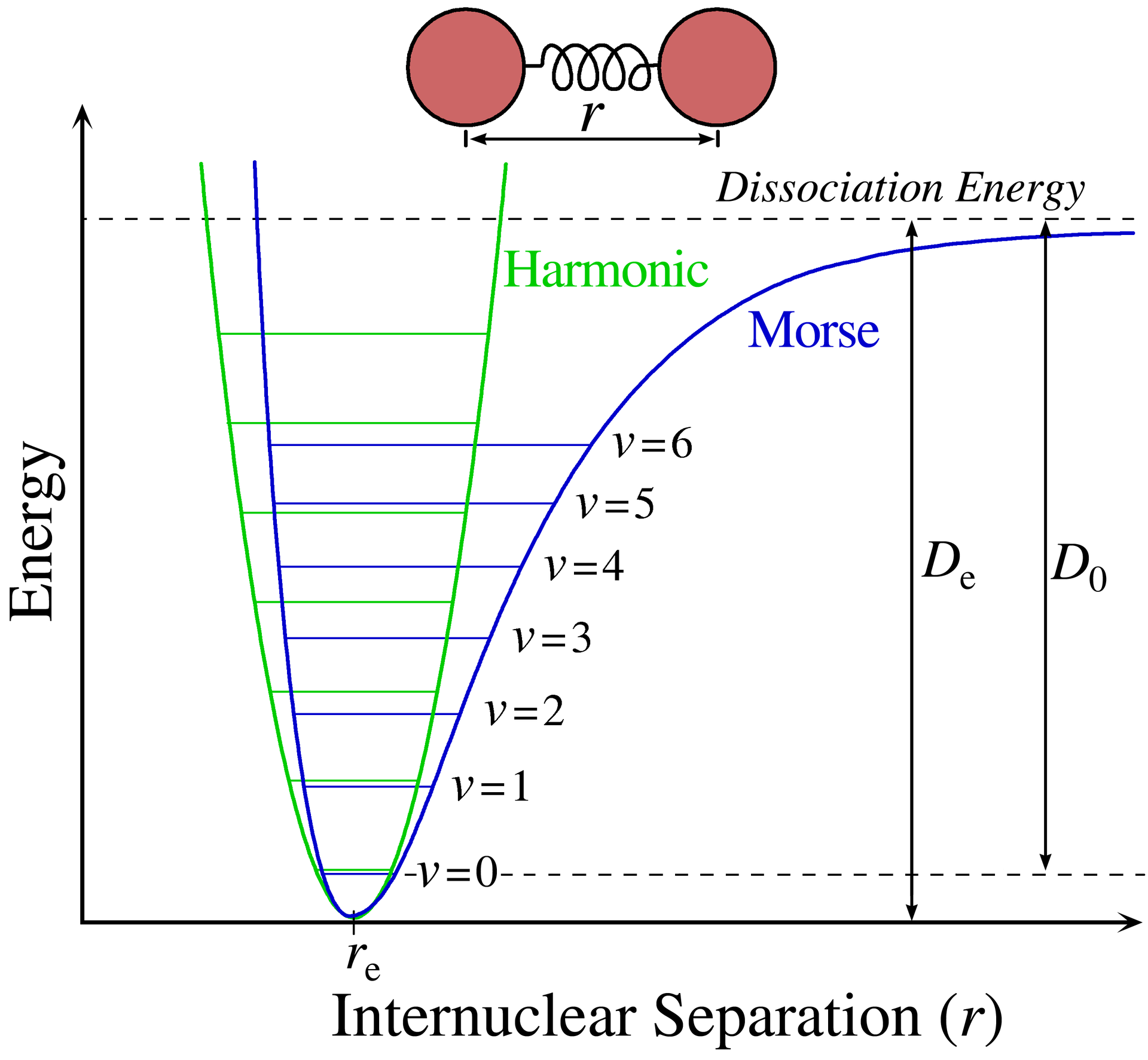
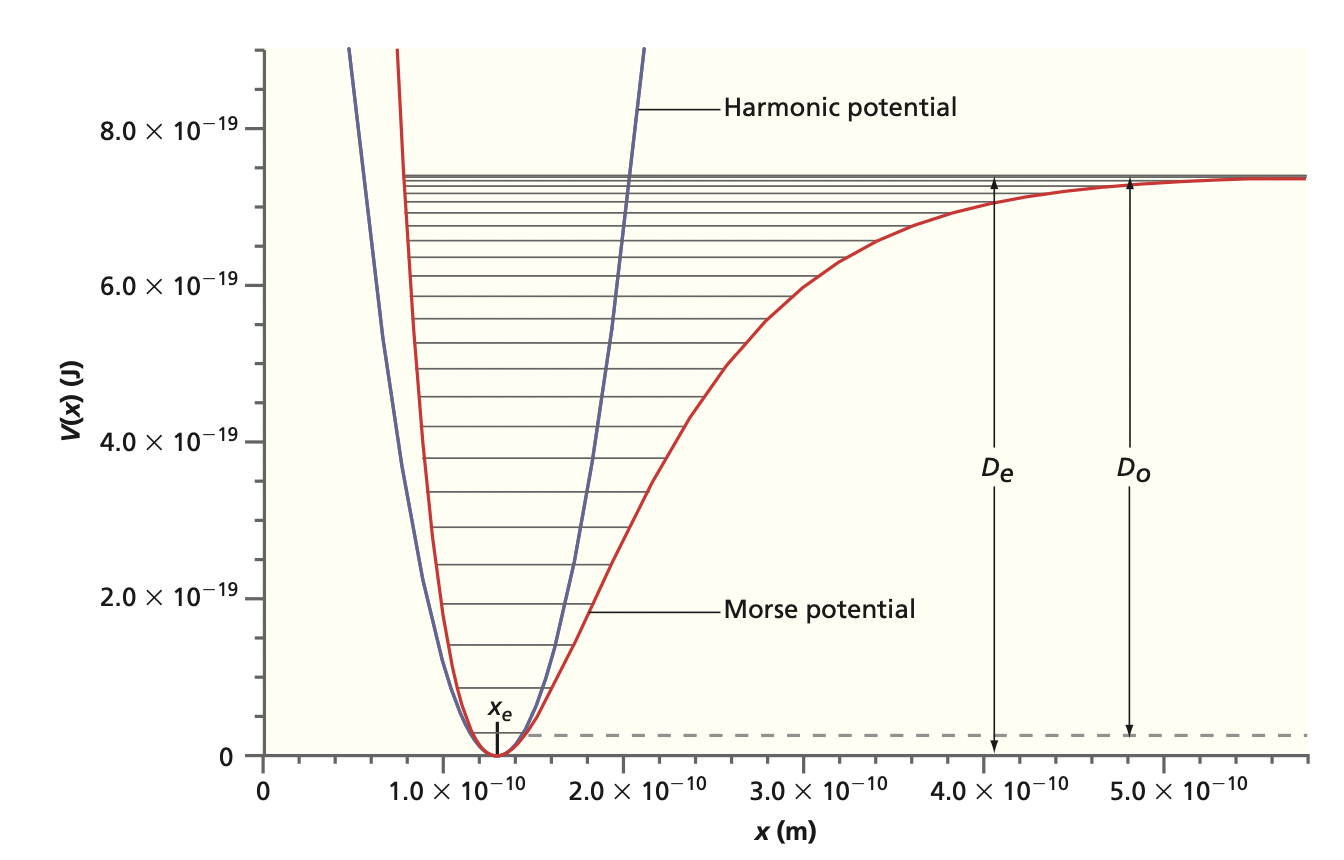
A parabola near the equilibrium bond length \(R_e\):
\[E(R) = \frac{1}{2}k(R - R_e)^2\]
It is the Taylor expansion of the true curve truncated at second order
Good near the bottom of the well, but it never dissociates
The Morse Potential
A realistic curve that dissociates:
\[V(R)=D_e\left(1-e^{-a(R-R_e)}\right)^2\]
\(D_e\): well depth from the minimum
\(D_0 = D_e - \tfrac{1}{2}h\nu\): from the ground level
Levels converge as \(v\) grows
Anharmonic Energy Levels
Add higher-order terms so levels are no longer evenly spaced:
\[\tilde{E}_v = \tilde{\nu}_e\left(v + \tfrac{1}{2}\right) - \tilde{\nu}_e x_e\left(v + \tfrac{1}{2}\right)^2 + \dots\]
- \(\tilde{\nu}_e\): vibrational wavenumber, \(x_e\): anharmonicity constant
- Transition energies shrink with \(v\): \[\tilde{\nu}_{v\rightarrow v+1} = \tilde{\nu}_e\left[1 - 2x_e(v+1)\right]\]
Normal Modes
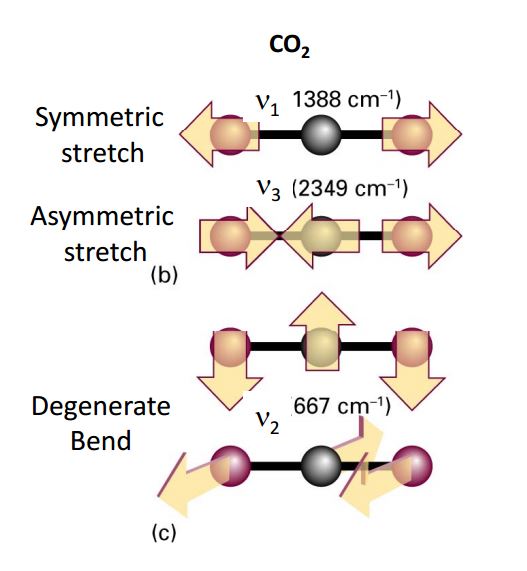
A polyatomic molecule’s motion resolves into independent normal modes.
- Linear molecules: \[N_{modes} = 3N - 5\]
- Nonlinear molecules: \[N_{modes} = 3N - 6\]
- Subtract translations and rotations from \(3N\)
IR Selection Rule
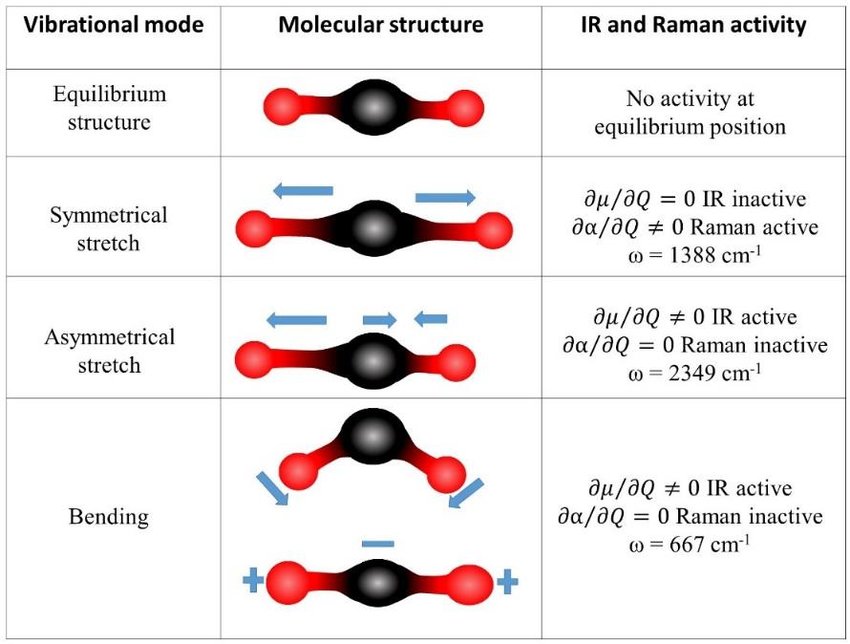
A transition is allowed only if the dipole changes with bond length:
\[\left( \frac{\partial \mu}{\partial x} \right)_{R_e} \neq 0\]
- And the quantum number changes by one: \[\Delta v = \pm 1\]
The transition probability \(P_{v\rightarrow v'} \sim \langle v | x | v' \rangle\) vanishes unless both conditions hold.
IR-Active vs Inactive
Heteronuclear (HCl, CO): dipole changes, IR-active
Homonuclear (H\(_2\), O\(_2\), N\(_2\)): zero dipole, IR-inactive
IR-inactive stretches can still appear in the Raman spectrum
Overtones
- Anharmonicity makes weak overtones appear: \(\Delta v = \pm 2, \pm 3, \dots\)
\[\tilde{\nu}_{0\rightarrow v} = \tilde{\nu}_e \cdot v - \tilde{\nu}_e x_e \cdot v(v+1)\]
Intensities fall off rapidly with each higher overtone
At room temperature almost all molecules sit in \(v=0\), so only the fundamental dominates the spectrum
Reading an IR Spectrum
Each bond type absorbs in a characteristic region
Stiff bonds and light atoms sit at high wavenumber
A spectrum is a fingerprint of functional groups
Takeaway
Bonds vibrate as quantized harmonic oscillators with \(\tilde{E}_v = \tilde{\nu}(v+\tfrac{1}{2})\); polyatomics split into \(3N-6\) (or \(3N-5\)) normal modes; a mode is IR-active only if the dipole changes, with \(\Delta v = \pm 1\); and the Morse potential captures the anharmonicity that lets molecules dissociate.