Angular Momentum
Chem 3240 · Lecture 4.4
Why angular momentum?
Rotation is to angular momentum what straight-line motion is to linear momentum.
Central to atomic structure and any system with rotational symmetry.
In QM it is a vector operator, like \(\vec{p}\).
Key twist: its three components do not commute.
Conservation from symmetry
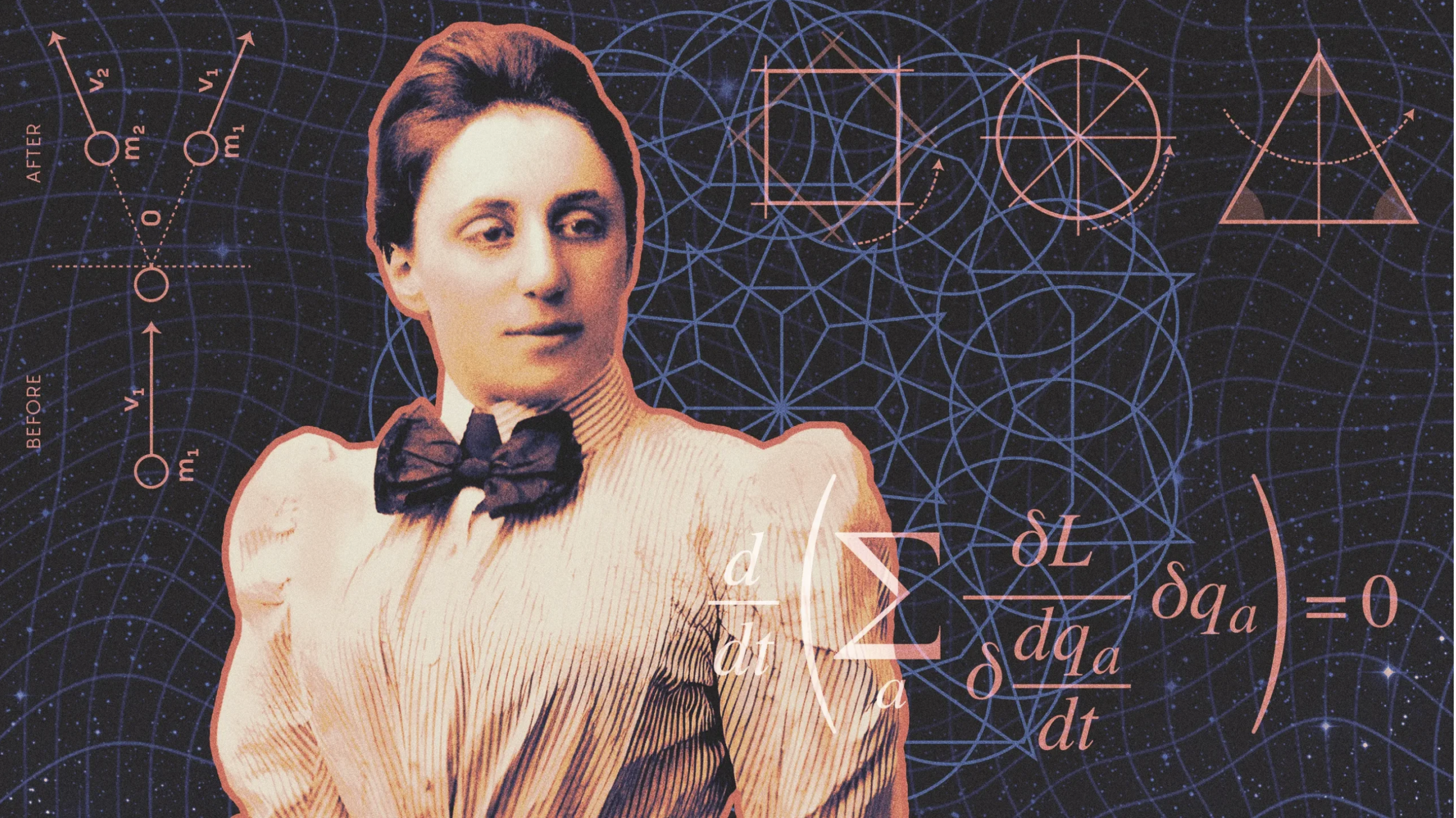
Noether’s theorem
Every continuous symmetry of the laws of physics corresponds to a conserved quantity.
- Translation \(\to\) momentum
- Rotation \(\to\) angular momentum
- Time shift \(\to\) energy
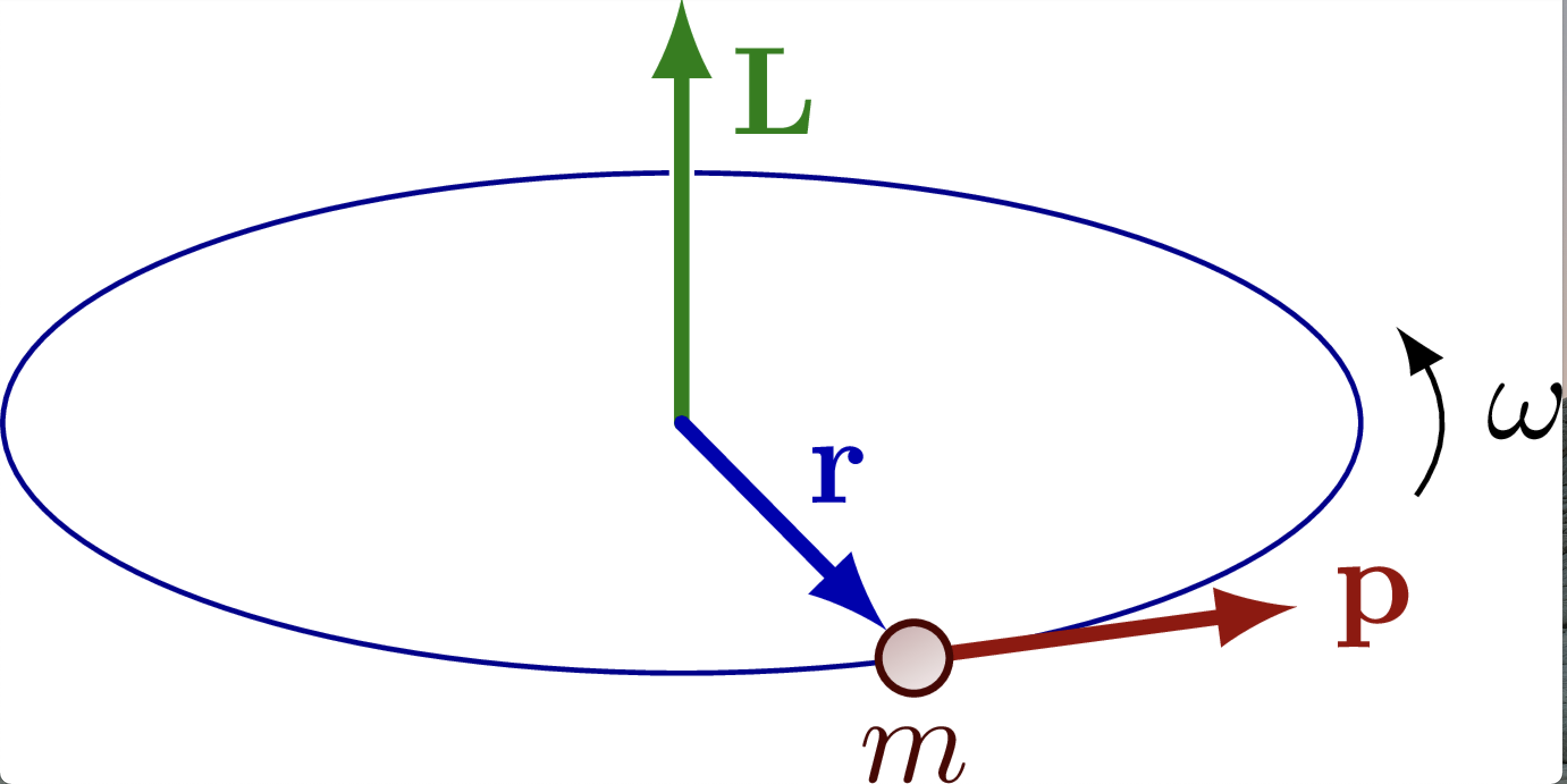
Classical definition
\[\vec{L}=\vec{r}\times\vec{p}\]
- A vector: direction by the right-hand rule.
- Components: \[L_x = yp_z - zp_y\] \[L_y = zp_x - xp_z\] \[L_z = xp_y - yp_x\]
Conservation in action
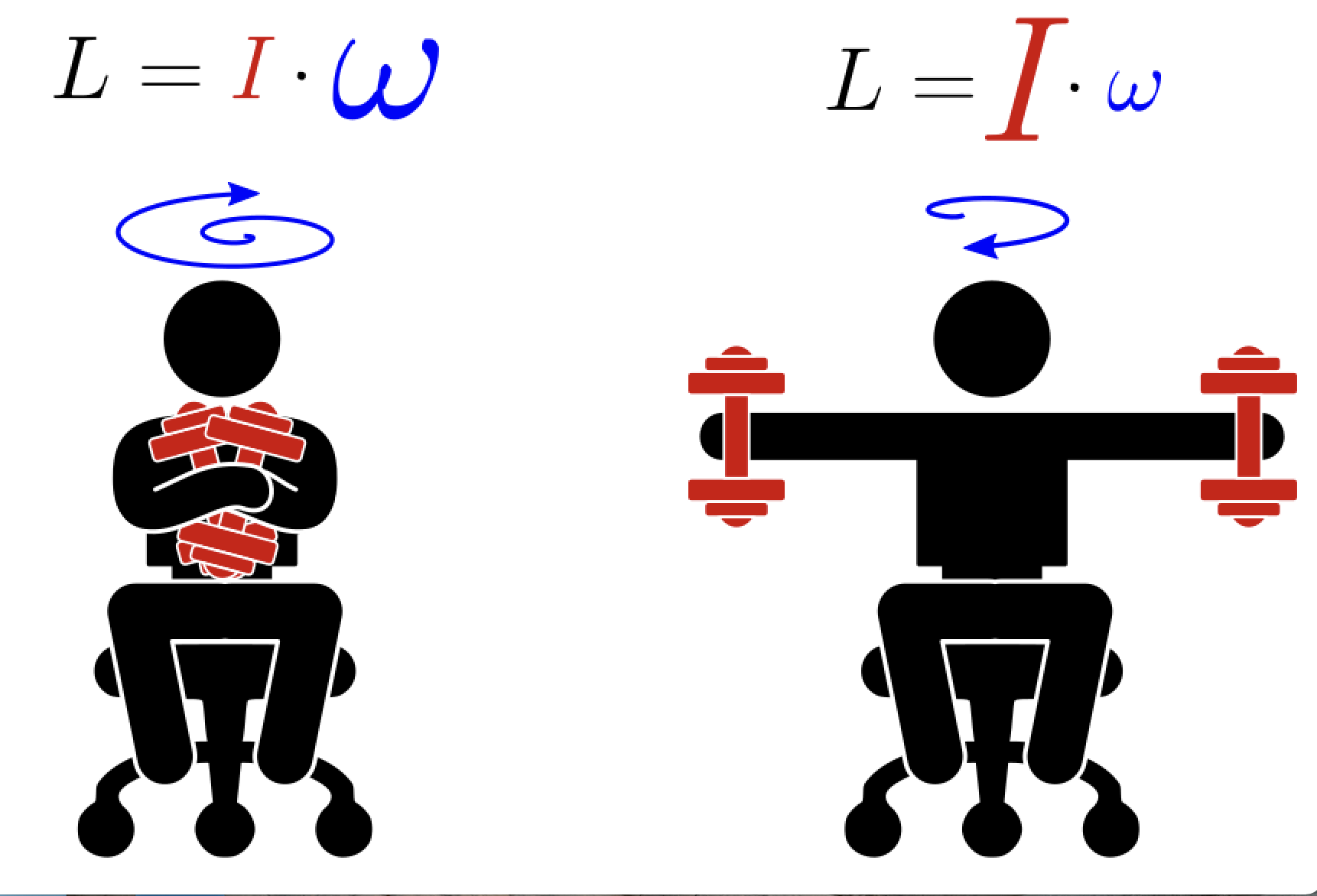
- No external torque \(\Rightarrow\) \(\vec{L}\) conserved.
- Rotational energy: \[E_\text{rot}=\frac{L^2}{2I}\]
- Pull mass inward \(\to\) smaller \(I\) \(\to\) faster spin.
Spherical coordinates
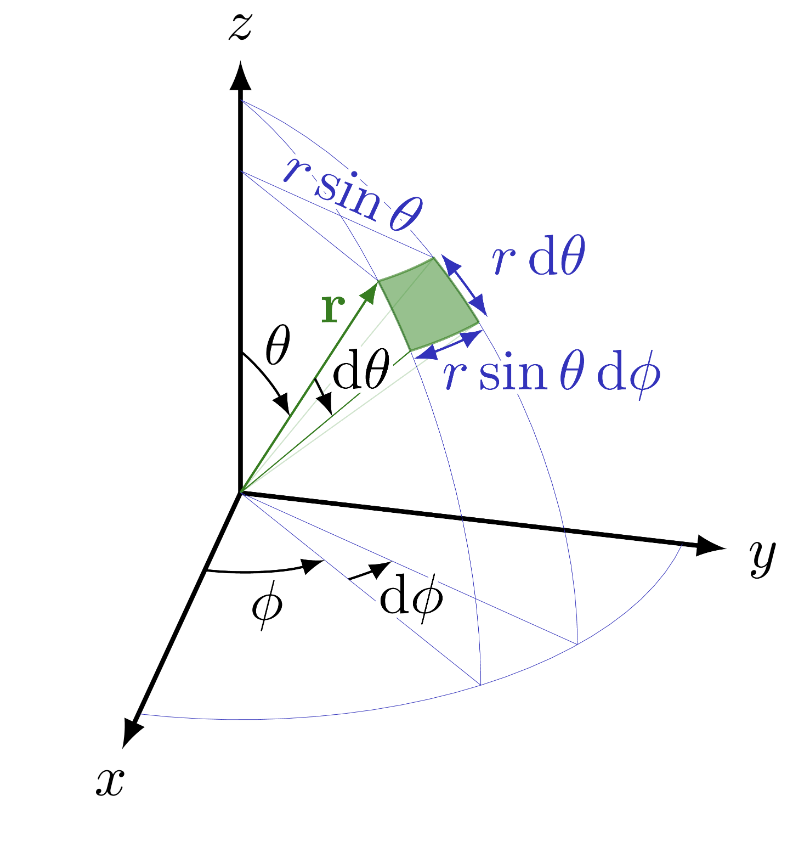
Natural choice for rotation: \((r,\theta,\phi)\).
Fixed orbit \(r=\text{const}\) removes the radial degree of freedom.
\[x=r\sin\theta\cos\phi\] \[y=r\sin\theta\sin\phi\] \[z=r\cos\theta\]
Quantum operators
- Promote classical \(\vec{L}\) to operators, e.g.
\[\hat{L}_z = -i\hbar\frac{\partial}{\partial\phi}\]
- Eigenvalue problem \(\hat{L}_z f = a f\) gives \[f(\phi)=e^{im\phi},\qquad a=\hbar m\]
- The \(z\)-axis is a choice (often set by an external field).
Components do not commute
\[\left[\hat{L}_x,\hat{L}_y\right]=i\hbar\hat{L}_z,\;\left[\hat{L}_y,\hat{L}_z\right]=i\hbar\hat{L}_x,\;\left[\hat{L}_z,\hat{L}_x\right]=i\hbar\hat{L}_y\]
\[\left[\hat{L}_x,\vec{\hat{L}}^2\right]=\left[\hat{L}_y,\vec{\hat{L}}^2\right]=\left[\hat{L}_z,\vec{\hat{L}}^2\right]=0\]
Quantized eigenvalues
- Shared eigenfunctions \(Y_l^m(\theta,\phi)\):
\[\hat{L}^2 Y_l^m = \hbar^2 l(l+1)\, Y_l^m\] \[\hat{L}_z Y_l^m = \hbar m\, Y_l^m\]
Magnitude quantized: \(L^2 \to \hbar^2 l(l+1)\).
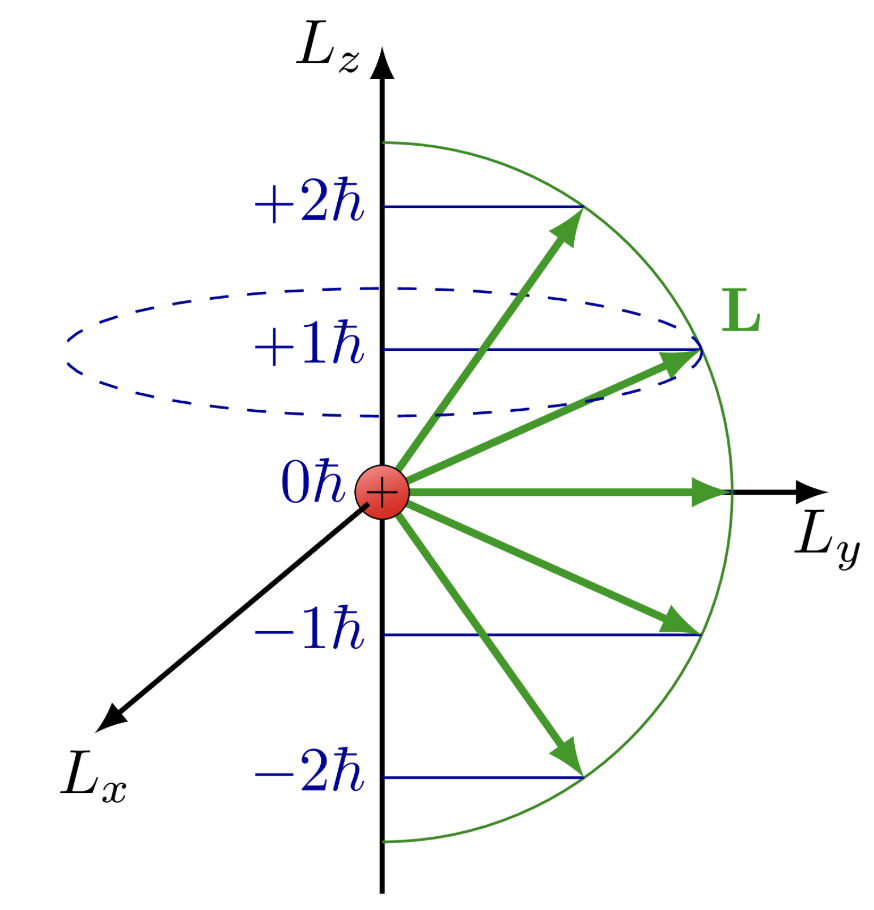
Projection quantized: \(L_z \to m\hbar\).
\(l=0,1,2,\dots\) and \(|m|\le l\), giving \(2l+1\) values of \(m\).
A vector on a cone
Fixed length \(\sqrt{l(l+1)}\,\hbar\).
Only \(2l+1\) projections onto \(z\).
\(\vec{L}\) never points exactly along \(z\): \(L_x, L_y\) stay uncertain.
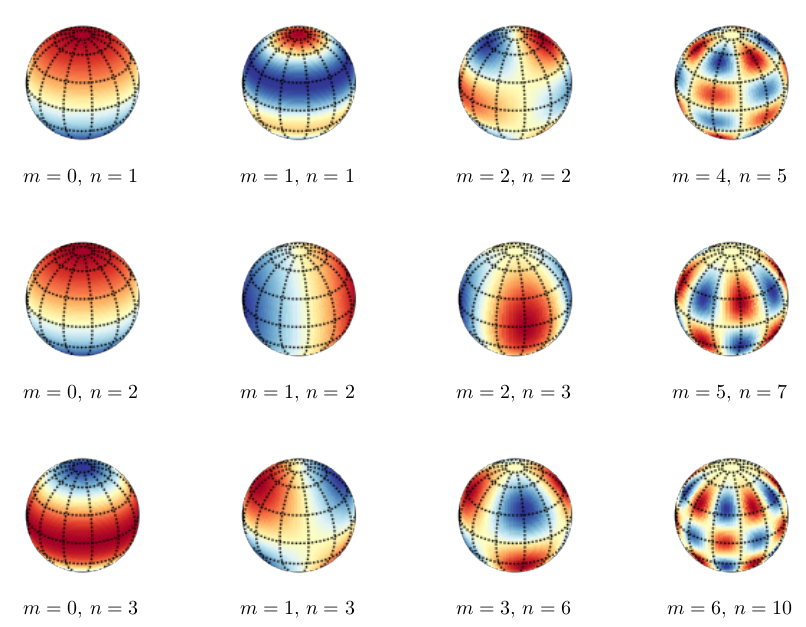
Spherical harmonics
\(Y_l^m(\theta,\phi)\) or \(|l,m\rangle\): the angular wavefunctions.
Orthonormal: \(\langle l',m'|l,m\rangle=\delta_{ll'}\delta_{mm'}\).
Total nodes \(= l\) (polar bands from \(l\), longitude lines from \(|m|\)).
Takeaway
Angular momentum is a vector operator with quantized magnitude \(L^2\to\hbar^2 l(l+1)\) and projection \(L_z\to m\hbar\). Its components do not commute, so only \(\vec{L}^2\) and one component are simultaneously sharp, and the spherical harmonics \(Y_l^m\) are their shared eigenfunctions.