Hydrogenlike Atoms

Chem 3240 · Lecture 5.1

Davit Potoyan

The Simplest Atom We Can Solve

  • One electron, one nucleus of charge \(Ze\): H, \(\text{He}^+\), \(\text{Li}^{2+}\).
  • The only atom solved exactly: add even one electron and electron-electron repulsion breaks it.
  • The Coulomb pull is isotropic: it depends only on distance \(r\).
  • That symmetry is the source of the degeneracies we will find.

The Schrodinger Equation

  • Kinetic energy plus one Coulomb attraction term.

\[\left[ -\frac{\hbar^2}{2m_e}\nabla^2 - \frac{Ze^2}{4\pi\epsilon_0 r}\right]\psi(r,\theta,\phi) = E\psi(r,\theta,\phi)\]

  • Since the potential depends only on \(r\), work in spherical coordinates.
  • Electron mass \(m_e\) replaces the reduced mass (the nucleus is far heavier).

Separation of Variables

  • The Laplacian splits into a radial and an angular piece via \(\hat{L}^2\).

\[\psi_{n,l,m}(r,\theta,\phi) = R_{nl}(r)\,Y_l^m(\theta,\phi)\]

  • Angular part is already solved: spherical harmonics \(Y_l^m\).
  • Radial part \(R_{nl}(r)\) is the new piece to find.

\[\hat{L}^2 Y_l^m = \hbar^2 l(l+1)\, Y_l^m\]

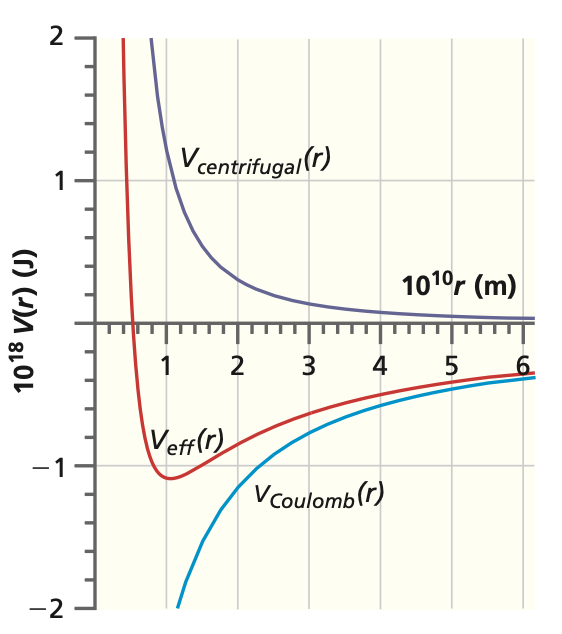
The Effective Radial Potential

\[V_{eff} = -\frac{Ze^2}{4\pi\epsilon_0 r} + \frac{l(l+1)\hbar^2}{2m_e r^2}\]

  • Coulomb attraction plus a centrifugal barrier.
  • For \(l > 0\) the barrier pushes the electron farther from the nucleus.

Radial Wavefunctions

\[R_{nl}(r) = \rho^l\, e^{-\rho/2}\, L_{n-l-1}^{2l+1}(\rho)\]

  • Laguerre polynomial times a decaying exponential.
  • Bohr radius sets the length scale: \(a_0 = \dfrac{4\pi\epsilon_0\hbar^2}{m_e e^2}\).
  • Scaled distance: \(\rho = \dfrac{2Zr}{n a_0}\).
  • Example, the 1s orbital: \(R_{10}(r) = 2\left(\dfrac{Z}{a_0}\right)^{3/2} e^{-\rho/2}\).

The Full Solution

\[\psi_{n,l,m_l} = N_{nl}\,R_{nl}(r)\,Y_{l,m_l}(\theta,\phi)\]

\[E_n = -\frac{m_e e^4}{8\varepsilon_0^2 h^2}\cdot\frac{1}{n^2}\]

  • Three quantum numbers in \(\psi\), but energy depends only on \(n\).

Degeneracy from Symmetry

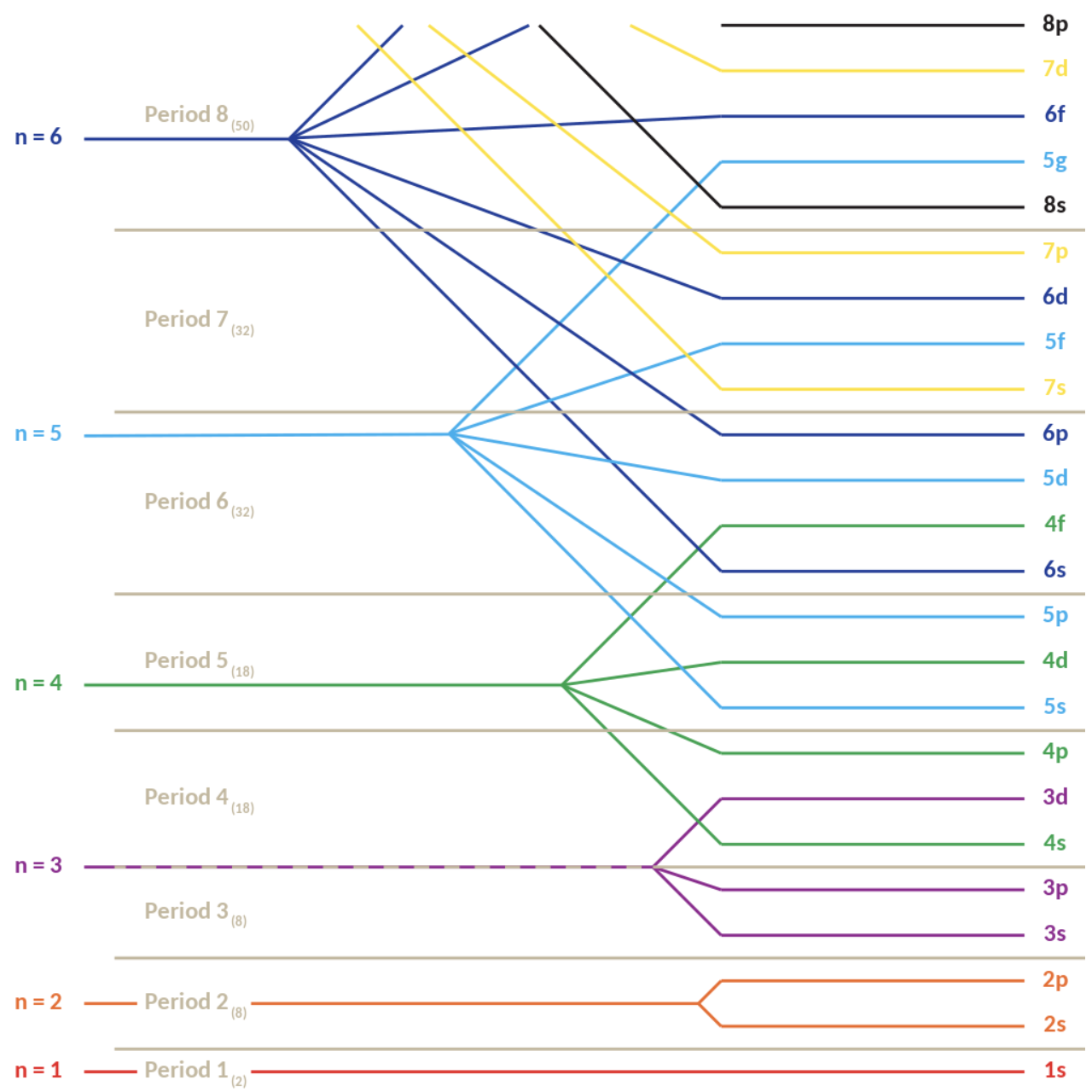
  • All states of a given \(n\) share the same energy.
  • For \(n = 2\): the \(2s\) and the three \(2p\) states are degenerate.
  • Counting spin, the total degeneracy of level \(n\) is \(2n^2\).
  • This accidental degeneracy is special to the \(1/r\) Coulomb potential.

Quantum Numbers

\[n = 1, 2, 3, \dots\] \[l = 0, 1, 2, \dots, n-1\] \[m = 0, \pm 1, \pm 2, \dots, \pm l\] \[m_s = \pm 1/2\]

  • \(n\) sets the energy, \(l\) the shape, \(m\) the orientation.
  • Letters for \(l\): \(s, p, d, f, \dots\) for \(l = 0, 1, 2, 3, \dots\)

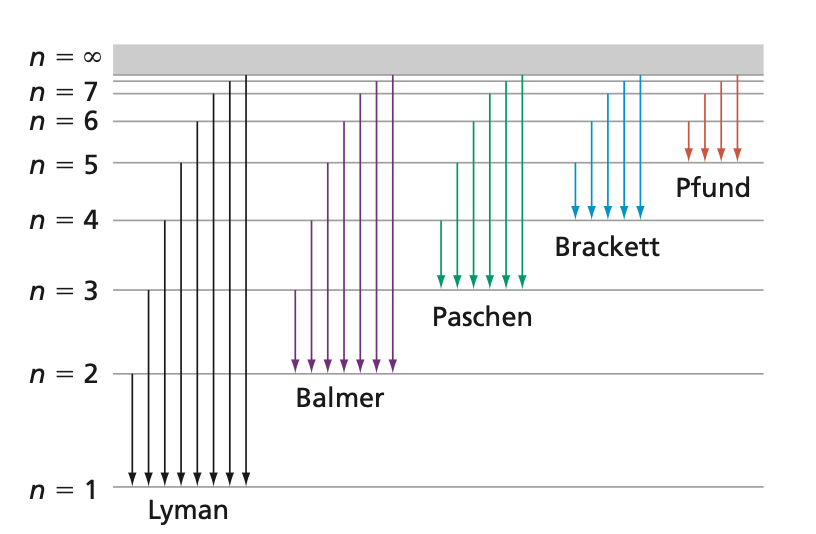
The Hydrogen Spectrum

\[\Delta\tilde{v} = R_H Z^2\left(\frac{1}{n_1^2} - \frac{1}{n_2^2}\right)\]

  • Lyman (\(n_1 = 1\)), Balmer (\(n_1 = 2\)), Paschen (\(n_1 = 3\)).
  • Balmer lines are the visible emission of hydrogen.

Ionization Energy

  • Removing the ground-state electron means \(n_1 = 1\), \(n_2 \to \infty\).

\[E_i = R_H Z^2\left(\frac{1}{1^2} - \frac{1}{\infty}\right)\]

  • For hydrogen: \(109678~\text{cm}^{-1} = 13.6057~\text{eV}\).
  • Larger nuclear charge \(Z\) means tighter binding.

Takeaway

The hydrogenlike atom separates into a radial function \(R_{nl}\) and a spherical harmonic \(Y_l^m\). Its energy \(E_n \propto -Z^2/n^2\) depends only on \(n\), so each level carries a \(2n^2\)-fold degeneracy that traces directly to the spherical symmetry of the Coulomb potential.