Atomic Orbitals

Chem 3240 · Lecture 5.2

Davit Potoyan

What Is an Orbital?

  • A one-electron wavefunction is called an orbital.
  • For the hydrogen atom it is an atomic orbital (AO), exact for H-like atoms.

\[\psi_{n\ell m_\ell}(r,\theta,\phi) = R_{n\ell}(r)\,Y_{\ell m_\ell}(\theta,\phi)\]

  • Splits cleanly into a radial part and an angular part.

Three Quantum Numbers

  • Principal: \(n = 1, 2, 3, \ldots\)
  • Orbital angular momentum: \(\ell = 0, 1, 2, \ldots, n-1\)
  • Magnetic: \(m_\ell = -\ell, -\ell+1, \ldots, \ell\)
  • Each valid triple labels one orbital.

Where Is the Electron?

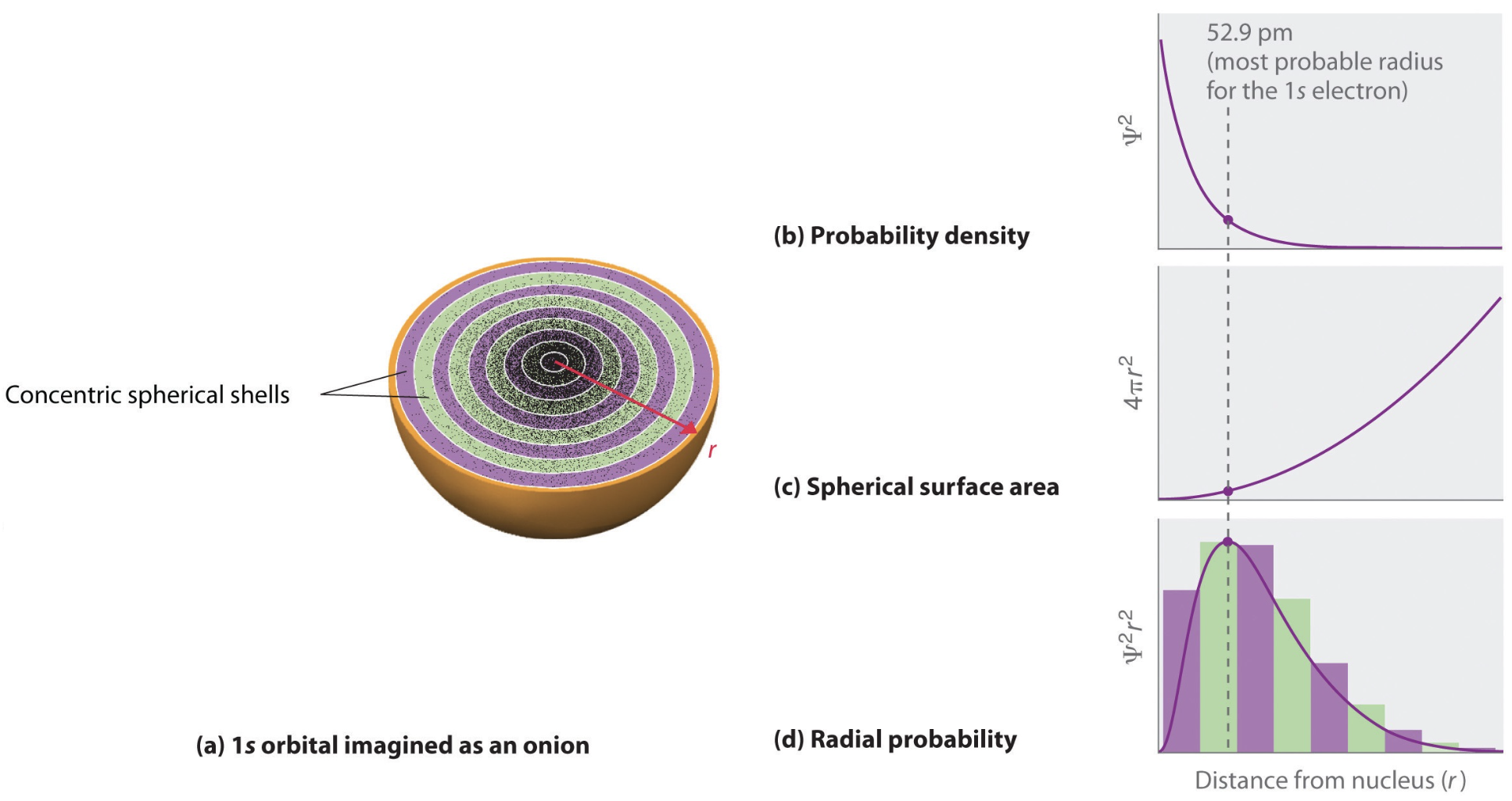
  • Probability over the full 3D volume:

\[|\psi|^2 dV = \big|R_{n\ell}(r)\big|^2 \cdot \big|Y_{\ell m_\ell}(\theta,\phi)\big|^2 \cdot r^2\sin\theta \, dr \, d\theta \, d\phi\]

  • The \(r^2\) factor reshapes the radial picture.

Radial Probability

\[P_r(r) = r^2\big|R_{n\ell}(r)\big|^2\]

  • Peaks mark the most probable distance from the nucleus.
  • For the \(1s\) orbital the peak sits at the Bohr radius \(a_0\).

How Far Out?

  • Average distance grows with \(n\):

\[\langle r\rangle_{nl} = \frac{n^2 a_0}{Z}\left\{ 1 + \frac{1}{2}\left[ 1 - \frac{l(l+1)}{n^2}\right]\right\}\]

  • Larger \(n\): electron moves outward.
  • Larger \(Z\): electron pulled inward.
  • Expectation value \(\langle r\rangle\) is not the most probable \(r\).

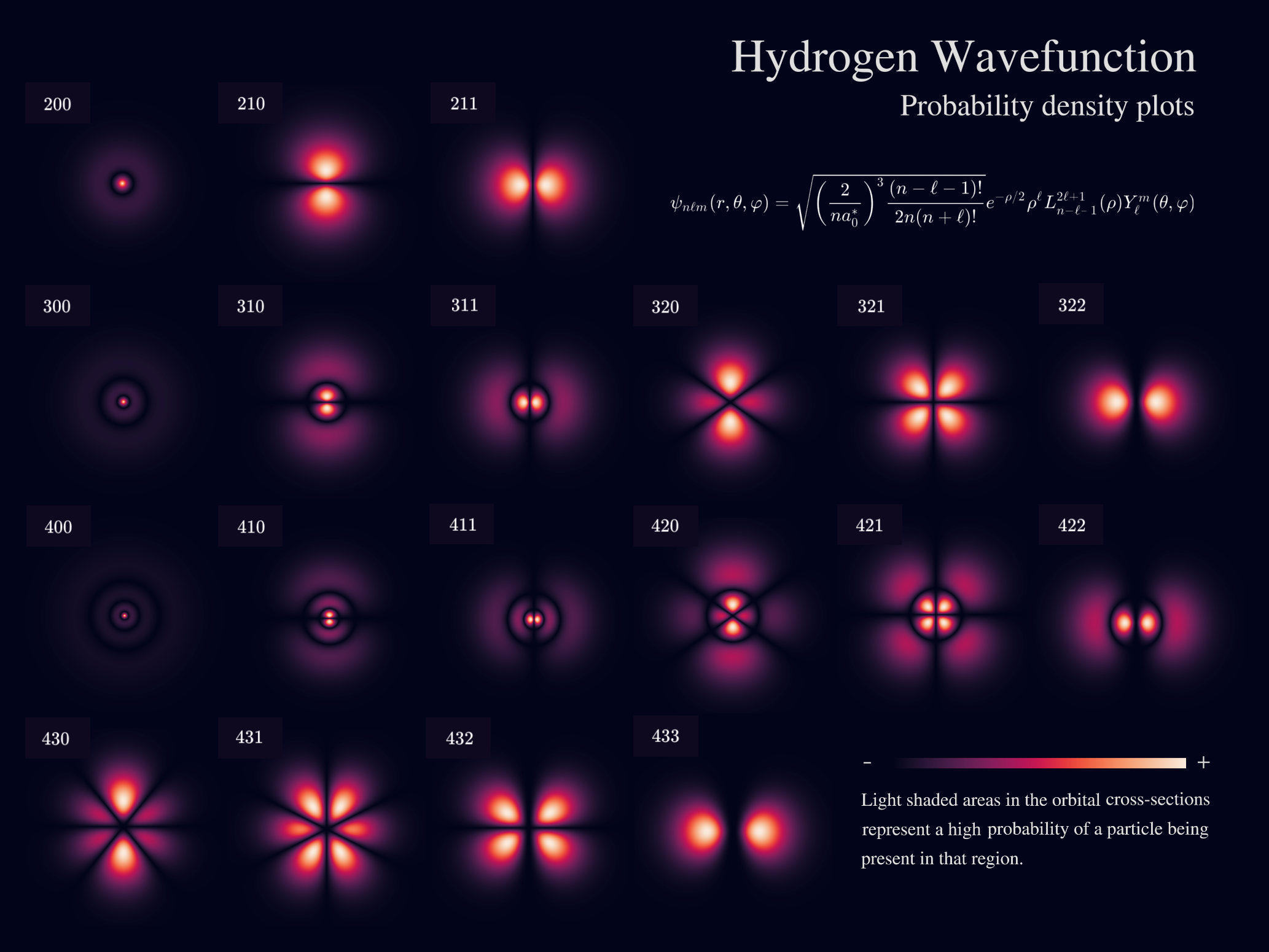
Counting Nodes

  • Radial nodes: \(n - \ell - 1\)
  • Angular nodes: \(\ell\)
  • Total nodes: \(n - 1\)
  • More nodes mean more curvature and higher energy.

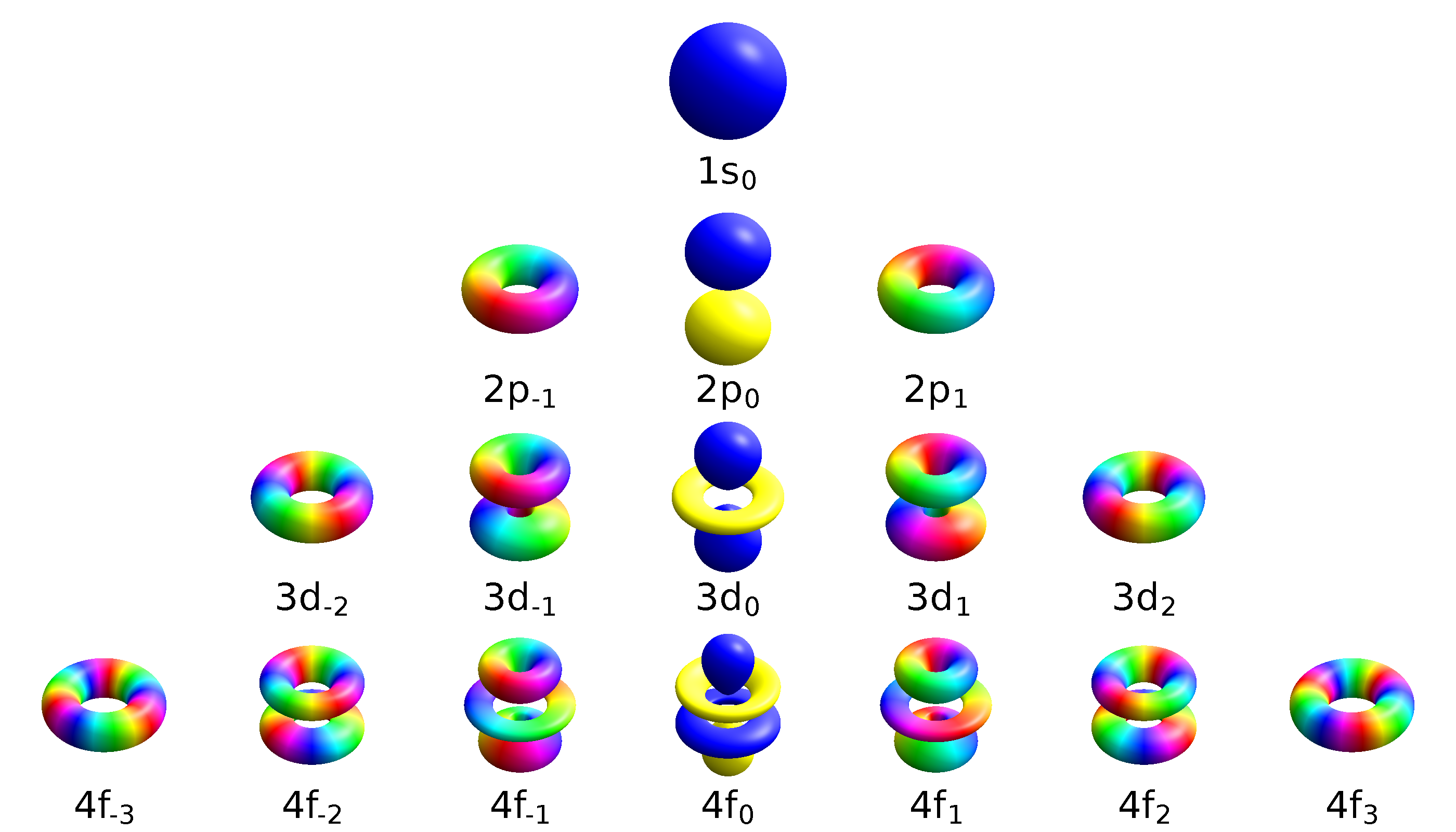
Angular Shapes

\[P_\Omega(\theta,\phi) = \big|Y_{\ell m_\ell}(\theta,\phi)\big|^2\]

  • \(s\) orbitals (\(\ell = 0\)) are isotropic: \(P_\Omega = \tfrac{1}{4\pi}\).
  • \(p, d, \ldots\) have angular nodes that carve the lobes.

Real vs Complex Orbitals
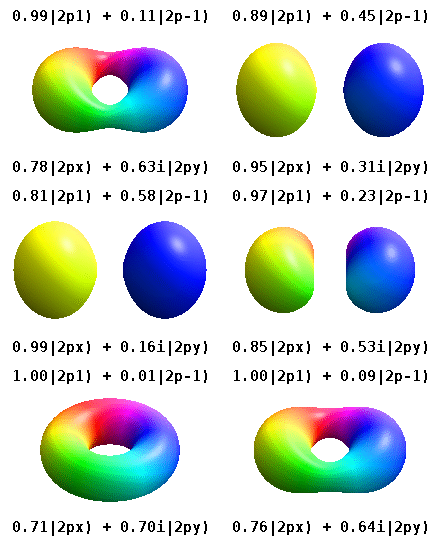
  • Degenerate \(\ell > 0\) states allow free recombination.

\[p_x \propto \sin\theta\cos\phi \propto x\] \[p_y \propto \sin\theta\sin\phi \propto y\] \[p_z = p_0\]

  • Same density, different frame.

Pointing the Lobes

  • Combining \(p_x, p_y, p_z\) aims a lobe in any direction.
  • Five degenerate \(d\) orbitals follow the same recipe:

\[d_{x^2 - y^2} = \tfrac{1}{\sqrt{2}}\left(d_{+2} + d_{-2}\right), \quad d_{xy} = -\tfrac{i}{\sqrt{2}}\left( d_{+2} - d_{-2}\right)\] \[d_{xz} = -\tfrac{1}{\sqrt{2}}\left( d_{+1} - d_{-1}\right), \quad d_{yz} = \tfrac{i}{\sqrt{2}}\left( d_{+1} + d_{-1}\right)\] \[d_{z^2} = d_0\]

Putting It Together

  • Cross sections of \(|\psi_{n\ell m}|^2\): radial reach times angular shape.

Takeaway

An atomic orbital factors as \(\psi = R_{n\ell}(r)\,Y_{\ell m_\ell}(\theta,\phi)\), labeled by \(n\), \(\ell\), \(m_\ell\). The radial part sets how far (\(n - \ell - 1\) nodes) and the angular part sets the shape (\(\ell\) nodes), for \(n - 1\) nodes in all.