Electron Spin

Chem 3240 · Lecture 5.3

Davit Potoyan

Moving Charge Makes a Magnet

  • A charge circulating around the nucleus generates a magnetic moment.

\[\vec{\mu} = \gamma_e \vec{L}, \qquad \mu_z = -\mu_B m_l\]

  • Bohr magneton \(\mu_B = \dfrac{e\hbar}{2m_e}\) sets the scale.
  • Only electrons with \(l > 0\) carry an orbital magnetic moment.

Atoms in a Magnetic Field

  • Add the field-interaction term to the Hamiltonian:

\[\hat{H} = \hat{H}_0 + \frac{eB}{2m_e}\hat{L}_z\]

  • \(\hat{L}_z\) commutes with \(\hat{H}_0\), so they share eigenstates.
  • The field only shifts each level by its \(m_l\).

The Orbital Zeeman Effect

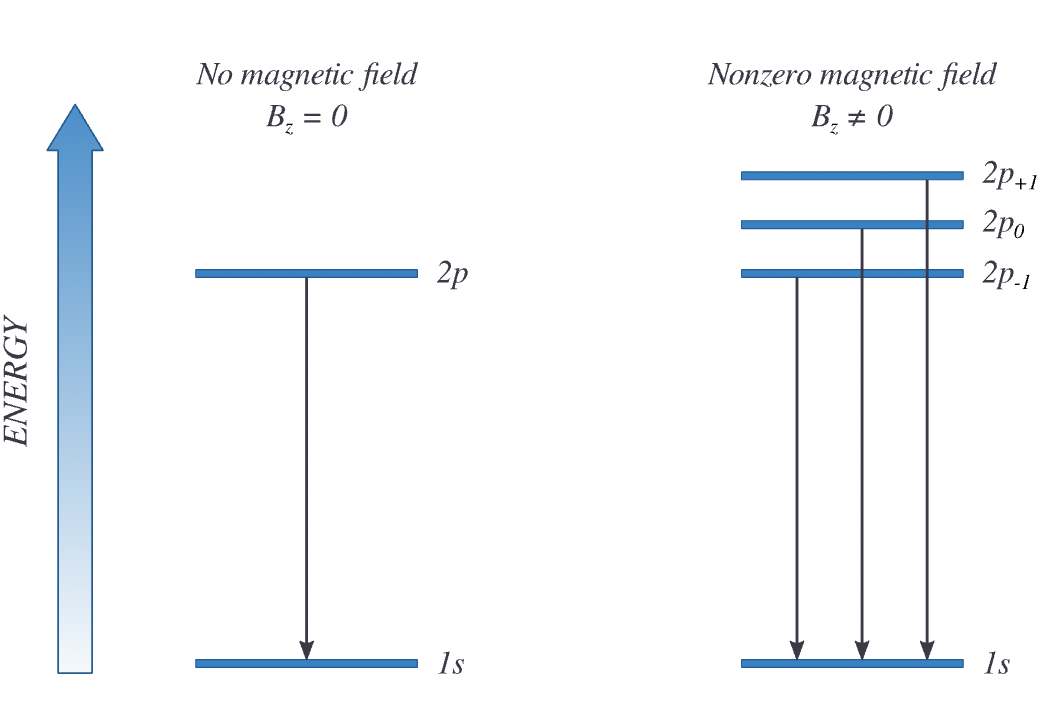
\[E_{nlm} = E_n + \mu_B m_l B\]

  • Field splits the \((2l+1)\) degenerate levels.
  • The \(2p\) level fans into three lines: \(-\mu_B B,\ 0,\ +\mu_B B\).

A Surprise: Spin

  • Stern-Gerlach split a beam into two spots, not an odd number.
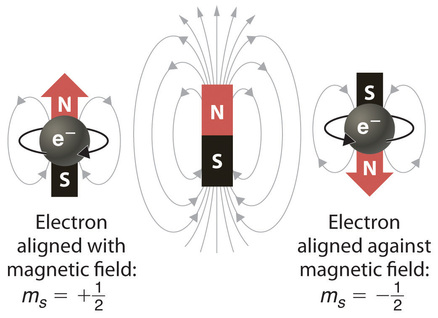
  • Electrons carry an intrinsic angular momentum: spin.
  • Not literal spinning, an intrinsic property like mass and charge.
  • The Schrodinger equation misses it; spin comes from the Dirac equation.

Spin as a Tiny Magnet

  • Every particle carries a permanent magnetic moment.
  • Add spin as a new quantum number \(s\), like \(l\).
  • Allowed projections: \(2s + 1\).
  • Experiment shows only two, so \(s = \tfrac{1}{2}\).

The Two Spin States

\[S = \frac{\sqrt{3}}{2}\hbar, \qquad S_z = \pm\frac{1}{2}\hbar\]

  • \(m_s = +\tfrac{1}{2}\) is \(\alpha\) (spin-up), \(m_s = -\tfrac{1}{2}\) is \(\beta\) (spin-down).

\[\hat{S}^2|\alpha\rangle = \tfrac{3}{4}\hbar^2|\alpha\rangle, \qquad \hat{S}_z|\alpha\rangle = +\tfrac{1}{2}\hbar|\alpha\rangle\]

Spin Joins the Wavefunction

  • States \(\alpha\) and \(\beta\) are orthonormal:

\[\langle\alpha|\alpha\rangle = \langle\beta|\beta\rangle = 1, \qquad \langle\alpha|\beta\rangle = 0\]

  • The full state is spatial times spin: \[|n,l,m_l,m_s\rangle = \psi_{n,l,m_l}\,\sigma, \quad \sigma = \alpha \text{ or } \beta\]

Magnetic Moment of Spin

\[\hat{\mu}_z = -\frac{g_e e}{2m_e}\hat{S}_z, \qquad g_e \approx 2\]

  • The \(g\)-factor \(g_e = 2.0023\) comes from relativistic theory.
  • Energy in a field: \(E = g_e \mu_B m_s B\).

\[\hat{H} = \hat{H}_0 + \frac{eB}{2m_e}\left(\hat{L}_z + g_e\hat{S}_z\right)\]

Spin-Orbit Coupling

  • Two internal magnets, orbital and spin, interact.

\[\hat{H} = \hat{H}_0 + \frac{A}{r^3}\,\hat{L}\cdot\hat{S}\]

  • \(\hat{L}\) and \(\hat{S}\) no longer commute with \(\hat{H}\).
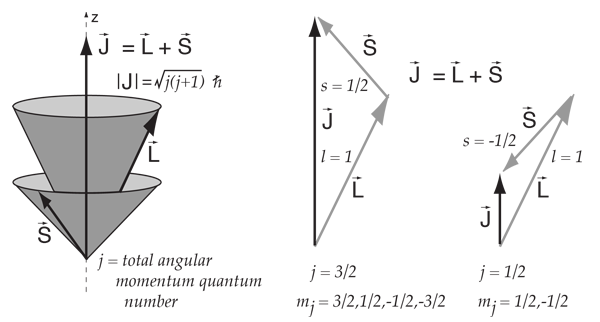
  • Need the total \(\vec{J} = \vec{L} + \vec{S}\).

Total Angular Momentum and Terms

\[j = |l - s|, \dots, l + s = l \pm \tfrac{1}{2}\]

  • Label each level by a term symbol: \[^{2S+1}L_J\]
  • A \(2p\) electron splits into \(^2P_{3/2}\) and \(^2P_{1/2}\) (fine structure).

Selection Rules

  • Transitions are allowed only when:

\[\Delta L = \pm 1\] \[\Delta S = 0\] \[\Delta J = 0, \pm 1 \quad (0 \rightarrow 0 \text{ forbidden})\]

  • These rules govern which spectral lines actually appear.

Takeaway

Electrons carry an intrinsic spin with \(s = \tfrac{1}{2}\) and two states \(\alpha, \beta\) at \(S_z = \pm\tfrac{1}{2}\hbar\). Its magnetic moment (\(g_e \approx 2\)) drives the anomalous Zeeman effect, while spin-orbit coupling binds \(\vec{L}\) and \(\vec{S}\) into the total \(\vec{J}\) that labels states as \(^{2S+1}L_J\).