The Helium Atom
Chem 3240 · Lecture 7.1
Why Helium Is Hard
Two electrons, one nucleus with \(Z = 2\).
Hydrogen has an exact solution.
Helium has no closed-form solution.
The culprit: electron, electron repulsion.
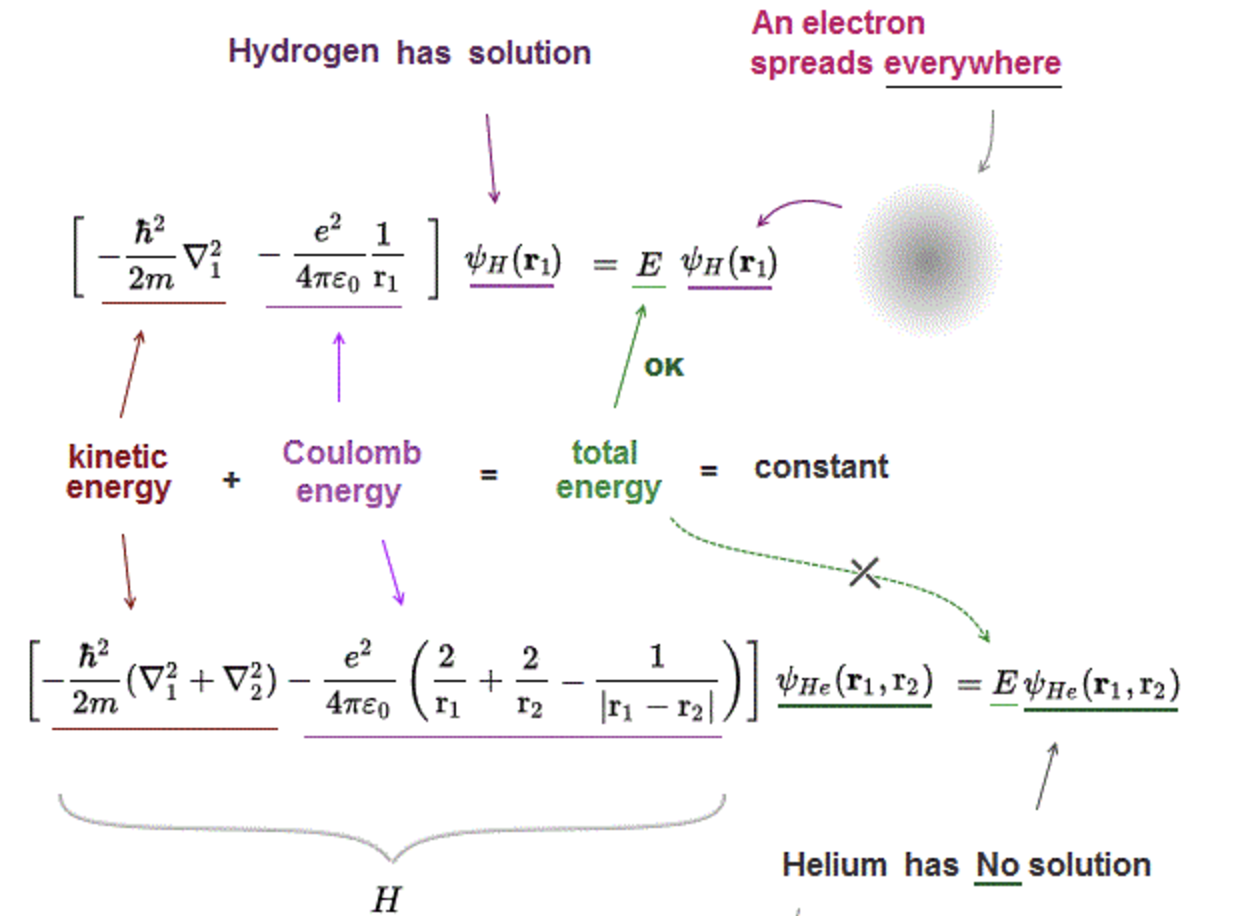
The Helium Hamiltonian
\[\hat{H} = -\frac{\hbar^2}{2m_e}\left(\Delta_1 + \Delta_2\right) - \frac{1}{4\pi\epsilon_0}\left(\frac{Ze^2}{r_1} + \frac{Ze^2}{r_2} - \frac{e^2}{r_{12}}\right)\]
Kinetic energy of both electrons.
Attraction to the nucleus.
The tough term \(-\,e^2/r_{12}\) couples the coordinates.
The Term That Breaks Everything
Repulsion \(e^2/r_{12}\) ties the two electrons together.
The Hamiltonian no longer separates into one-electron pieces.
Without it, helium would just be two hydrogen atoms.
Strategy: drop it first, then patch it back.
The Independent-Electron Approximation
- Ignore the \(r_{12}\) term.
\[\hat{H} = \hat{H}_1 + \hat{H}_2\]
\[\hat{H}_i = -\frac{\hbar^2}{2m_e}\Delta_i - \frac{Ze^2}{4\pi\epsilon_0 r_i}\]
- A sum of two hydrogenlike atoms, so the problem separates.
The Separable Solution
\[E = E_1 + E_2 = -RZ^2\left(\frac{1}{n_1^2} + \frac{1}{n_2^2}\right)\]
\[\psi(r_1,r_2) = \frac{1}{\pi}\left(\frac{Z}{a_0}\right)^3 e^{-Z(r_1 + r_2)/a_0}\]
- Ground state: both electrons in \(1s\), so \(\psi = 1s(1)\,1s(2)\).
How Good Is It?
Energy is a product of two hydrogen orbitals.
Computed: \(E \approx -74.8\) eV.
Exact: \(E = -79.0\) eV.
Error of about 5.2 eV: we lost the repulsion.
The estimate sits above the truth, as the variational principle demands.
A Better Trial: Vary the Charge
- Treat the nuclear charge \(Z\) as an adjustable parameter.
\[E = \langle\psi|\hat{H}|\psi\rangle = \left[Z^2 - \frac{27Z}{8}\right]\frac{e^2}{4\pi\epsilon_0 a_0}\]
- The variational principle: lower energy means a better wavefunction.
Minimize the Energy
- Set the derivative to zero:
\[\frac{dE}{dZ} = \left(2Z - \frac{27}{8}\right)\frac{e^2}{4\pi\epsilon_0 a_0} = 0\]
\[Z = \frac{27}{16} \approx 1.7, \qquad E \approx -77.5 \text{ eV}\]
- Closer to the exact \(-79.0\) eV than \(Z = 2\) gave.
Shielding
The optimal charge \(Z \approx 1.7\) is less than the true \(Z = 2\).
Each electron screens the nucleus from the other.
The other electron feels a reduced effective charge.
Our first quantitative encounter with shielding.
The Lesson of Helium
Even two electrons have no closed-form solution.
Build wavefunctions from hydrogenlike orbitals.
Use the variational principle to systematically improve them.
Perturbation theory offers an alternative route.
Takeaway
Helium has no exact solution because the \(1/r_{12}\) repulsion couples the electrons. We approximate it as two hydrogenlike orbitals, then sharpen the estimate with the variational principle: optimizing the nuclear charge gives \(Z \approx 1.7\), our first measure of shielding, and an energy of \(-77.5\) eV against the exact \(-79.0\) eV.
Chem 3240 · Quantum Mechanics