Multi-Electron Atoms

Chem 3240 · Lecture 7.2

Davit Potoyan

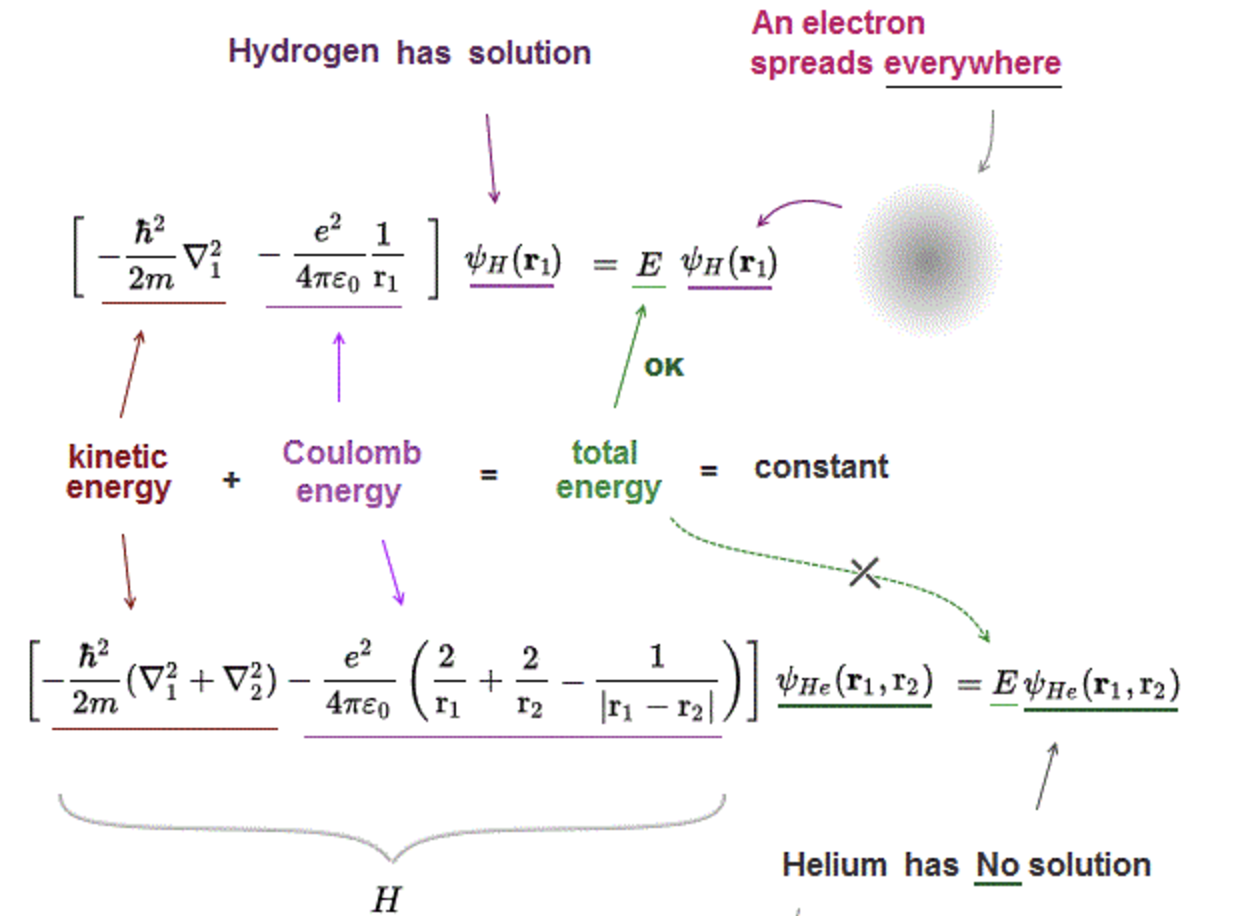
Why Helium Is Hard

  • One extra electron-electron repulsion term couples the coordinates.
  • The coordinates do not separate, so there is no exact analytical solution.
  • We must approximate the many-electron wavefunction.

The Orbital Approximation

  • Build the wavefunction from single-electron orbitals.

\[\Psi(r_1, r_2, \ldots, r_n) \approx \phi_1(r_1)\phi_2(r_2)\cdots\phi_n(r_n)\]

  • Each \(\phi_i(r)\) is an atomic orbital holding one electron.
  • Orbitals come from computation (for example, variationally).

Three Problems With a Plain Product

For helium, \(\Psi(r_1,r_2) \approx \phi_1(r_1)\phi_2(r_2)\) fails because of:

  • Indistinguishability: cannot label “electron 1” with “orbital 1”.
  • Spin: a spin function is needed so the total state is antisymmetric.
  • Correlation: a product assumes electrons move independently.

Antisymmetry Requirement

  • Electrons are fermions: swapping two must flip the sign.

\[\Psi(\ldots, r_m, \ldots, r_n, \ldots) = -\Psi(\ldots, r_n, \ldots, r_m, \ldots)\]

  • Antisymmetrized helium spatial part: \[\Psi(r_1,r_2) \propto \phi_1(r_1)\phi_2(r_2) - \phi_1(r_2)\phi_2(r_1)\]

Spin Pairs With Space

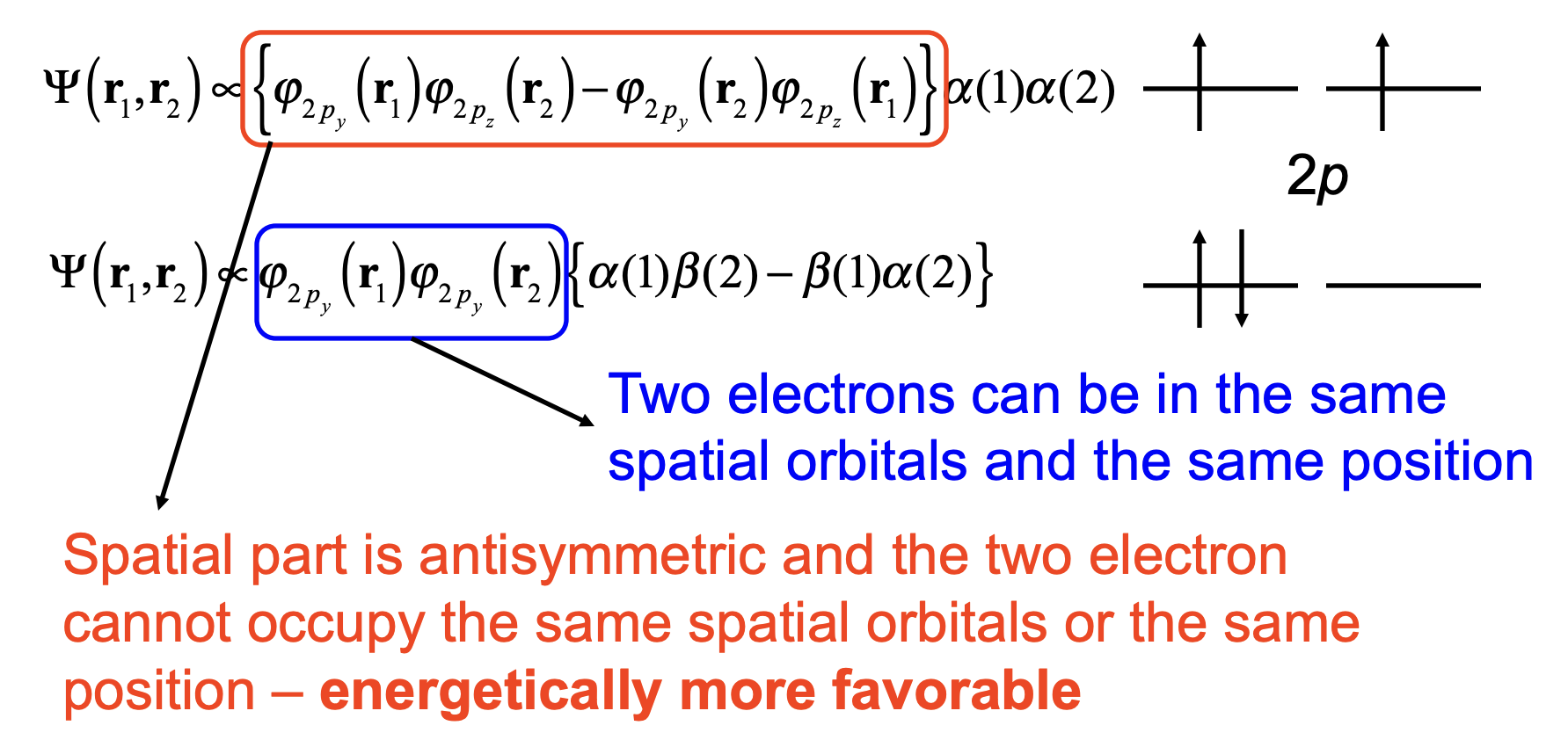
  • Total wavefunction = spatial times spin, and must be antisymmetric.
  • Symmetric space pairs with antisymmetric spin.
  • Antisymmetric space pairs with symmetric spin.
  • This is the Pauli exclusion principle: > No two electrons can possess identical sets of quantum numbers.

Slater Determinant

  • A compact, universal way to enforce antisymmetry.

\[\Psi(r_1,\ldots, r_n) = \frac{1}{\sqrt{n!}} \begin{vmatrix} \chi_1(1) & \chi_2(1) & \cdots & \chi_n(1) \\ \chi_1(2) & \chi_2(2) & \cdots & \chi_n(2) \\ \vdots & \vdots & \ddots & \vdots \\ \chi_1(n) & \chi_2(n) & \cdots & \chi_n(n) \end{vmatrix}\]

  • \(\chi_j(i)\) is a spin-orbital; swapping two rows flips the sign.

Singlets and Triplets

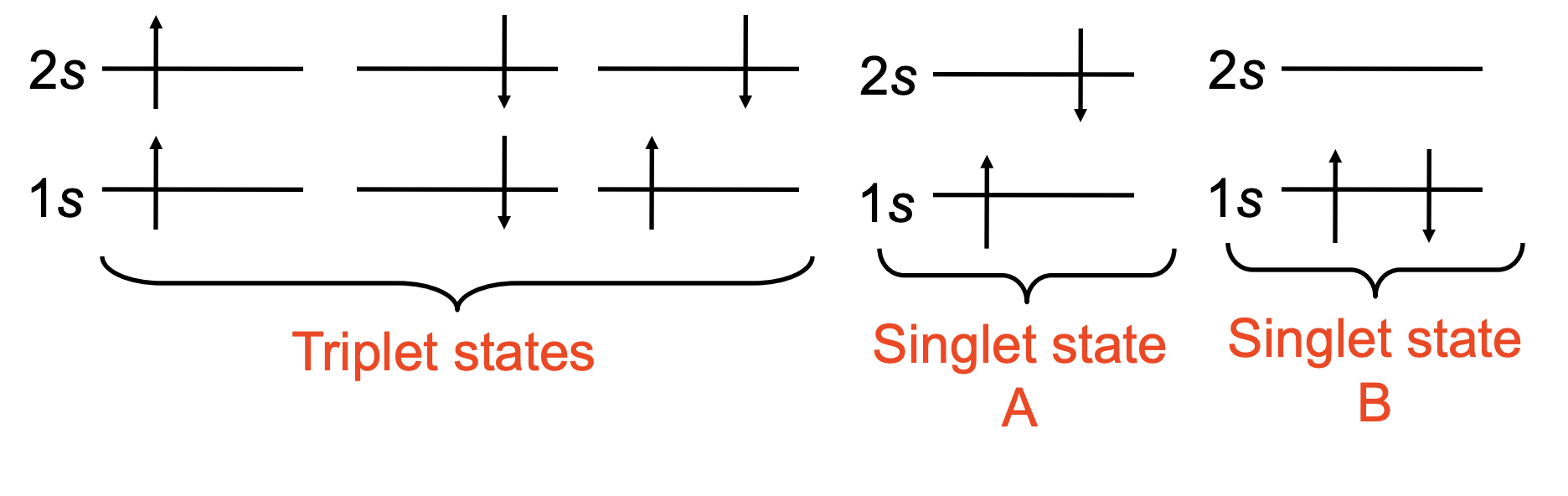
For \(1s2s\) helium, the spatial part is symmetric or antisymmetric:

  • Triplet (\(S=1\)): symmetric spin, antisymmetric space.
  • Singlet (\(S=0\)): antisymmetric spin, symmetric space.

Exchange Stabilization
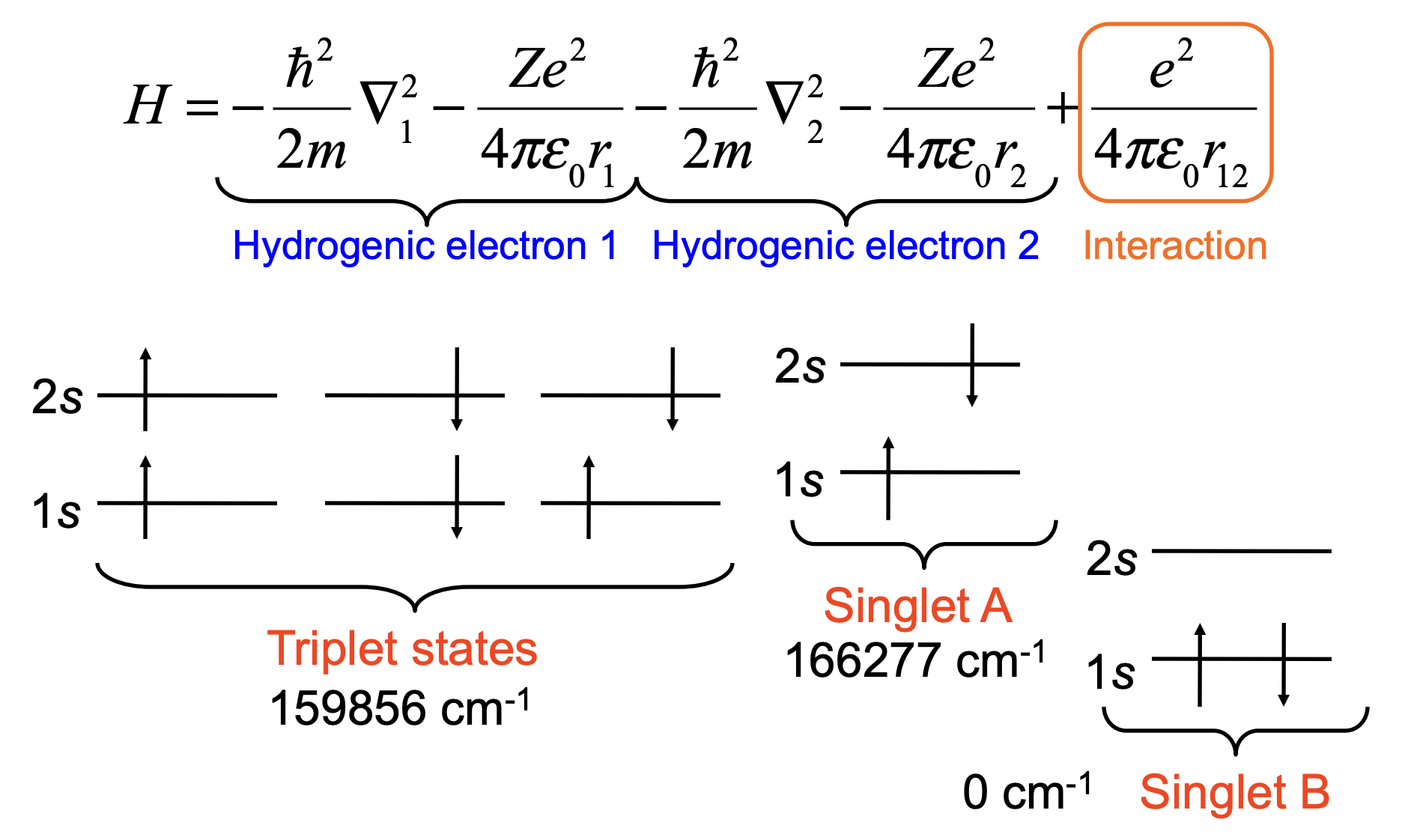
  • Triplet electrons are spatially antisymmetric: they avoid each other, feel less repulsion, lie lower.
  • Singlet electrons overlap more and lie higher.
  • The split is the origin of exchange stabilization.

Coulomb and Exchange Integrals

  • The repulsion energy splits into two kinds of integral.

\[J_{ij} = \int |\phi_i(r_1)|^2 \frac{e^2}{4\pi\epsilon_0 r_{12}} |\phi_j(r_2)|^2 \, d^3r_1 \, d^3r_2\] always positive.

\[K_{ij} = \int \phi_i^*(r_1)\phi_j^*(r_2) \frac{e^2}{4\pi\epsilon_0 r_{12}} \phi_j(r_1)\phi_i(r_2) \, d^3r_1 \, d^3r_2\] purely quantum; lowers the triplet.

The Splitting Made Explicit

\[E_{\text{triplet}} = I(1s) + I(2s) + J(1s,2s) - K(1s,2s)\]

\[E_{\text{singlet}} = I(1s) + I(2s) + J(1s,2s) + K(1s,2s)\]

  • \(J\) shifts both up; \(K\) splits them.
  • Triplet sits lower by \(2K(1s,2s)\).

Filling the Orbitals

  • Aufbau: fill orbitals in order of increasing energy.
  • Pauli: two electrons per orbital, opposite spins.
  • Hund: fill degenerate orbitals singly with parallel spins first.
  • Same exchange stabilization that split helium’s triplet below its singlet.

Takeaway

Multi-electron atoms do not separate, so we build wavefunctions from orbitals made antisymmetric by a Slater determinant. Antisymmetry forces Pauli exclusion, and the exchange integral \(K\) lowers parallel-spin (triplet) states, the origin of exchange stabilization and Hund’s rule.