Angular Momentum and Term Symbols

Chem 3240 · Lecture 7.4

Davit Potoyan

Adding Angular Momenta

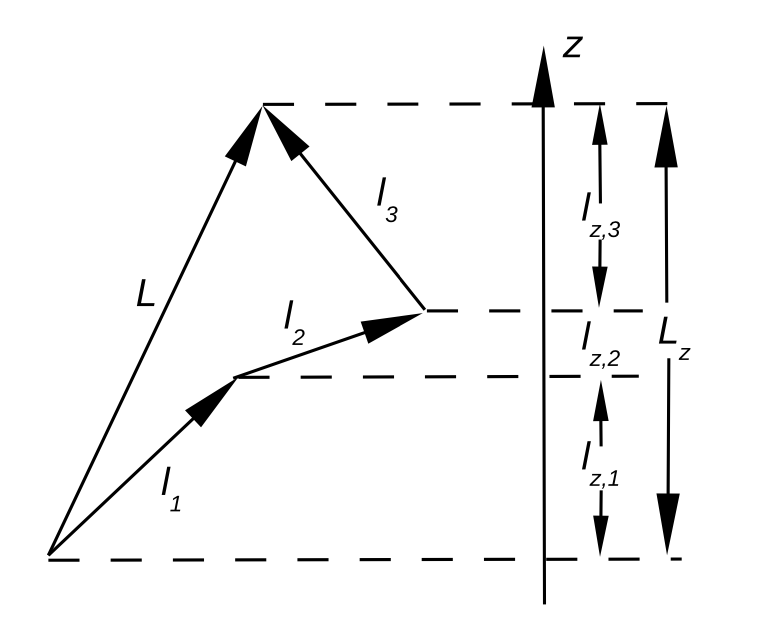
  • Each electron carries orbital and spin angular momentum.
  • They add as vectors, not numbers.

\[\hat{L} = \sum_{i=1}^{N} \hat{l}_i, \qquad M_L = \sum_{i=1}^{N} m_i\]

  • Light atom: neglect spin-orbit for now.

Total Orbital Momentum L

  • Two electrons couple between parallel and antiparallel.

\[L = l_1 + l_2,\; l_1 + l_2 - 1,\; \ldots,\; |l_1 - l_2|\]

  • Two \(p\) electrons: \(L = 2, 1, 0\).
  • State count matches: \(5 + 3 + 1 = 9 = 3^2\).

Total Spin S

  • Same coupling rule for the spins.

\[S = s_1 + s_2,\; s_1 + s_2 - 1,\; \ldots,\; |s_1 - s_2|\]

  • Two electrons: \(S = 1\) (triplet) or \(S = 0\) (singlet).

Total Angular Momentum J

  • Combine orbital and spin: \(\vec{\hat{J}} = \vec{\hat{L}} + \vec{\hat{S}}\).

\[J = L + S,\; L + S - 1,\; \ldots,\; |L - S|\] \[M_J = M_L + M_S\]

  • This is Russell-Saunders (\(LS\)) coupling.
  • Good for the first two rows of the table.

Term Symbols

  • One compact label for a whole group of states.

\[^{2S+1}L_J\]

  • \(2S+1\) is the spin multiplicity (1 singlet, 2 doublet, 3 triplet).
  • \(L\) as a letter: S, P, D, F for \(L = 0, 1, 2, 3\).
  • Only valence electrons matter.

Configurations, Terms, Levels

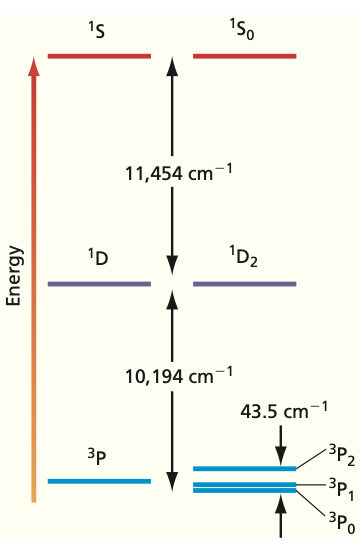
  • One configuration splits into terms (electron repulsion).
  • Each term splits into levels by \(J\) (spin-orbit).
  • Carbon \(2p^2\): \(^3\)P, \(^1\)D, \(^1\)S.

Hund’s Rules

  • Maximum multiplicity \(2S+1\) lies lowest.
  • For equal \(S\), maximum \(L\) lies lowest.
  • For equal \(S\) and \(L\), \(J\) depends on filling:
    • Less than half-filled: smallest \(J\) lowest.
    • More than half-filled: largest \(J\) lowest.
  • Carbon ground state: \(^3\)P\(_0\).

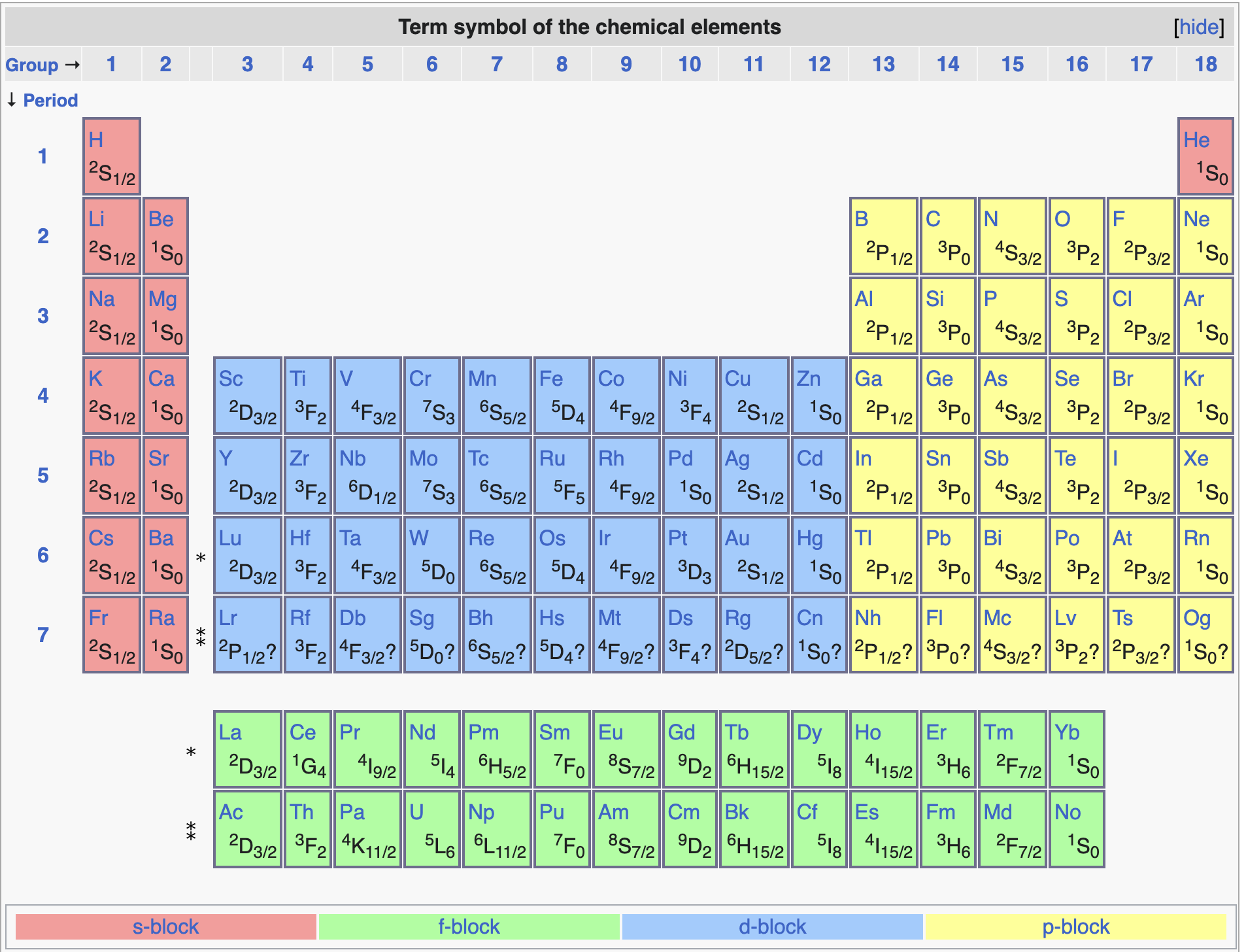
Ground Terms Across the Table

  • Every element’s ground state is a single term symbol.
  • Read straight off Hund’s rules.

Spin-Orbit Interaction

  • A relativistic term couples \(\vec{L}\) and \(\vec{S}\):

\[\hat{H}_{SO} = A\,\vec{\hat{L}}\cdot\vec{\hat{S}}\]

\[\vec{\hat{L}}\cdot\vec{\hat{S}} = \tfrac{1}{2}\left[J(J+1)-L(L+1)-S(S+1)\right]\]

  • Larger for heavy atoms; only \(J\) stays a good quantum number.

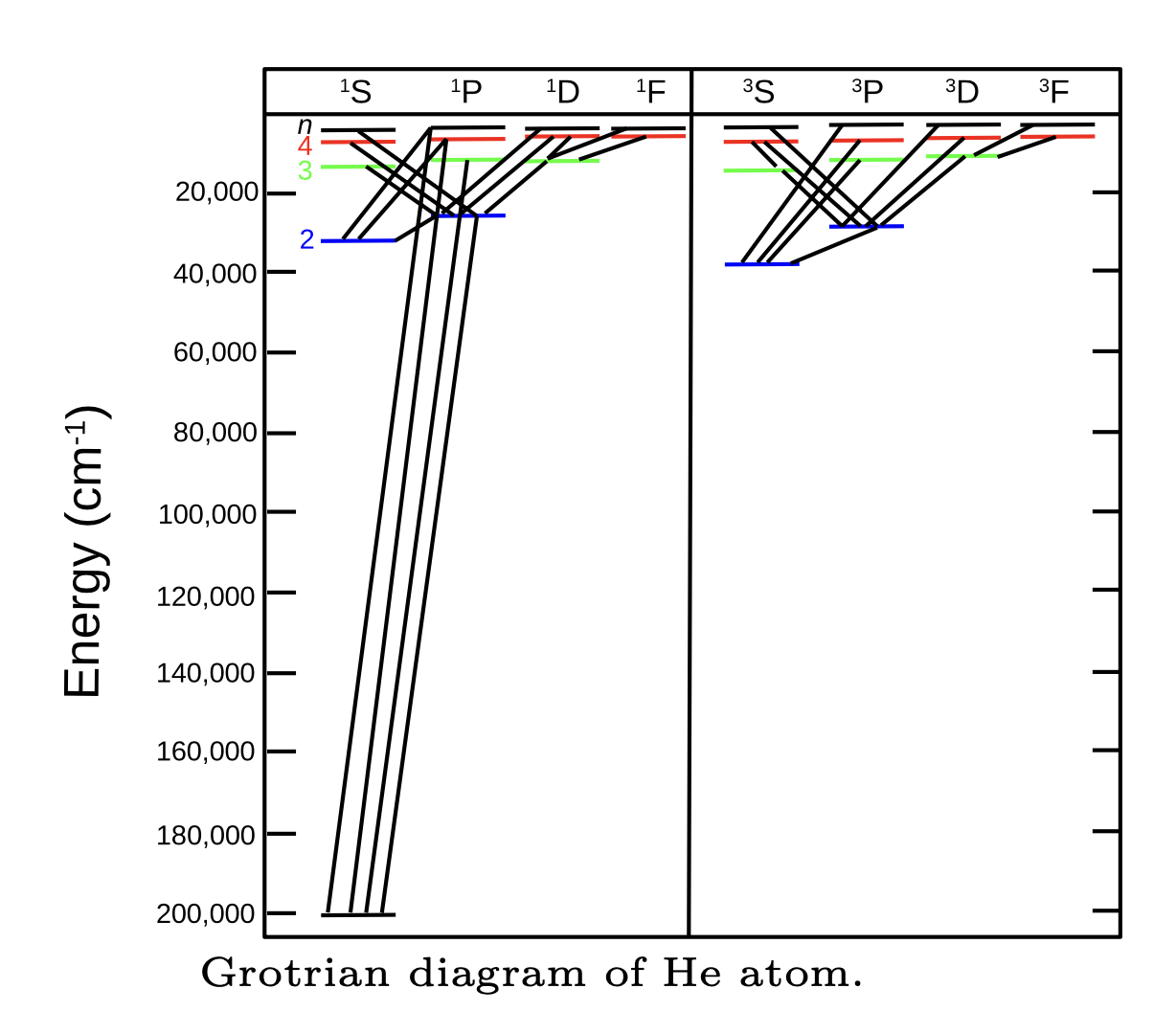
Selection Rules

  • \(\Delta L = 0, \pm 1\) (not \(0 \to 0\)).
  • \(\Delta l = \pm 1\) for the active electron.
  • \(\Delta J = 0, \pm 1\) (not \(0 \to 0\)).
  • \(\Delta S = 0\) (spin does not flip).
  • Violations are forbidden: weak, long-lived metastable states.

Takeaway

Couple the electron momenta as vectors to get \(L\), \(S\), and \(J\), pack them into a term symbol \(^{2S+1}L_J\), and let Hund’s rules pick the ground state. Spin-orbit coupling splits terms into levels, and selection rules decide which transitions you actually see.