The Born-Oppenheimer Approximation

Chem 3240 · Lecture 8.1

Davit Potoyan

From Atoms to Molecules

  • Multi-electron methods worked for atoms.
  • Molecules add a new problem: moving nuclei.
  • One idea makes it tractable: separate the fast electrons from the slow nuclei.
  • This is the Born-Oppenheimer (BO) approximation.

The Simplest Molecule

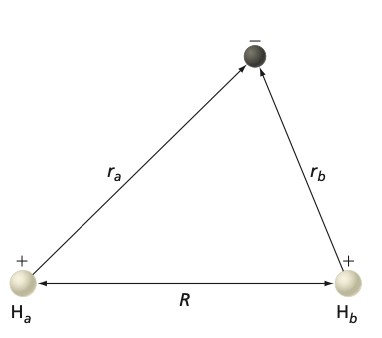
  • \(H_2^+\): one electron, two protons.
  • Cleanest model of a chemical bond.
  • Electron at \(\vec{r}_1\), protons at \(\vec{R}_A\), \(\vec{R}_B\).
  • Internuclear distance \(R = |\vec{R}_A - \vec{R}_B|\).

The Full Hamiltonian

  • Kinetic energy of both nuclei and electron, plus Coulomb terms.

\[\hat{H} = -\frac{\hbar^2}{2M}(\Delta_A + \Delta_B) - \frac{\hbar^2}{2m_e}\Delta_e + \frac{e^2}{4\pi\epsilon_0}\left(\frac{1}{R} - \frac{1}{r_{1A}} - \frac{1}{r_{1B}}\right)\]

  • Wavefunction depends on all coordinates: \(\psi(\vec{r}_1, \vec{R}_A, \vec{R}_B)\).

The Key Insight: Mass

  • Proton mass \(M\) is about 1800 times the electron mass \(m_e\).
  • Electrons are fast and light; nuclei are slow and heavy.
  • Electrons adjust instantly to any nuclear position.
  • So freeze the nuclei, then solve for the electron.

Separating the Wavefunction

  • Split into an electronic and a nuclear part.

\[\psi(\vec{r}_1, \vec{R}_A, \vec{R}_B) = \psi_e(\vec{r}_1, R)\,\psi_n(\vec{R}_A, \vec{R}_B)\]

  • \(\psi_e\) depends on \(R\) as a parameter, not a variable.
  • \(\psi_n\) further splits into vibration, rotation, translation.

The Electronic Schrodinger Equation

\[\hat{H}_e\,\psi_e = E_e\,\psi_e\]

\[\hat{H}_e = -\frac{\hbar^2}{2m_e}\Delta_e + \frac{e^2}{4\pi\epsilon_0}\left(\frac{1}{R} - \frac{1}{|r_1 - R_A|} - \frac{1}{|r_1 - R_B|}\right)\]

  • No nuclear kinetic energy: the nuclei are frozen.
  • One equation for each value of \(R\).

R is a Parameter, Not a Variable

  • Solve the electronic problem at a fixed geometry.
  • Both the energy and the orbital depend on \(R\): \[E_e = E_e(R), \qquad \psi_e = \psi_e(R)\]
  • Change \(R\), get a new energy and a new wavefunction.

The Potential Energy Surface

  • Sweep \(R\) across many fixed geometries.
  • Each solution gives one point \(E_e(R)\).
  • Together they trace the potential energy surface.
  • The nuclei then move on this surface.
  • This is what makes electronic structure tractable.

Molecular Orbitals

  • The single-electron wavefunctions of a molecule.
  • Called molecular orbitals (MOs).
  • The molecular analog of atomic orbitals.
  • Each geometry \(R\) gives its own set of MOs.

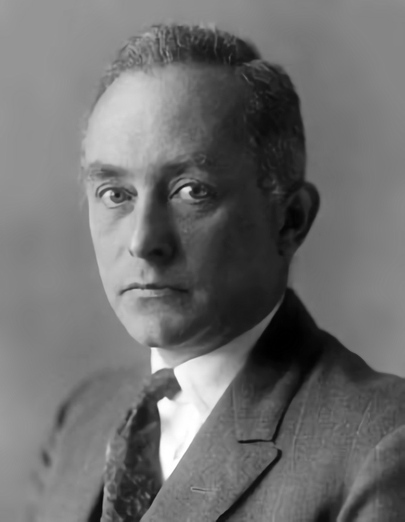
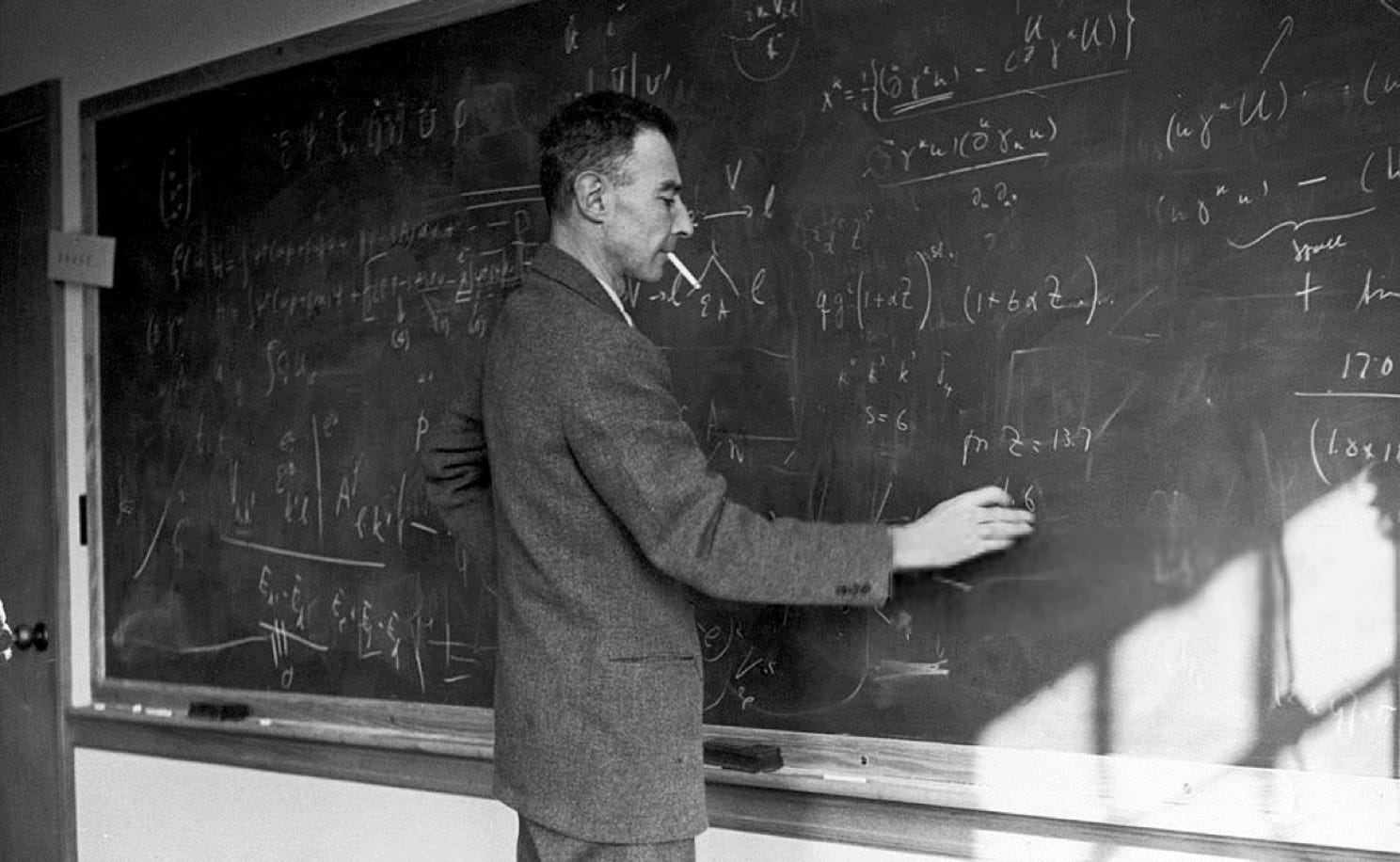
Born and Oppenheimer

Max Born

Robert J. Oppenheimer

  • Their 1927 separation underpins all of molecular quantum chemistry.

Takeaway

Because nuclei are far heavier than electrons, the molecular wavefunction separates into electronic and nuclear parts. Solving \(\hat{H}_e\psi_e = E_e\psi_e\) at each fixed nuclear geometry \(R\) yields molecular orbitals and traces the potential energy surface on which the nuclei move.