The Hydrogen Molecule Ion
Chem 3240 · Lecture 8.2
Building MOs from AOs
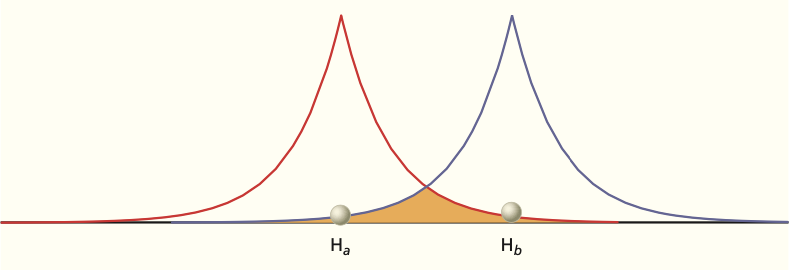
- Combine two hydrogen 1s orbitals.
\[\psi_{\pm} = c\,\big(1s_A \pm 1s_B\big)\]
- This is the LCAO approximation.
- Identical nuclei force \(c_1 = c_2 \equiv c\) by symmetry.
Where the Electron Goes
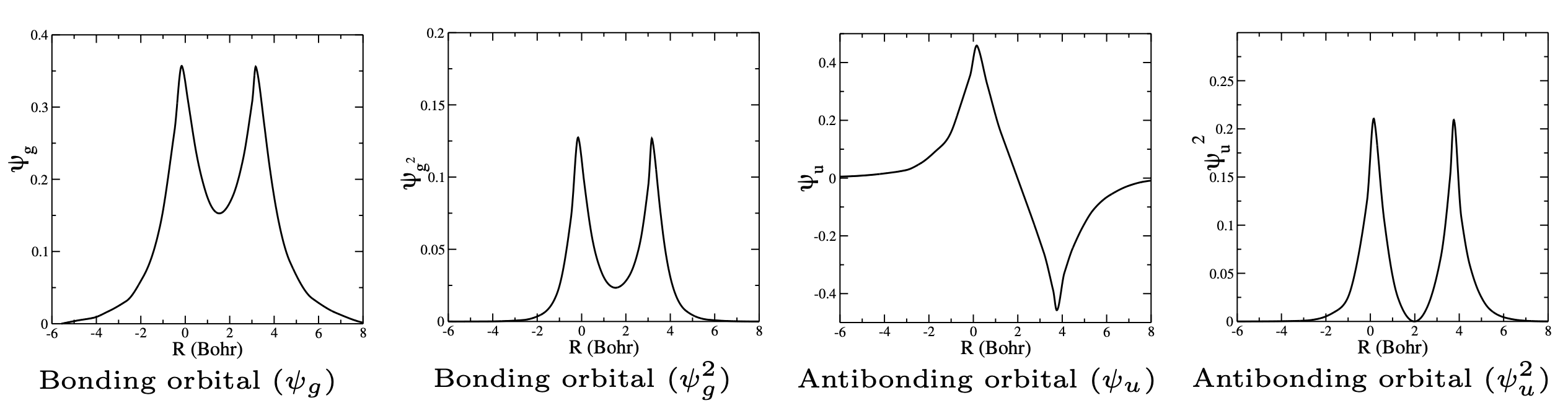
Bonding \((+)\): density piled up between the nuclei.
Antibonding \((-)\): density scooped out, a node at the midpoint.
This buildup of charge glues the nuclei together.
Energy vs Internuclear Distance
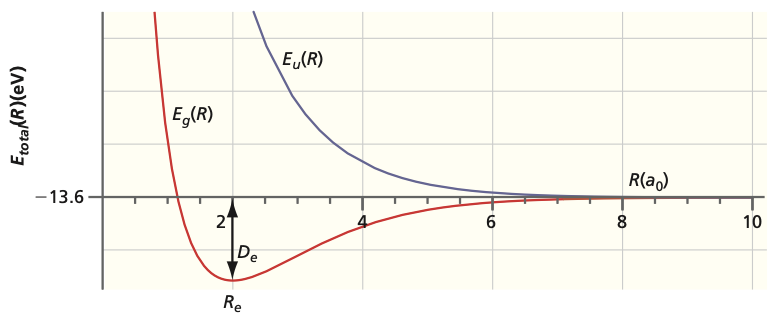
\(E_g\) has a minimum: a stable bond.
\(E_u\) is repulsive at all \(R\): a purely excited state.
Crude model: bond length 132 pm vs 106 pm experiment.
Improved by adding more terms to the LCAO.
The MO Diagram
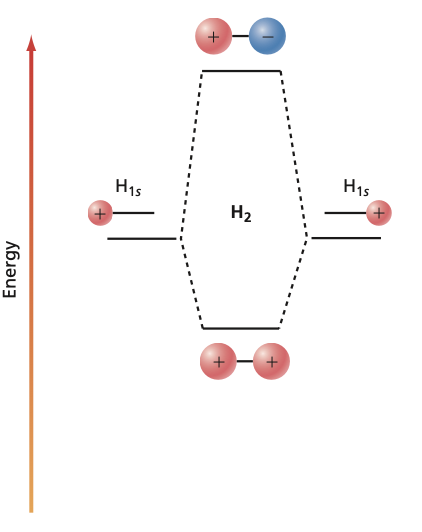
Two AOs split into a lower \(\sigma_g\) and a higher \(\sigma_u^{*}\).
\(\sigma\): zero angular momentum about the axis, \(\lambda = 0\).
\(\pi\) orbitals from \(p_{x,y}\) are doubly degenerate.
Same recipe scales to all homonuclear diatomics.