Electronic Structure of Polyatomic Molecules
Chem 3240 · Lecture 8.4
The Non-Crossing Rule
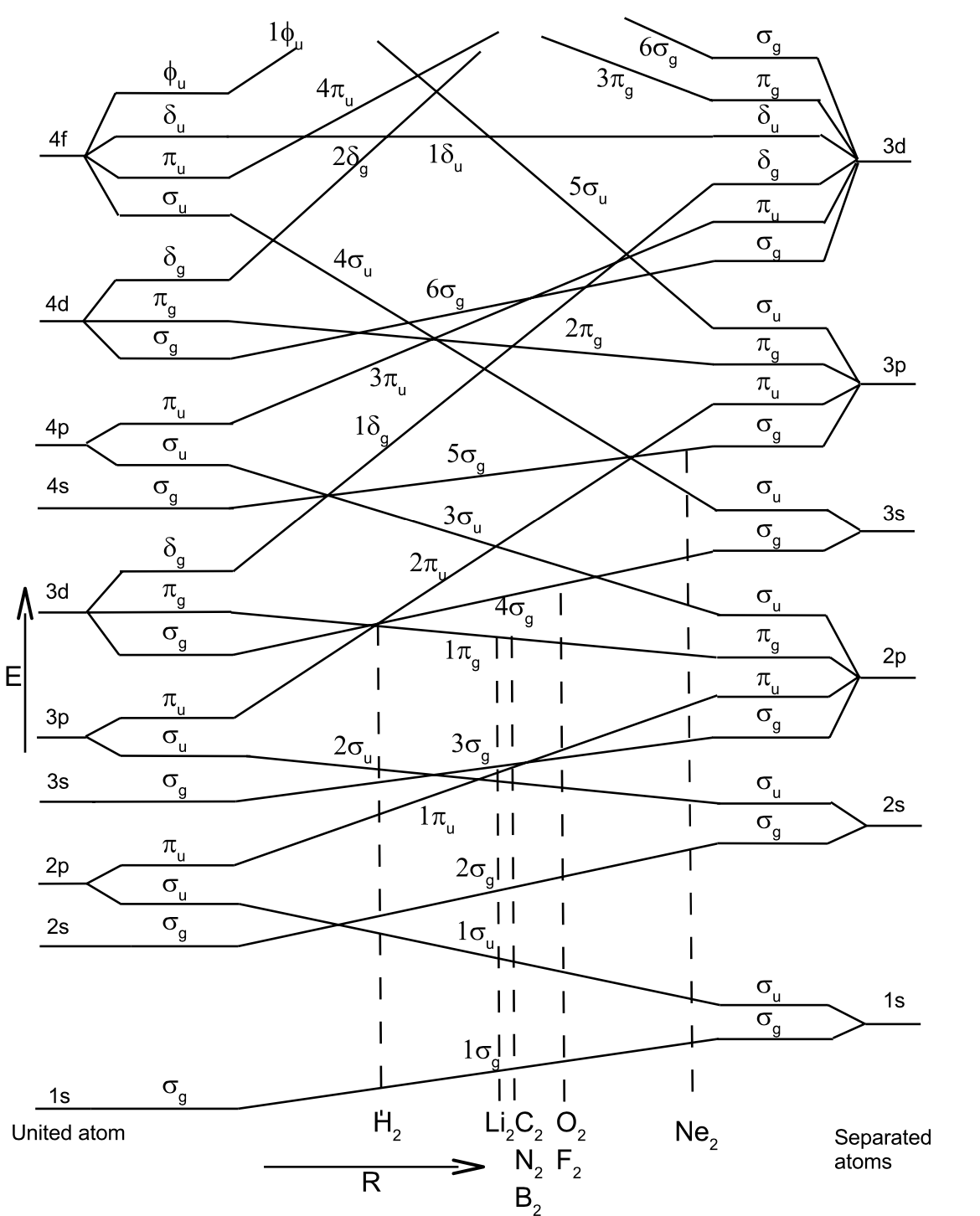
States of the same symmetry never cross.
As \(R\) changes, same-symmetry levels avoid each other.
Sorts orbitals into clean bonding / antibonding ladders.
sp Hybrids: \(BeH_2\)
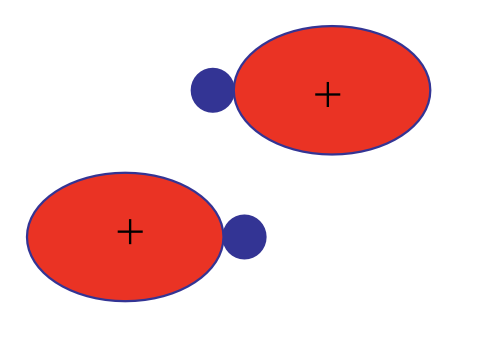
\[\psi_{sp}^1 = \tfrac{1}{\sqrt{2}}(2s + 2p_z)\]
\[\psi_{sp}^2 = \tfrac{1}{\sqrt{2}}(2s - 2p_z)\]
- One \(s\) plus one \(p\) give two hybrids.
- Geometry is linear: H-Be-H.
sp3 Hybrids: \(CH_4\)
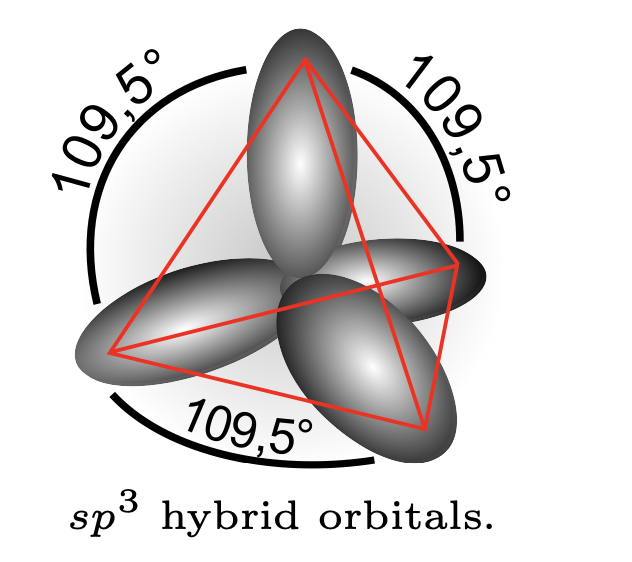
\[\psi^1_{sp^3} = \tfrac{1}{2}(2s + 2p_x + 2p_y + 2p_z)\]
One \(s\) plus three \(p\) give four hybrids.
Geometry is tetrahedral.
Count is conserved: orbitals in = hybrids out.
Reading an MO Diagram
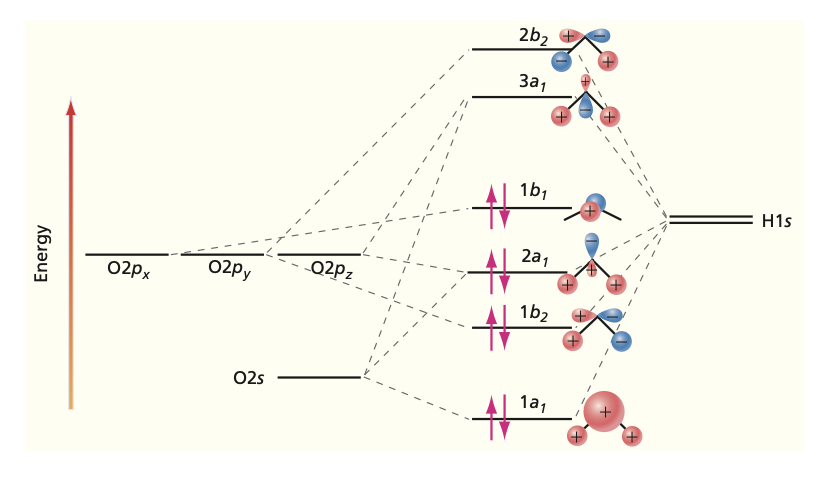
Atomic orbitals on the sides, molecular orbitals in the middle.
Bonding orbitals drop below the atomic levels.
Antibonding rise above.