Huckel Molecular Orbital Theory

Chem 3240 · Lecture 8.5

Davit Potoyan

Why Conjugated Systems Need a New Approach
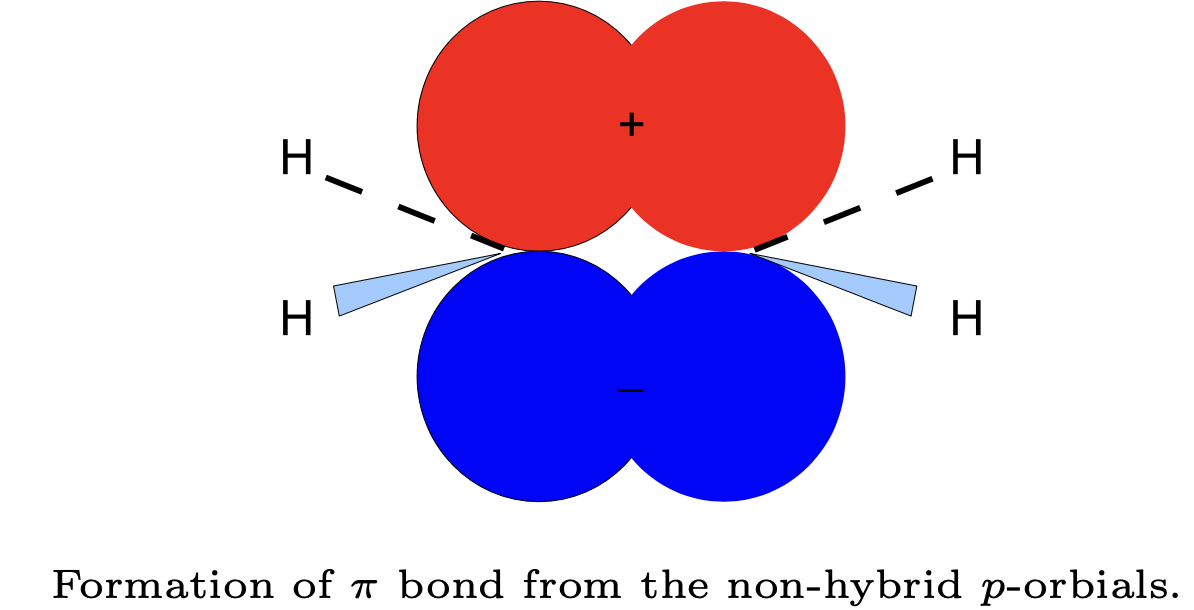
  • \(\pi\) electrons are delocalized over the whole molecule.
  • Localized valence bond pictures fail for benzene.
  • We need a model built for delocalization.

The Huckel Idea

  • Treat the \(\pi\) electrons independently of the \(\sigma\) framework.
  • Each \(\pi\) MO is a linear combination of carbon \(2p\) orbitals.

\[\psi = c_1\phi_1 + c_2\phi_2 + \cdots\]

  • The variational principle gives a secular determinant to solve.

The Three Huckel Approximations

  1. Overlaps \(S_{ij}=0\) unless \(i=j\), where \(S_{ii}=1\).
  1. All diagonal elements \(H_{ii}=\alpha\), the Coulomb integral.
  1. Off-diagonal \(H_{ij}=\beta\) only for neighboring atoms, else \(0\). This is the resonance integral.
  • \(\alpha\) and \(\beta\) are empirical: no Hamiltonian needed.

Ethylene: The Simplest Case

  • Two carbons, one neighboring pair. The secular determinant is

\[\begin{vmatrix}\alpha - E & \beta\\ \beta & \alpha - E\\ \end{vmatrix} = 0\]

  • Expanding gives a quadratic with roots \[E = \alpha \pm \beta\]
  • Since \(\beta < 0\), the bonding level is \(E_1 = \alpha + \beta\).

Ethylene MOs and Energy

  • Substituting each \(E\) back gives the normalized orbitals:

\[\psi_1 = \tfrac{1}{\sqrt{2}}(\phi_1 + \phi_2), \qquad \psi_2 = \tfrac{1}{\sqrt{2}}(\phi_1 - \phi_2)\]

  • Two \(\pi\) electrons fill \(\psi_1\): \(E_{tot} = 2\alpha + 2\beta\).
  • Excitation energy \(= 2|\beta|\), measurable by UV/VIS.

HOMO and LUMO

  • HOMO: highest occupied molecular orbital.
  • LUMO: lowest unoccupied molecular orbital.
  • The HOMO-LUMO gap sets the lowest electronic excitation.
  • For ethylene that gap is exactly \(2|\beta|\).

Butadiene: Build the Matrix

  • Number the carbons \(1\,2\,3\,4\); neighbors get a \(\beta\).
  • Divide each row by \(\beta\) and set \(x = (\alpha - E)/\beta\):

\[\begin{vmatrix} x & 1 & 0 & 0\\ 1 & x & 1 & 0\\ 0 & 1 & x & 1\\ 0 & 0 & 1 & x\\ \end{vmatrix} = 0\]

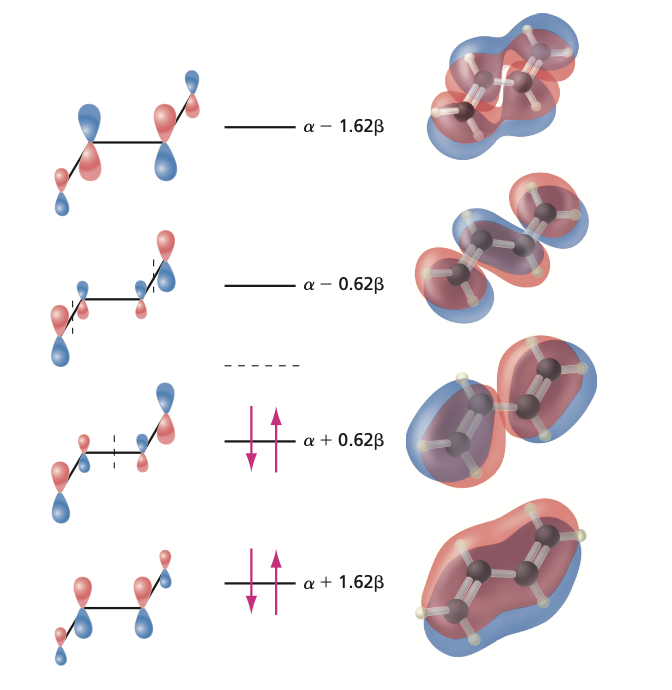
  • Expanding: \(x^4 - 3x^2 + 1 = 0\), with \(x = \pm 0.618,\ \pm 1.618\).

Butadiene: Four Levels

\[E_1 = \alpha + 1.618\beta\] \[E_2 = \alpha + 0.618\beta\] \[E_3 = \alpha - 0.618\beta\] \[E_4 = \alpha - 1.618\beta\]

  • Four electrons fill \(E_1, E_2\): \[E_\pi = 4\alpha + 4.472\beta\]

Resonance Stabilization

  • Delocalized \(\pi\) energy: \(E_\pi = 4\alpha + 4.472\beta\).
  • Two isolated double bonds would give \(4\alpha + 4\beta\).
  • The extra \(0.472\beta\) is the resonance stabilization energy.
  • Delocalization lowers the total \(\pi\) energy.

Benzene: Aromatic Stabilization

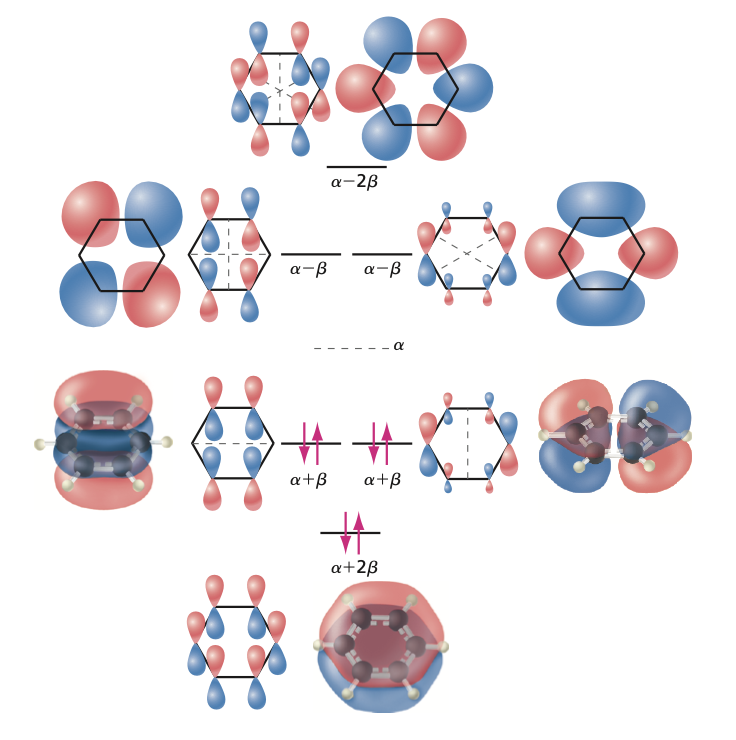
\[E_1 = \alpha + 2\beta\] \[E_2 = E_3 = \alpha + \beta\] \[E_4 = E_5 = \alpha - \beta\] \[E_6 = \alpha - 2\beta\]

  • Six electrons fill the lowest three: \(E_\pi = 6\alpha + 8\beta\).
  • Three ethylenes give \(6\alpha + 6\beta\): benzene gains an extra \(2\beta\).

Symmetry and Degeneracy

  • Benzene’s ring symmetry forces degenerate pairs: \(E_2 = E_3\) and \(E_4 = E_5\).
  • High symmetry produces shared energy levels, just as in the 3D box.
  • The \(2\beta\) bonus is the quantum origin of aromaticity.

Takeaway

Huckel theory reduces the \(\pi\) system to a matrix of just two empirical numbers, \(\alpha\) and \(\beta\). Diagonalizing it gives the orbital energies, and the extra binding beyond isolated double bonds (an extra \(2\beta\) for benzene) is the quantum origin of resonance and aromatic stabilization.