Dipole Moments and Ionic Bonding

Chem 3240 · Lecture 8.6

Davit Potoyan

The Electric Dipole Moment

  • A dipole measures the asymmetry of a charge distribution.

\[\vec{\mu} = \sum_{i=1}^{N} Q_i\,\vec{r_i}\]

  • A vector pointing from negative to positive charge.
  • SI units of C m; often quoted in debye (D).

Dipole as an Expectation Value

  • For a molecule, take the expectation value of the dipole operator.

\[\hat{\mu}_x = \sum_{i=1}^{N} Q_i x_i, \quad \hat{\mu}_y = \sum_{i=1}^{N} Q_i y_i, \quad \hat{\mu}_z = \sum_{i=1}^{N} Q_i z_i\]

\[\left\langle \vec{\hat{\mu}} \right\rangle = \int \psi^* \, \vec{\hat{\mu}} \, \psi \, d\tau\]

Ionic versus Covalent

  • Similar electronegativity: orbitals spread evenly, a covalent bond.
  • Different electronegativity: orbitals lopsided, ionic character and a permanent dipole.
  • Neither pure ionic nor pure covalent bonds truly exist.

When Is a Bond Ionic? (LiF)

  • Compare the cost of electron transfer.
  • Li ionization energy \(\approx 5.4\) eV, F electron affinity \(\approx 3.5\) eV.
  • Difference of only 1.9 eV, so ionic bonding is favorable.
  • Contrast the C-H bond: the gap exceeds 10 eV, so it stays covalent.

The Ionic Binding Curve

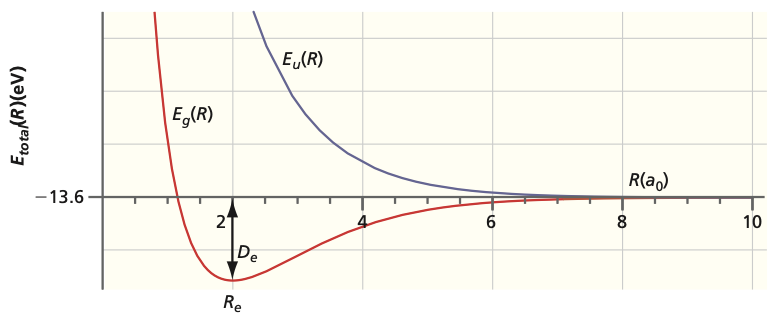
  • Coulomb attraction at long range pulls the ions together.

\[E(R) = \frac{Q_1 Q_2}{4\pi\epsilon_0 R} + b\,e^{-aR}\]

  • Short-range Pauli repulsion sets the minimum at \(R_e\).

Why the Short-Range Repulsion?
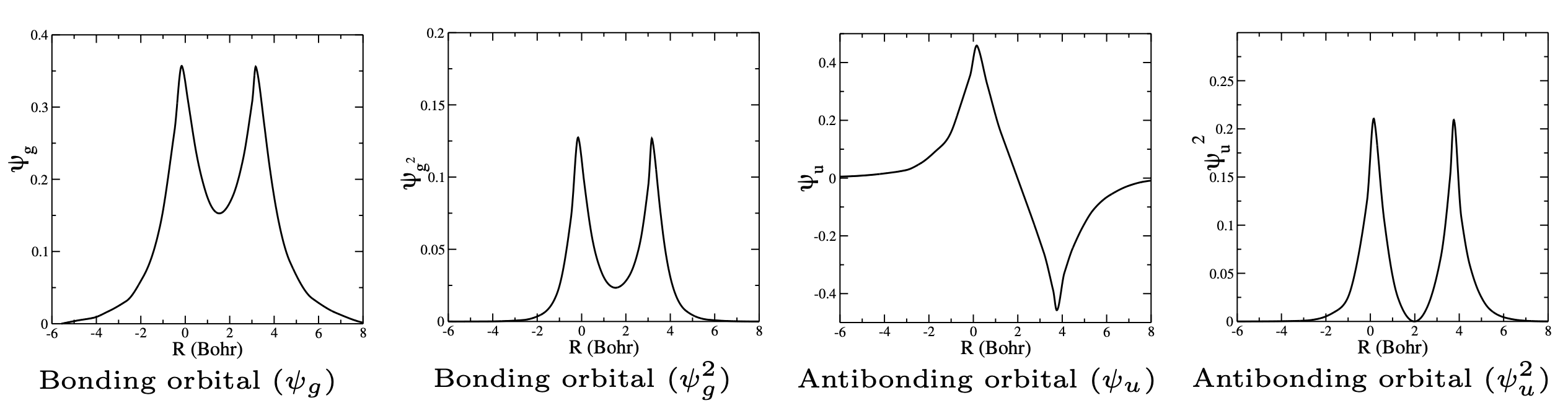
  • Close in, filled orbitals overlap.
  • Both bonding and antibonding orbitals fill.
  • Antibonding repulsion outweighs bonding attraction.
  • This is the Pauli repulsion term \(b\,e^{-aR}\).

Dissociation Goes to Atoms

  • An avoided crossing switches ionic to covalent on the way out.
  • The molecule breaks into neutral atoms, not ions.

\[D_e(\text{MX} \to \text{M} + \text{X}) = D_e(\text{MX} \to \text{M}^+ + \text{X}^-) - E_{ea}(\text{X})\]

Intermolecular Forces

  • Even with no chemical bond, molecules attract weakly.
  • Three weak attractions, all scaling as \(1/R^6\):
    • Dipole-dipole (Keesom)
    • Dipole-induced-dipole
    • Dispersion (London)
  • Balanced by Pauli repulsion at short range.

The Three \(1/R^6\) Attractions

  • Dipole-dipole, thermally averaged: \[\langle V \rangle_{dd} = -\frac{2}{3kT}\left(\frac{\mu_A \mu_B}{4\pi\epsilon_0}\right)^2 \frac{1}{R^6}\]
  • Dispersion needs no permanent dipole: \[\langle V \rangle_{disp} = -\frac{3}{2}\left(\frac{E_A E_B}{E_A + E_B}\right)\frac{\alpha_A \alpha_B}{(4\pi\epsilon_0)^2}\frac{1}{R^6}\]

The Lennard-Jones Potential

  • Combine \(1/R^6\) attraction with a steep repulsion.

\[V(R) = 4\epsilon\left[\left(\frac{\sigma}{R}\right)^{12} - \left(\frac{\sigma}{R}\right)^{6}\right]\]

  • \(R^{-12}\) is Pauli repulsion, \(R^{-6}\) is van der Waals binding.
  • Well depth \(\epsilon\) sits at \(R_e = 2^{1/6}\sigma\).

Takeaway

A dipole is the expectation value of \(\sum_i Q_i \vec{r_i}\); an ionic bond is Coulomb attraction \(Q_1 Q_2/4\pi\epsilon_0 R\) tamed by Pauli repulsion, and weak \(1/R^6\) forces plus that repulsion give the Lennard-Jones potential \(4\epsilon[(\sigma/R)^{12} - (\sigma/R)^{6}]\).