Trigonometry and Complex Numbers
Chem 3240 · Appendix A.2
One theme: rotation in a plane
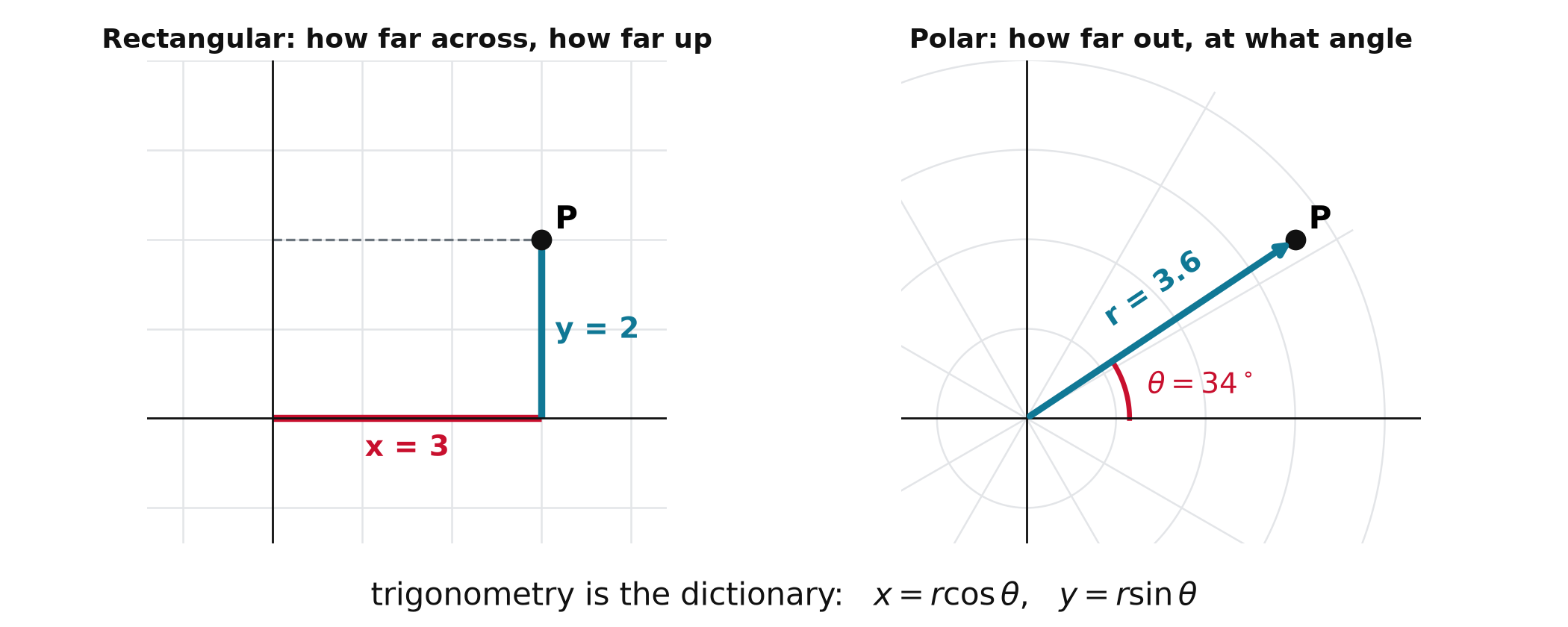
- One point, two ways to name it: across and up, or out and around
- Trigonometry converts between them; complex numbers make the second one algebra
Sine and cosine are coordinates
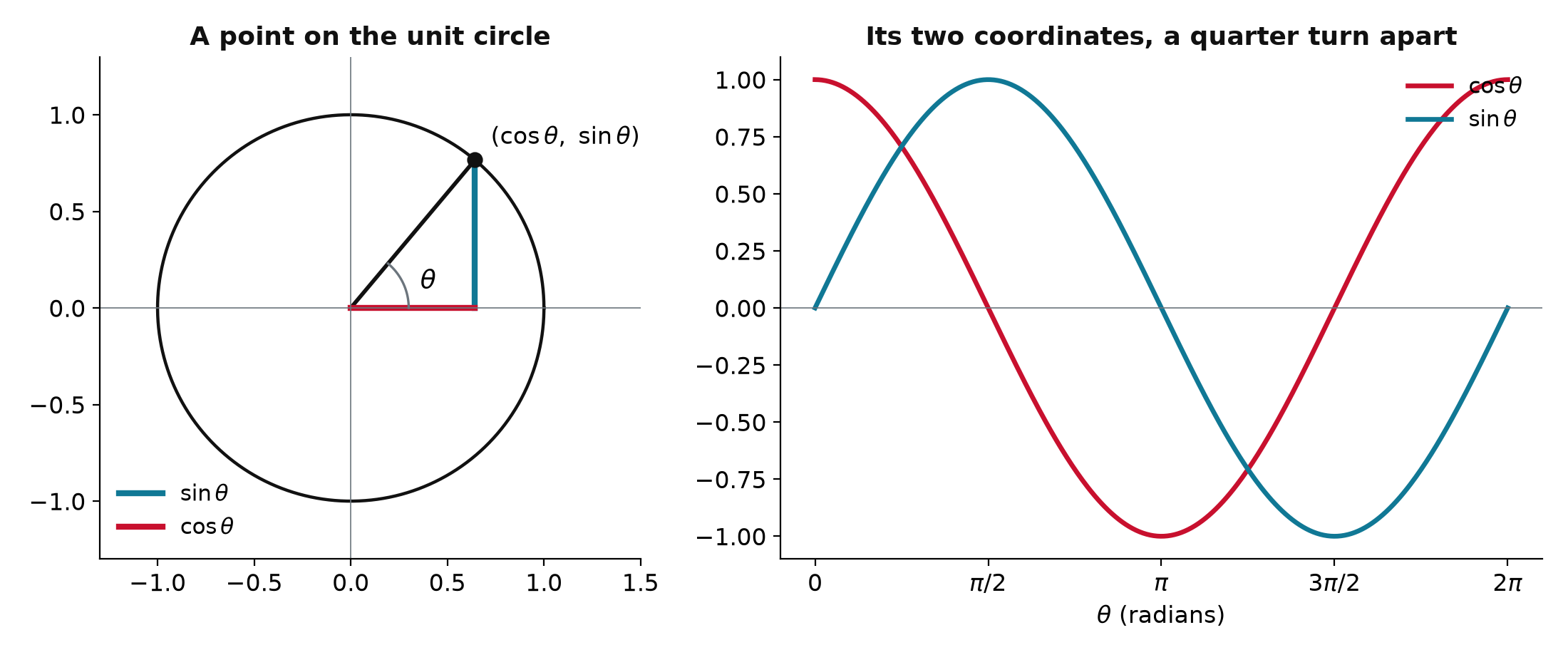
- Rotate a point on the unit circle by \theta radians: x = \cos\theta, y = \sin\theta
- A full turn is 2\pi; each function is the other shifted by a quarter turn
Complex numbers live in 2D
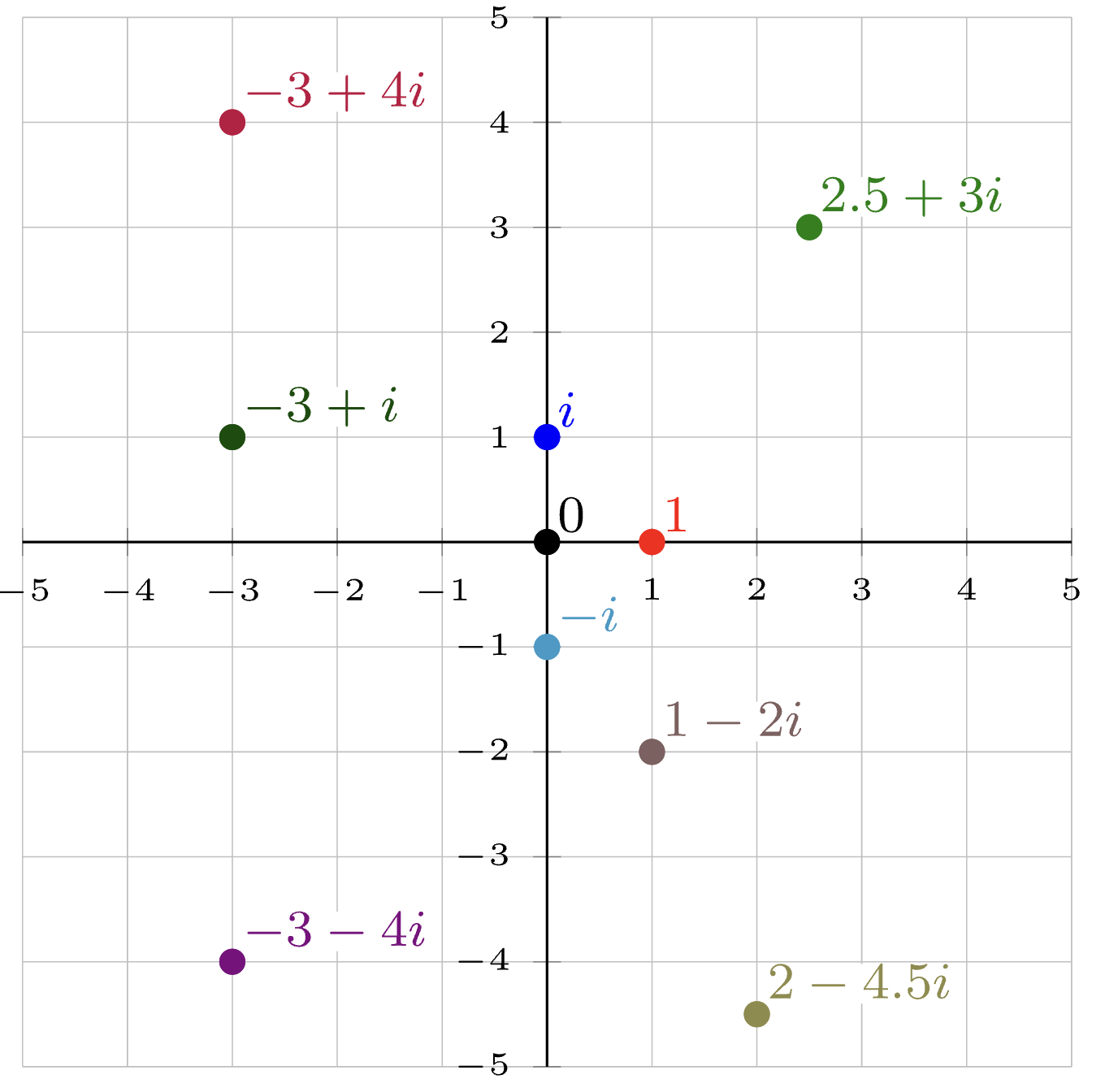
- x^2 + 1 = 0 has no real root, so extend the line to a plane with one new symbol, i^2 = -1
z = x + iy, \qquad x = \operatorname{Re} z,\ \ y = \operatorname{Im} z
- A complex number is a point in a plane: real part across, imaginary part up
- 3 + 2i, -2i, and 1.1 are all complex numbers
Why we needed i: every root, every time
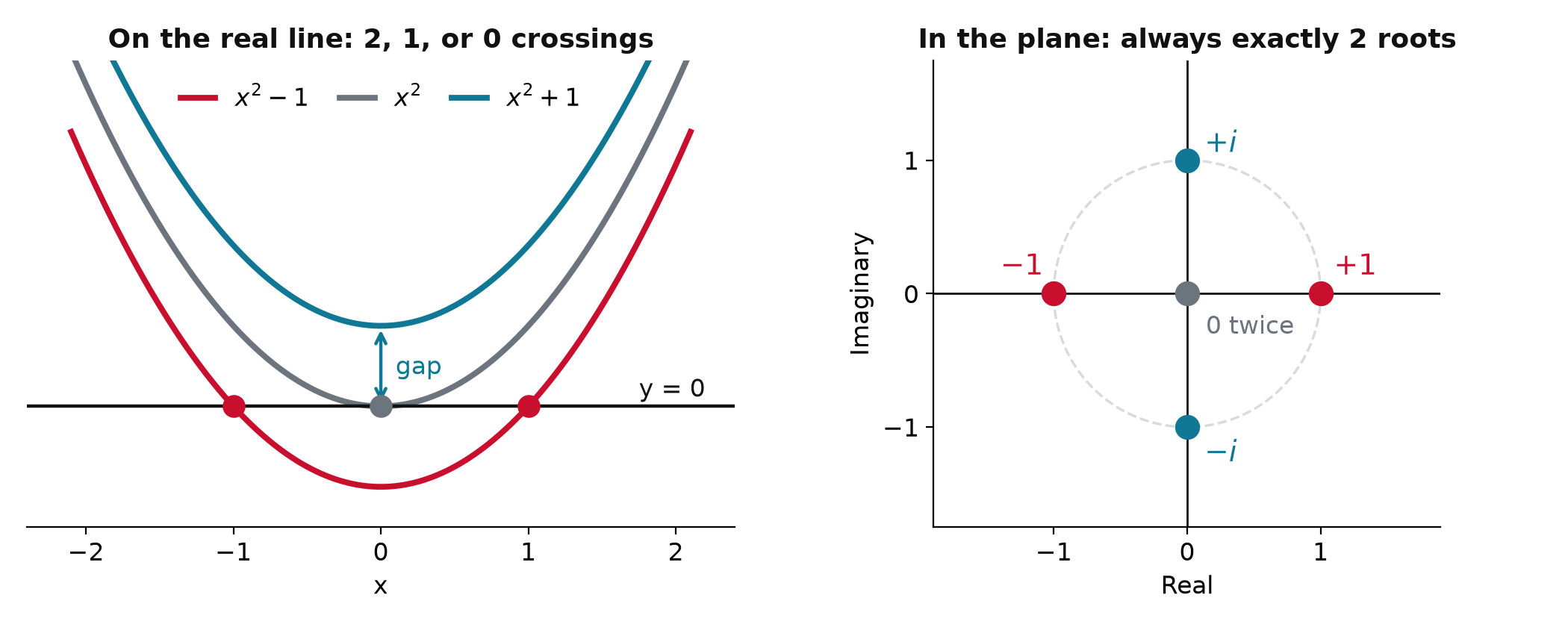
- Lift the parabola and the crossings vanish, but the roots do not: they step off the line
- Fundamental theorem of algebra: degree n means exactly n complex roots, always
Polar form and Euler’s formula
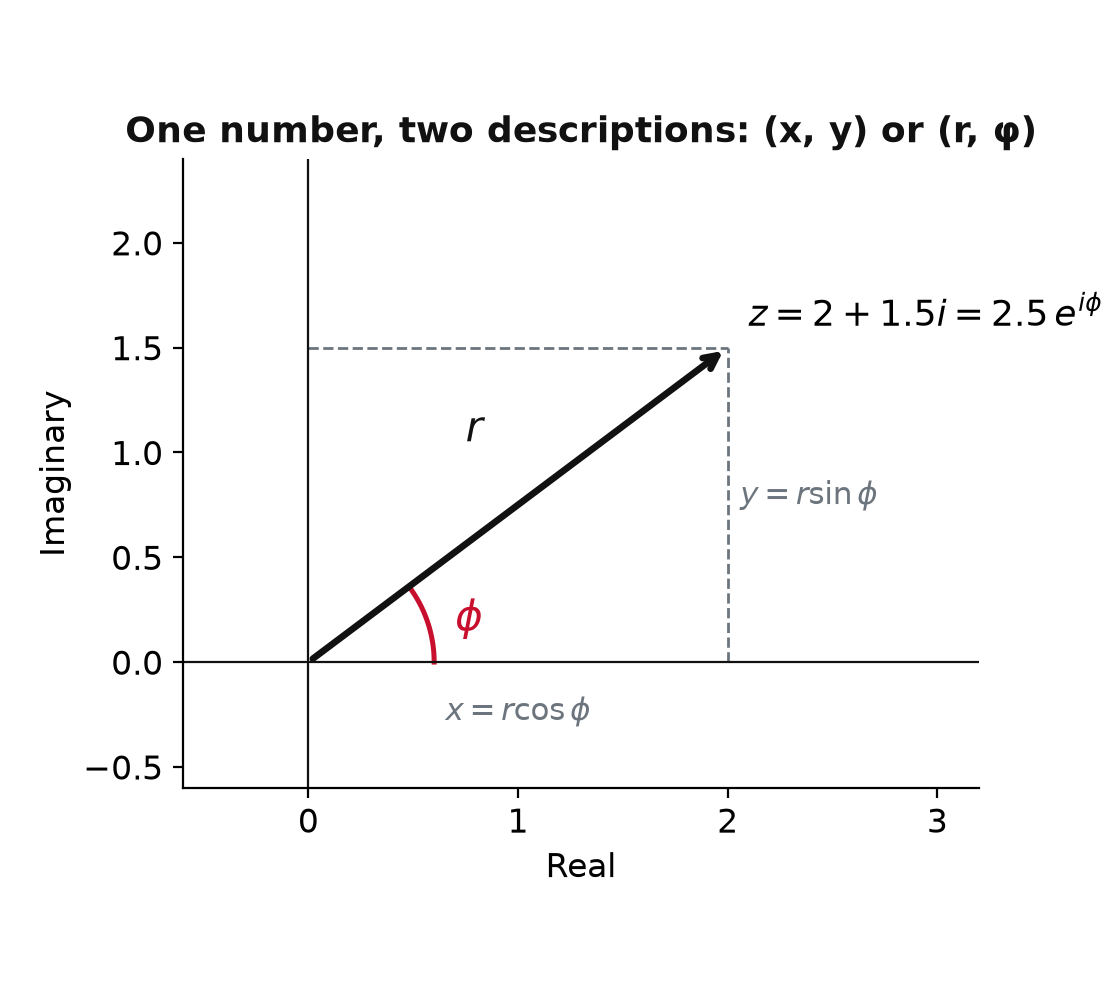
Locate z by its distance r and angle \phi
x = r\cos\phi, \qquad y = r\sin\phi
e^{i\phi} = \cos\phi + i\sin\phi
z = r(\cos\phi + i\sin\phi) = r\,e^{i\phi}
- r = \sqrt{x^2 + y^2} is the magnitude, \phi the phase
Multiplication is rotation
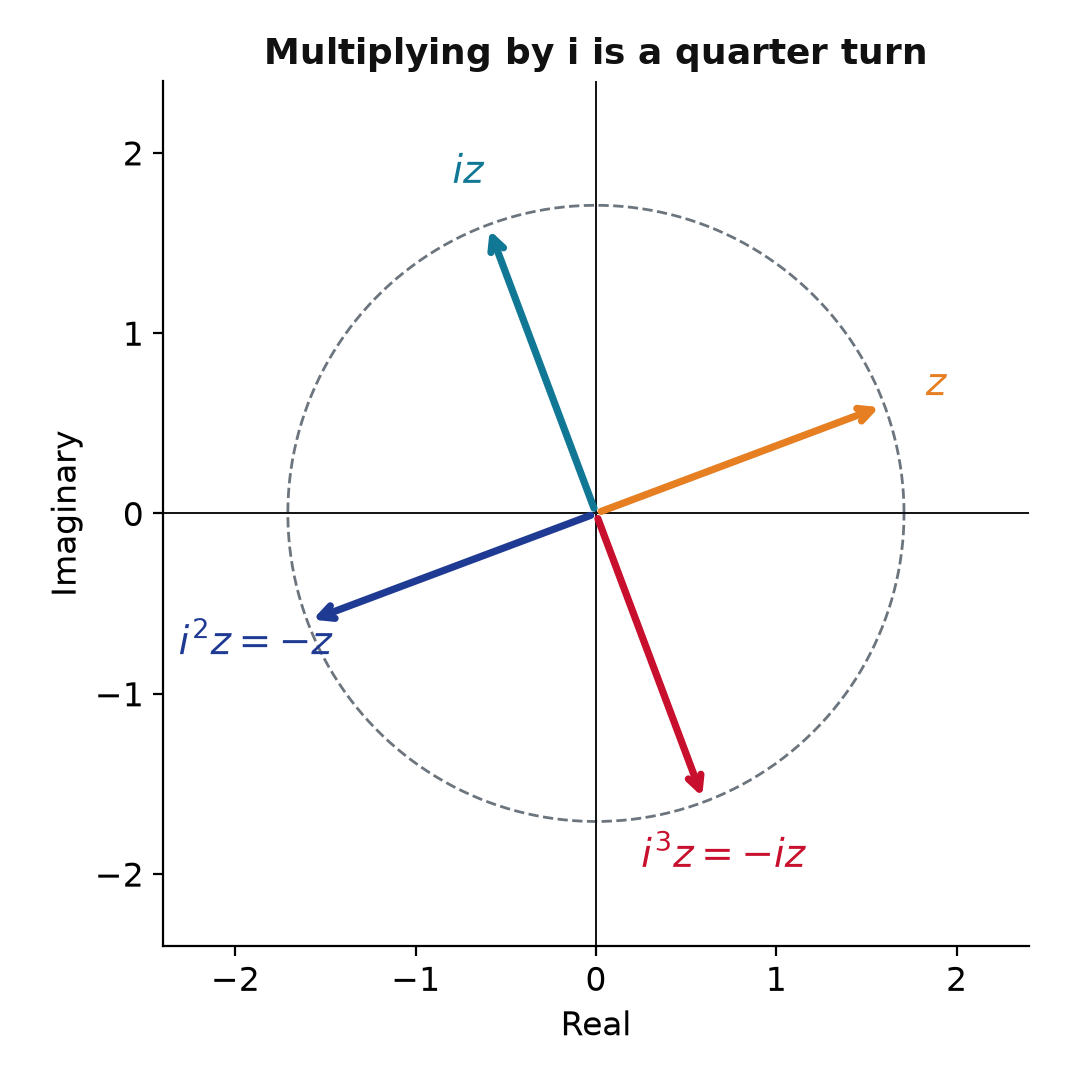
(r_1 e^{i\phi_1})(r_2 e^{i\phi_2}) = r_1 r_2\, e^{i(\phi_1 + \phi_2)}
- Magnitudes multiply, angles add
- |e^{i\phi}| = 1, so multiplying by e^{i\phi} is a pure turn by \phi: no stretching
- i = e^{i\pi/2} is a quarter turn; four of them bring you home, i^4 = 1
- e^{-i\phi} undoes e^{i\phi}; angles matter only mod 2\pi
The rotating phase is a helix
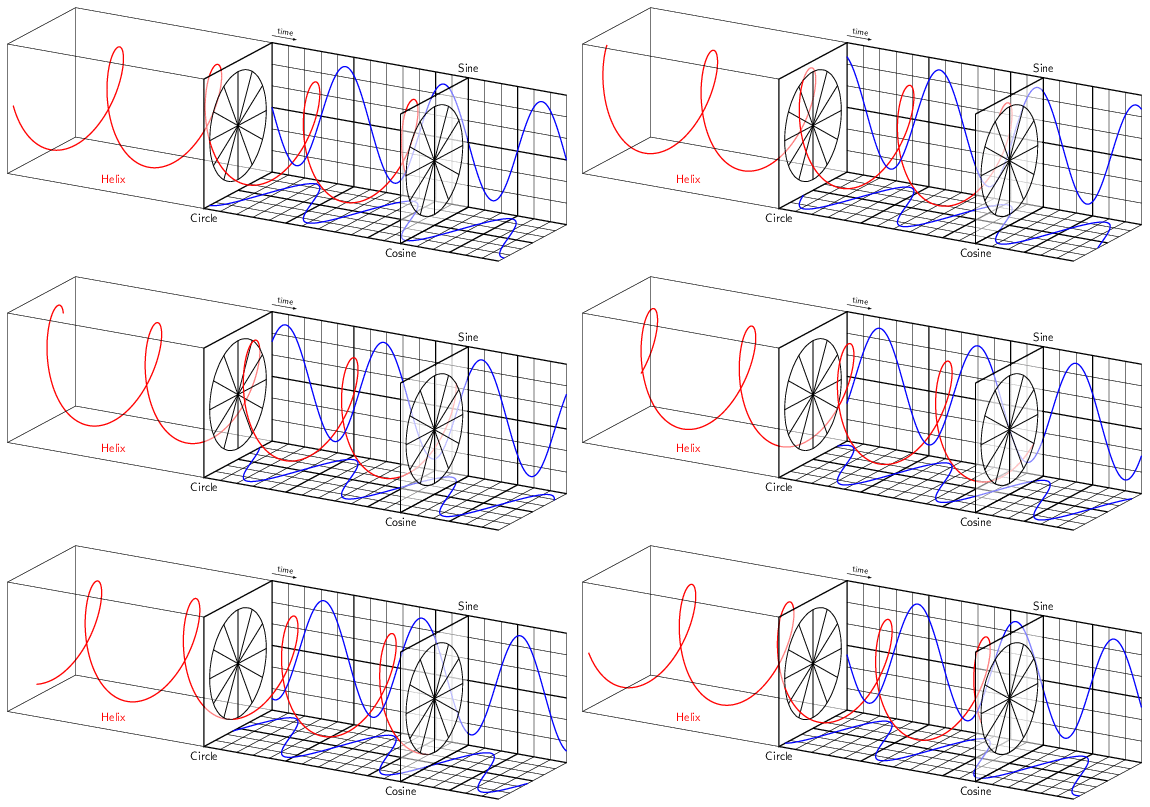
e^{i\omega t} = \cos\omega t + i\sin\omega t
- The tip runs around a circle in the complex plane; let time run along a third axis and the path is a helix
- Its shadow on one wall is \cos\omega t, on the other \sin\omega t
- One turning arrow carries both waves, which is why one exponential replaces two trig functions
Interference is the length of one arrow
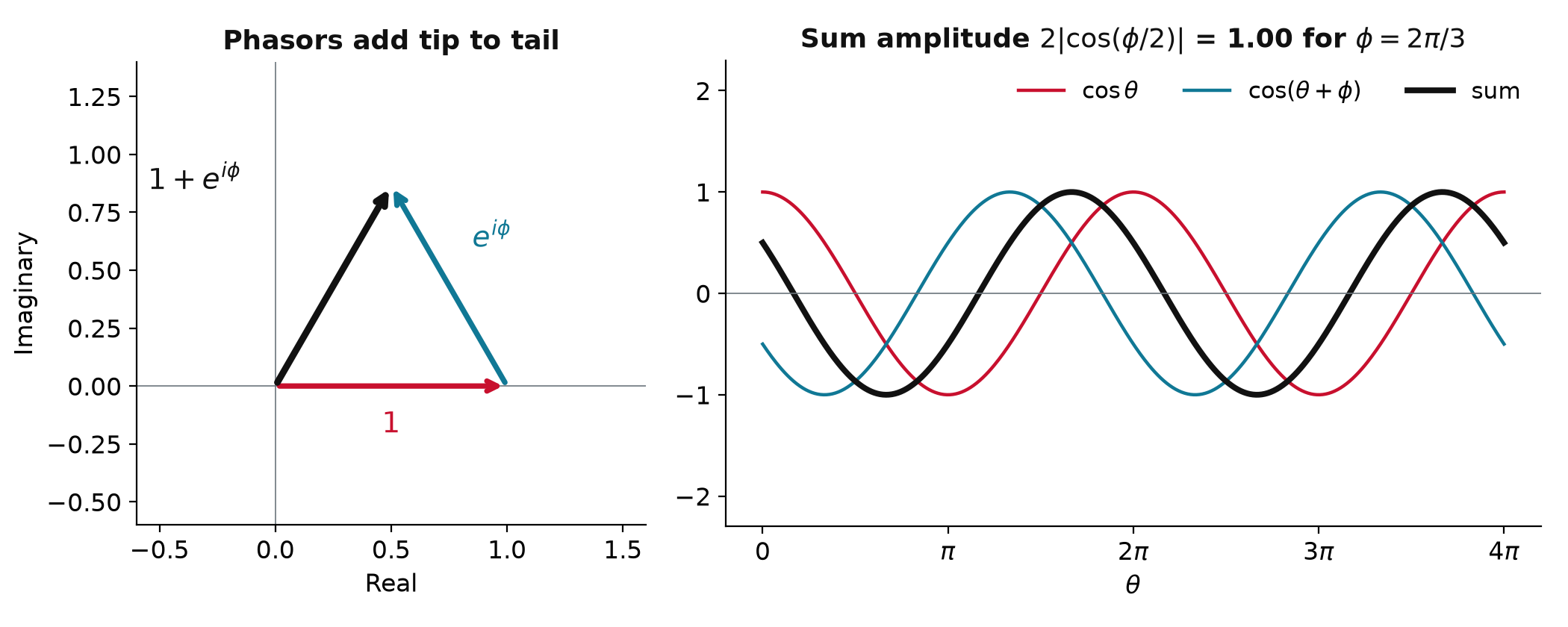
|1 + e^{i\phi}| = 2\left|\cos(\phi/2)\right|
- \phi = 0: arrows aligned, amplitude doubles. \phi = \pi: opposed, amplitude zero
- Bright and dark fringes are exactly this arrow, long or short