Extensive vs Intensive variables
Extensive variables: Depdent on System size These are fundamental variables that uniquely define the equilibrium states. Examples are .
Intensive variables: Size Independent These are derived from the extensive ones and are considered as conjugate pairs. E.g , and , are conjugate pairs.
Intensive variables do not have the same fundamental status as extensive variables
Because they do not always uniquely describe the state of matter in equilibrium.
For example, a glass of water with and without an ice cube can be under 1 atm and 0 C, whereas energy and entropy volume values will differ.
Exercise: Extensivity of Energy
For volume, it may be straightforward to explain why it is extensive. But why is Energy an extensive quantity for a system with N interacting particles?
Does extensivity of energy always hold? think of two molecules, ten, thousands, Avogadro number?
Solution
The additivity of energy can hold if we assume pairwise interactions between particles with interacting potential decaying with distance faster than the in 3D. Meaning that surface interactions become negligible. For instance, if we divide the glass of wat er into two parts, the total energy, to a good approximation, is a sum of two halves. But notice that if we have microscopic quantities, like handfuls of molecules, this is no longer true
Equilibrium and thermodynamic space
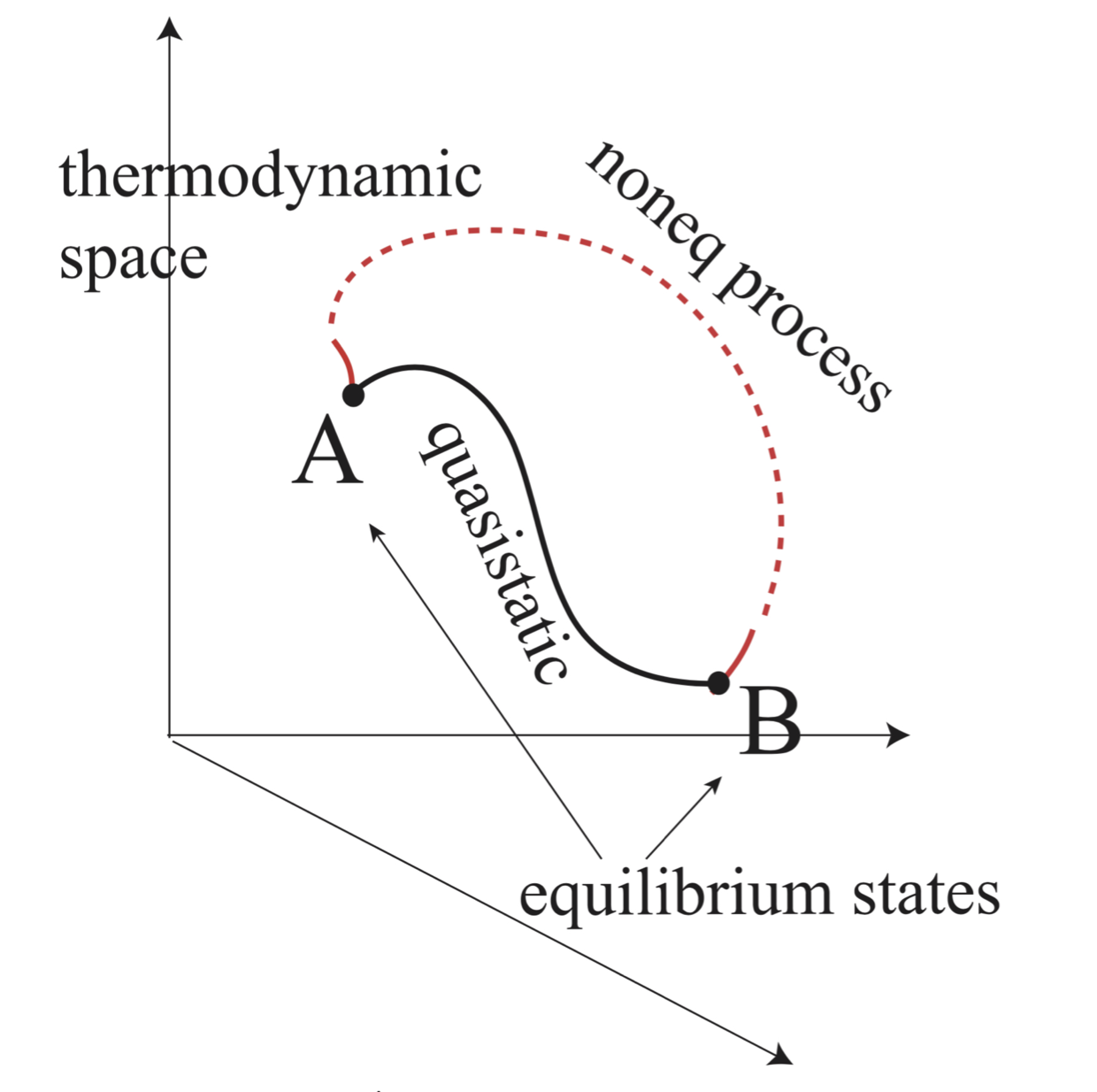
A and B are equilibrium states. A quasistatic process connecting A and B is in the thermodynamic space (however, see the warning in the text). From A to B a process need not be quasistatic. Then, most such processes are outside the thermodynamic space (broken curve).
Equilibrium refers to a state of matter which is unchanging. There are no macroscopic fluxes or flows of energy or matter.
The state of Equilibrium is defined relative to observation time! A glass of water on the table is in a state of equilibrium on the time scale of minutes but in a state of non-equilibrium over the scale of days because water evaporates, changing the thermodynamic state of the glass.
Euilibrium is represented as a point in the Thermodynamic space where are extensive variables.
These coordinates have unique and well-defined values for each equilibrium state irrespective to how such state was created.
Intensive variables become ill-defined if the system is not in equilibrium (temperature, pressure, etc).
Functions like energy are called state functions, and their changes are given by differences between initial or final state only .
On the other hand one can have quantities such as work or heat . These are path dependent characterizing the way energy is transferred to the system and not characterizing equilibrium states!
Fundamental equation of thermodynamics
Transformations between equilibrium states is the central task of thermodynamics. Knowing the fundamental equation, one can predict the equilibrium state B, which results from equilibrium state A through spontaneous transformation upon removal of a constraint. E.g computing given expansion of a box.
Quasi-static path: a dense succession of equilibrium states that connects A with B in extensive variables is constructed to compute changes in thermodynamic variables between states A and B. The quasistatic process ensures the system does not deviate from the equilibrium state during transformation.
Reversible transformations can go forward or backward without any change in the environment. This necessitates the introduction of Entropy, which differentiates reversible from non-reversible changes.
The quasistatic path may or may not be reversible Just because the process is infinitely slow and locally in equilibrium does not make it reversible along the path of transofrmation. For instance, poking a small hole in a container and letting one molecule out very slowly does not make the process reversible.
First Law
Note on signs
By convention sign of work or heat is positive if energy is transfered to the system. Negative if it system loses energy. Hence think about signs from the perspective ofa system under study.
If engine does work against external pressure then . You can see work is going to be negative for expanding volume and positive for contracting
If system is absorbing heat from environment (heating up) . If the system is refridgerating then
Adiabatic Change
No work
Adiabatic Processes
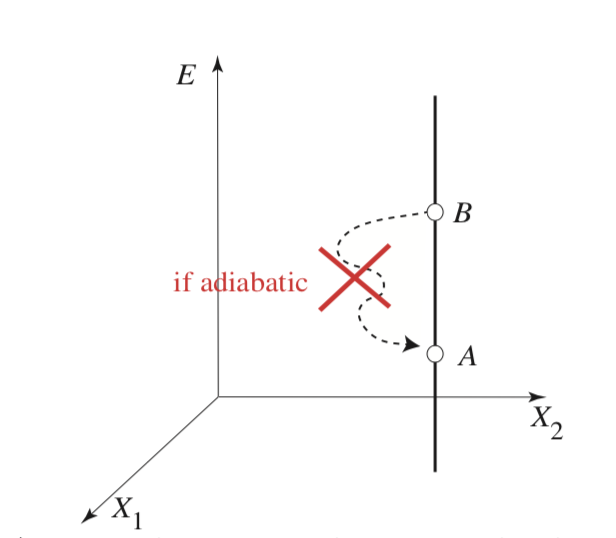
Intuitively, this means that purely mechanical manipulation of an isolated system can only add energy to it, for example through friction or dissipation. It is impossible to extract energy from a closed system by mechanical means alone without producing a net change in the environment.
As a consequence, not all paths in thermodynamic state space are accessible. One cannot, in general, move freely between arbitrary states using adiabatic processes alone. This restriction suggests the existence of a deeper organizing principle, potentially a new state variable, governing adiabatic accessibility.
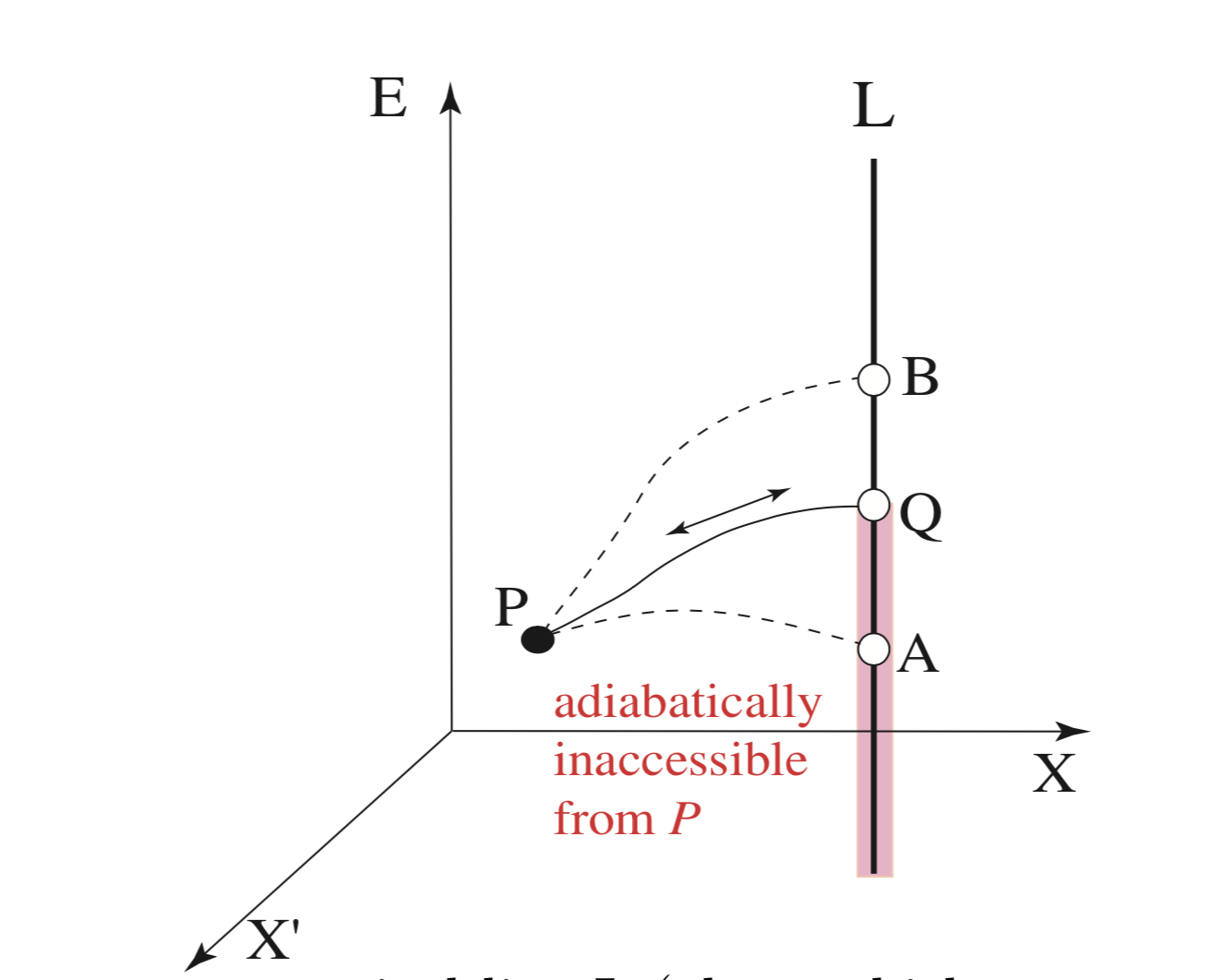
Let be a state on a vertical line , along which motion is possible by heat exchange alone, that can be reached from a state by an adiabatic and quasistatic process. If another state on were also adiabatically reachable from , one could construct an adiabatic cycle that decreases the system’s energy, violating Planck’s principle. Hence, only a single point on is adiabatically accessible from .
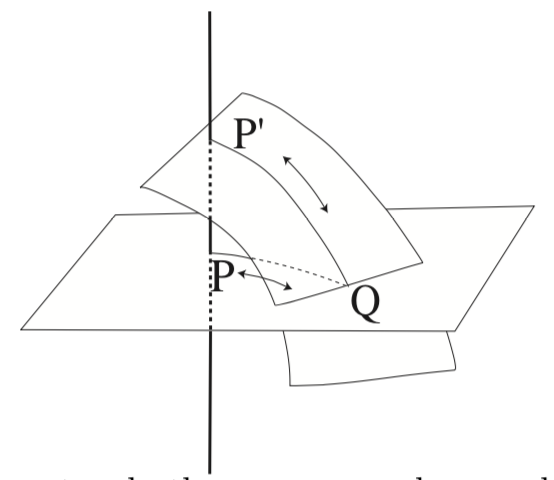
If two adiabatic curves were to cross or touch, one could trace a closed adiabatic cycle in either direction. This would again permit a decrease of energy in an isolated system, contradicting Planck’s formulation of the Second Law.
These arguments imply that adiabatic curves (or surfaces) cannot intersect. If they did, one could design a cyclic mechanical process that lowers the system’s energy, in direct violation of the Second Law.
Therefore, thermodynamic state space is foliated by non-intersecting adiabats. Each adiabat defines a class of states that are mutually accessible by reversible adiabatic processes.
This geometric structure motivates the introduction of an extensive state variable, entropy , which is:
constant along each adiabat, and
monotonically increasing when moving between different adiabats at fixed work coordinates.
The entropy formulation of the Second Law is more general than Planck’s statement: it applies not only to adiabatic processes, but also to non-adiabatic transformations involving heat exchange.
Reversible Heat Exchange
Moving from one adiabat to another cannot be achieved by mechanical work alone; it requires the exchange of heat with the surroundings.
Along a reversible path, entropy changes are directly associated with heat flow. In contrast, entropy remains constant or increases during adiabatic processes.
For a reversible heat exchange,
where the partial derivative is taken at fixed work coordinates .
The proportionality factor relating reversible heat input to entropy change defines the temperature:
Since mechanical manipulation alone does not move the system between adiabats, entropy can be reduced only by removing heat from the system:
System + reservoir
For a general non-adiabatic process in which a system is in contact with an infinitely large thermal reservoir (heat bath), the Second Law applies to the combined system + reservoir:
For an ideal reservoir, the entropy change arises solely from heat exchange. Since ,
Understanding the Inequality
Irreversibility and entropy production
The strict inequalityreflects internal entropy production due to irreversible processes such as: friction and viscosity in fluids, turbulence, non-equilibrium chemical reactions, and unrestrained (free) expansion.
Reversible heat transfer
The equalityholds only when:
the system remains in thermal equilibrium with its surroundings, and
heat is exchanged across an infinitesimal temperature difference.
Equilibrium condition
At equilibrium, entropy is maximized:and no spontaneous macroscopic changes occur.
Gibbs Relation
The internal energy of a thermodynamic system can be expressed as a function of its extensive variables: entropy , volume , and number of particles :
Taking the total differential of , we obtain:
We identify the intensive variables conjugate to the extensive variables:
Temperature
Pressure
Chemical potential
The first law of thermodynamics can then be written in its fundamental formm Texpressing how changes in entropy, volume, and particle number contribute to changes in energy.
Gibbs Duhem relation
The extensivity property implies linear scaling with respect to extensive variables. In other words, extensive variables are additive quantities.
Using chain rule we get a liner relationship between extensive variables not involving any differentials:
When we take the derivative of E and compare with Gibbs relation we end up with equation where independent variables are now intensive ones
Entropy Maximization Principle
When we release a constraint in an adiabatic system the extensive coordinates change. This spontaneous change must always lead to increase in entropy
Entropy can increase until reaching its maximum possible value after which no further change is possible.
A change in system entropy due to any change or pertrubation is therefore telling us that
If system spontaneously evolves
If system is thermodynamically stable (any change from maximum leads to decrease of entropy)
Therefore the second law gives us a variational principle in terms of entropy to find stable equilibrium states for an adiabatic systems.
Thermodynamic Stability and Concavity of Entropy
Let us join two systems made of the same substances to make a single system. The entropy maximization principle tells us that the entropy of the resultant compound system is given by
Where the maximum is taken over all the partitions of and (collection of any work coordinates) between the two systems as and
This implies with the aid of the extensivity
for any . That is, S is a concave function (its graph is convex upward) of all the thermodynamic coordinates
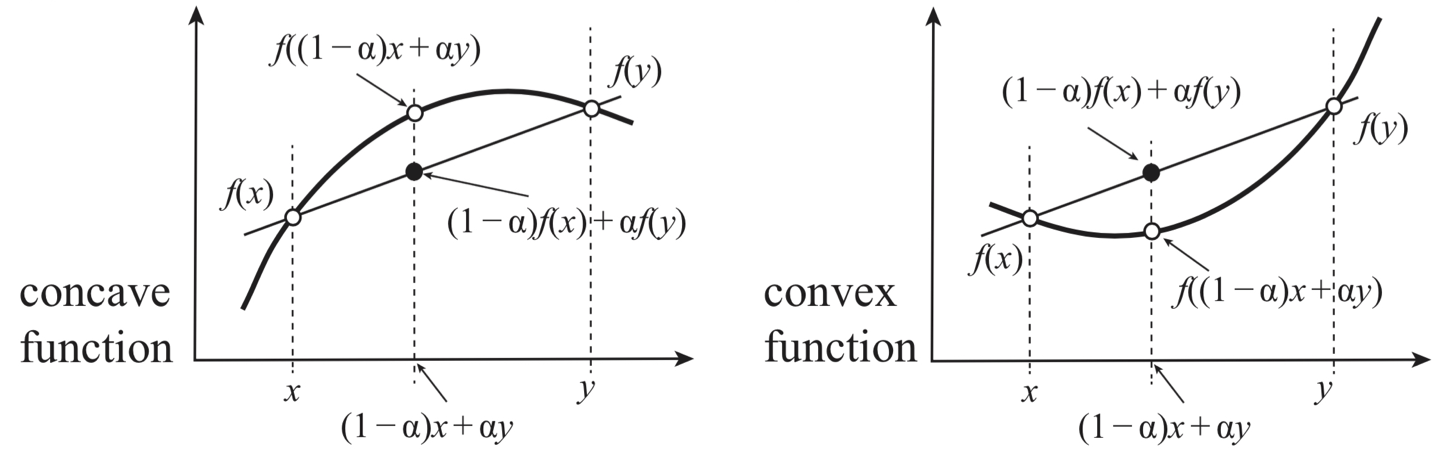
Entropy is a concave function of all extensive variables.
Energy Minimization Principle
Entropy maximimization principle states that at equilibrium values of thermodynamic coordinates entropy is maximized so any deviation in coordinates leads to smaller entropy:
Given that entropy is an increasing function of energy we can boost the energy to in the second term to get an equality
This implies that under the constant entropy condition, if an extra constraint to fix is removed the system goes from higher to lower .
Thus we have Energy Minimization Principle: internal energy is minimized under a constant entropy condition, the system must be in equilibrium.
Thermodynamic stability and Heat Capacity
The entropy function must be concave to ensure stability.
Mathematically, for equilibrium stability, the second derivative of entropy must satisfy:
This inequality shows that equilibrium state is stable against any thermal fluctuations that deviate from equilibrium.
Taking second derivative of entropy and making use of the following equality:
Since heat capacity at constant volume is:
we obtain the stability condition:
Implication: A positive heat capacity () ensures local thermodynamic stability.
Spontaneous Change and Partitioning of Extensive Variables
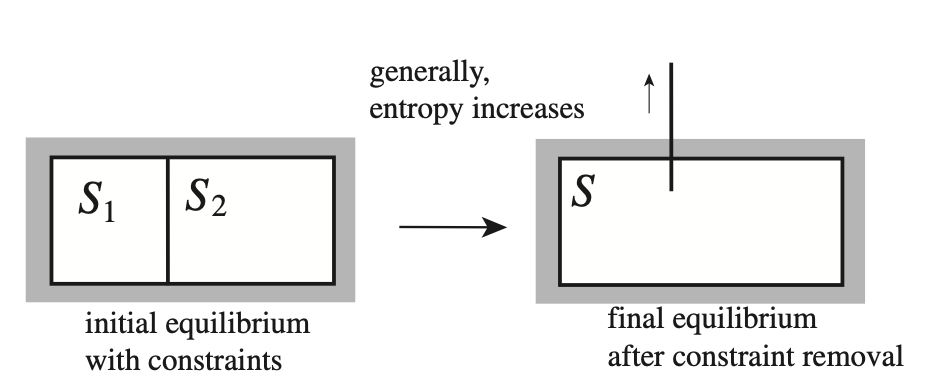
What way the system will parition energy, volume particles when the constraint separating flow of these variables is removed?
A spontaneous process occurs when a system undergoes a transformation that maximizes entropy. In thermodynamic equilibrium, extensive variables (such as energy, volume, and particle number) partition between subsystems in a way that maximizes the total entropy.
Consider two subsystems, and , exchanging energy. Since the total energy is conserved we can write down total energy and entropy as:
At equilibrium, entropy is maximized by varying in this case the only free extensive coordinate , which determines energy partitioning:
We once again come to appreciate that derivative of entropy with respect to energy is related to temperature:
We obtain the equilibrium condition showing that temperature imbalance drives energy distirbution until we reach equal temperatures throughout the system.
In general system spontaneously evolves toward equilibrium by redistributing energy, volume, and particles:
Example: find final energy partitioning
The fundamental equations for two systems and separated by diathermal wall (no heat flow allowed) is
The total energy is
The volume and mole number of system are and 3 mol respectively.
The volume and mole number for system are and 2 mol respectively.
Plot the total entropy as function of energy distribution between two systems
If we enable heat flow between systems A and B a new equilibrium state would be established. What would and be like in this new equilibrium state?
Appendix
Entropy and Efficiency of Heat Engines
Consider a heat engine that absorbs heat from a hot reservoir, performs work , and rejects heat to a cold reservoir.
The total energy of the system (engine + reservoirs) is conserved. Using the first law of thermodynamics, we express this as:
Since the engine does work on the surroundings, it loses energy, meaning is considered and negative from the system’s perspective. To express work as a positive quantity:
The efficiency of the engine, defined as the fraction of input heat converted into useful work, is:
The second law of thermodynamics states that total entropy must increase or remain constant:
Since entropy is a state function, we write:
This inequality shows that an irreversible engine dissipates more heat to the cold reservoir, leading to lower work output.
Substituting this result into the efficiency expression:
yields the fundamental upper bound on efficiency:
This result represents the Carnot efficiency, which is the maximum possible efficiency for any heat engine operating between two reservoirs at temperatures and .
Practical symmary of thermodynamic principles
1.Thermodynamic variables are either extensive or intensive. The total amount of an extensive quantity of a compound system is the sum of the extensive quantities of the subsystems (additivity)
There is a state called an equilibrium state. which is described in terms of extensive thermodynamic coordinates (,, ), where is the internal energy and are coordinates in thermodynamic space.
The conservation of energy: where the variables appear in intensive-extenisve "conjugate pairs” like
The thermodynamic space is foliated into (hyper) surfaces. For adiabatic process with work only, never happens; to reduce entropy we definitely need cooling.
A reverisble heat transfer increases entropy of system by amount.
Thermodynamics calculations proceed by defining a quasistatic process for which Gibbs relation holds: often it is convenient to write
Problems
Problem 1 Fundamental equations
The following ten equations are purported to be fundamental equations for various thermodynamic systems. Five, however, are inconsistent with the basic postulates of a fundamental equation and are thus unphysical. For each, plot the relationship between and and identify the unacceptable five. , , and are all positive constants and, in the case of fractional exponents, the real positive root is to be implied.
Problem 2: Expansion of gas into the vacuum
As a general case of gas expanding into the vacuum, use the Gibbs relation for to show that this would show that free adiabatic expansion is accompanied by entropy increase and is hence and irreversible process.
Now consider a gas in container energy described by the following equation
Plot E as a function of V for a few temperatures.
Suppose that a gas expands adiabatically into a vacuum. How will the energy and entropy of the system change, and what is the work done by the gas?
Initially, the gas occupies a volume at a temperature . The gas then expands adiabatically into a vacuum to occupy a total volume . What is the final temperature of the gas?
Problem 3 Entropy of mixing two gases
Using the expression for an ideal gas , calculate the entropy change resulting after removing a divider separating molecules of gas A occupying Volume from molecules of gas B occupying volume .
Hints
The system overall is thermally insulated and pressure and temperatures are constant; hence, numbers and volumes are proportional so you can express entropy change entirely in terms of molar numbers or their fractions
You need to first calculate the entropy change due to gas A expanding from volume to volume and the same for gas B. the total entropy change will be the sum of these two changes.
Problem 4: Entropy of heating
1 kg of water (specific heat = 4.2 kJ/(kg·K)) at is in contact with a heat bath, and eventually reaches . What is the entropy change of the water? What is the increase of the entropy of this water plus the heat bath?
Imagine now that the water at is in contact with a heat bath. Then, after reaching thermal equilibrium, the water is subsequently put in contact with a heat bath until it reaches the final temperature . What is the increase of the entropy of the water after it has been put in contact with two heat baths? Compare the answer to the case of (1)
Show that in the two-step heating process, whatever the first heat bath temperature T is between and , the total change of entropy of the water plus heat baths is less than the case of (1)