We approximate many-electron wavefunctions using hydrogenic orbitals as building blocks.
Unlike the hydrogen atom, multi-electron problems do not separate and therefore do not admit exact analytical solutions.
Spin and antisymmetry impose strict constraints on the allowed electronic wavefunctions, giving rise to the Pauli exclusion principle and the Slater determinant .
Symmetric versus antisymmetric spatial functions split helium’s excited states into singlets and triplets , and the energy difference between them is the origin of exchange stabilization .
The Aufbau principle , Pauli exclusion , and Hund’s rule together explain how electrons fill atomic orbitals.
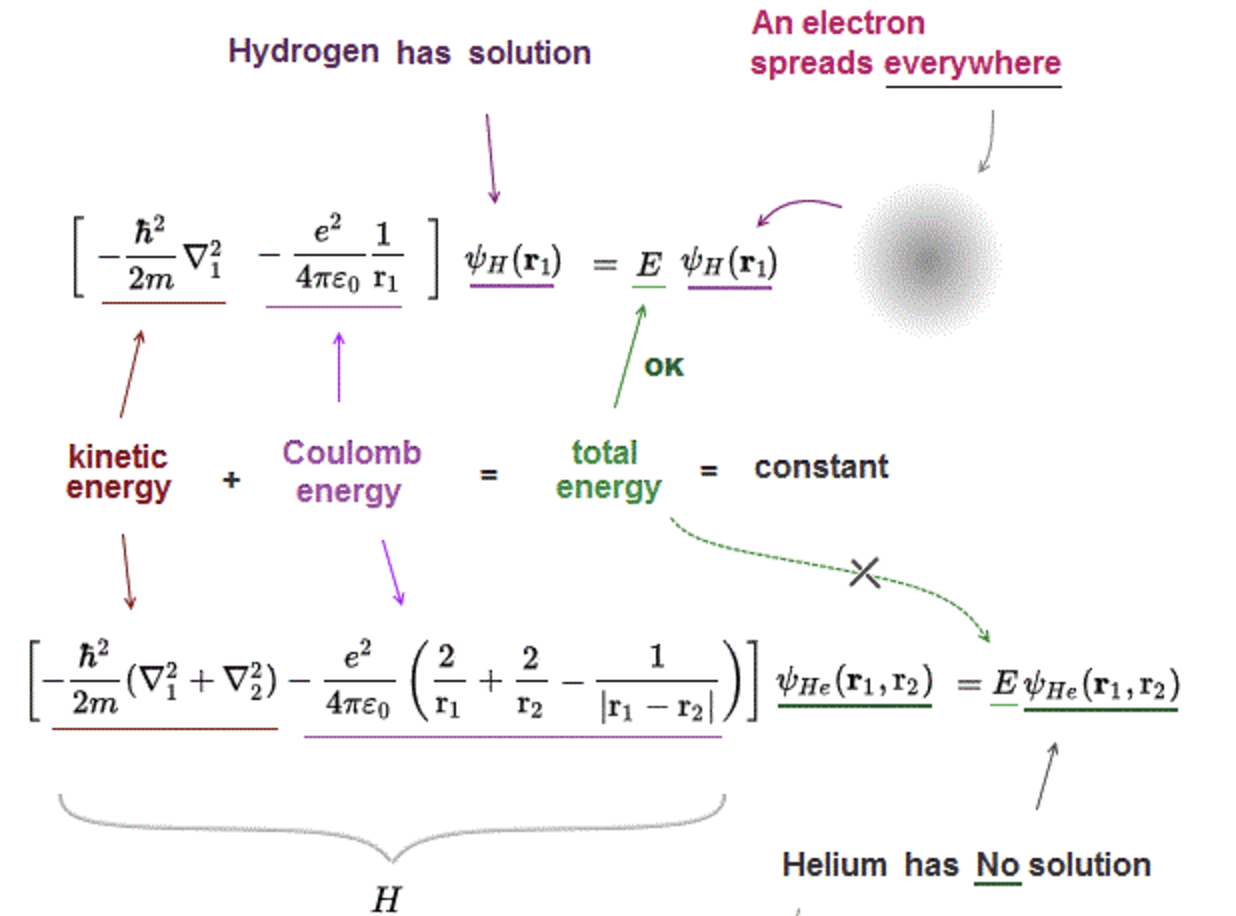
The Orbital Approximation ¶ Fig. 1 Difference between the hydrogen and helium Hamiltonians that makes multi-electron atoms analytically unsolvable. The extra electron, electron repulsion term couples the coordinates and blocks separation of variables.
For multi-electron atoms, the Hamiltonian depends on the coordinates of all electrons. The coordinates cannot be separated , so the Schrodinger equation is not analytically solvable.
A practical approximation is to represent the wavefunction as a product of single-electron orbitals , which are obtained computationally (for example, variationally):
Ψ ( r 1 , r 2 , … , r n ) ≈ ϕ 1 ( r 1 ) ϕ 2 ( r 2 ) ⋯ ϕ n ( r n ) \Psi(r_1, r_2, \ldots, r_n) \approx \phi_1(r_1)\phi_2(r_2)\cdots\phi_n(r_n) Ψ ( r 1 , r 2 , … , r n ) ≈ ϕ 1 ( r 1 ) ϕ 2 ( r 2 ) ⋯ ϕ n ( r n ) The Helium Wavefunction ¶ For helium, the simplest guess would be
Ψ ( r 1 , r 2 ) ≈ ϕ 1 ( r 1 ) ϕ 2 ( r 2 ) . \Psi(r_1, r_2) \approx \phi_1(r_1)\phi_2(r_2). Ψ ( r 1 , r 2 ) ≈ ϕ 1 ( r 1 ) ϕ 2 ( r 2 ) . This form, however, suffers from three fundamental issues:
Indistinguishability. Electrons are identical; the wavefunction cannot assign “electron 1” to “orbital 1” and “electron 2” to “orbital 2”.
Missing spin information. The spatial wavefunction must combine with a spin function so that the total wavefunction is antisymmetric .
Neglect of electron, electron correlation. The product form assumes electrons move independently, which leads to quantitative errors in energies.
Issue 1: Indistinguishability and Antisymmetry ¶ Particles such as electrons are indistinguishable. Therefore the probability density must remain unchanged upon interchange:
∣ Ψ ( r 1 , r 2 ) ∣ 2 = ∣ Ψ ( r 2 , r 1 ) ∣ 2 , |\Psi(r_1,r_2)|^2 = |\Psi(r_2,r_1)|^2, ∣Ψ ( r 1 , r 2 ) ∣ 2 = ∣Ψ ( r 2 , r 1 ) ∣ 2 , which implies
Ψ ( r 1 , r 2 ) = ± Ψ ( r 2 , r 1 ) . \Psi(r_1,r_2) = \pm \Psi(r_2,r_1). Ψ ( r 1 , r 2 ) = ± Ψ ( r 2 , r 1 ) . Electrons are fermions , and Pauli’s principle dictates that their total wavefunction must be antisymmetric :
Ψ ( … , r m , … , r n , … ) = − Ψ ( … , r n , … , r m , … ) . \Psi(\ldots, r_m, \ldots, r_n, \ldots)
= -\Psi(\ldots, r_n, \ldots, r_m, \ldots). Ψ ( … , r m , … , r n , … ) = − Ψ ( … , r n , … , r m , … ) . A simple way to generate symmetric or antisymmetric forms for a two-variable function f ( x , y ) f(x,y) f ( x , y )
Symmetric:
g + ( x , y ) = f ( x , y ) + f ( y , x ) g_+(x,y) = f(x,y) + f(y,x) g + ( x , y ) = f ( x , y ) + f ( y , x ) Antisymmetric:
g − ( x , y ) = f ( x , y ) − f ( y , x ) g_-(x,y) = f(x,y) - f(y,x) g − ( x , y ) = f ( x , y ) − f ( y , x ) For helium, the antisymmetrized spatial wavefunction is
Ψ ( r 1 , r 2 ) ∝ ϕ 1 ( r 1 ) ϕ 2 ( r 2 ) − ϕ 1 ( r 2 ) ϕ 2 ( r 1 ) . \Psi(r_1,r_2) \propto \phi_1(r_1)\phi_2(r_2) - \phi_1(r_2)\phi_2(r_1). Ψ ( r 1 , r 2 ) ∝ ϕ 1 ( r 1 ) ϕ 2 ( r 2 ) − ϕ 1 ( r 2 ) ϕ 2 ( r 1 ) . Issue 2: The Spin Requirement ¶ Electrons have two spin states, α \alpha α β \beta β total wavefunction (spatial times spin) must be antisymmetric:
If the spatial part is symmetric , the spin part must be antisymmetric .
If the spatial part is antisymmetric , the spin part must be symmetric .
The three symmetric spin functions are:
α ( 1 ) α ( 2 ) \alpha(1)\alpha(2) α ( 1 ) α ( 2 ) β ( 1 ) β ( 2 ) \beta(1)\beta(2) β ( 1 ) β ( 2 ) 1 2 [ α ( 1 ) β ( 2 ) + α ( 2 ) β ( 1 ) ] \frac{1}{\sqrt{2}}\left[\alpha(1)\beta(2) + \alpha(2)\beta(1)\right] 2 1 [ α ( 1 ) β ( 2 ) + α ( 2 ) β ( 1 ) ] The single antisymmetric spin function is:
1 2 [ α ( 1 ) β ( 2 ) − α ( 2 ) β ( 1 ) ] \frac{1}{\sqrt{2}}\left[\alpha(1)\beta(2) - \alpha(2)\beta(1)\right] 2 1 [ α ( 1 ) β ( 2 ) − α ( 2 ) β ( 1 ) ] The Pauli Exclusion Principle ¶ A key result of antisymmetry is the Pauli exclusion principle :
No two electrons can possess identical sets of quantum numbers.
For helium’s ground state (1 s 2 1s^2 1 s 2
Ψ = 1 2 [ 1 s ( 1 ) 1 s ( 2 ) + 1 s ( 2 ) 1 s ( 1 ) ] [ α ( 1 ) β ( 2 ) − α ( 2 ) β ( 1 ) ] . \Psi = \frac{1}{\sqrt{2}}
\left[1s(1)1s(2) + 1s(2)1s(1)\right]
\left[\alpha(1)\beta(2) - \alpha(2)\beta(1)\right]. Ψ = 2 1 [ 1 s ( 1 ) 1 s ( 2 ) + 1 s ( 2 ) 1 s ( 1 ) ] [ α ( 1 ) β ( 2 ) − α ( 2 ) β ( 1 ) ] . Slater Determinants ¶ Slater introduced a compact and universally applicable way to construct antisymmetric many-electron wavefunctions:
A determinant expands into an antisymmetric sum of products of one-electron spin-orbitals.
Any exchange of two electrons flips the sign of the wavefunction.
This guarantees that the Pauli exclusion principle is satisfied automatically.
Ψ ( r 1 , … , r n ) = 1 n ! ∣ χ 1 ( 1 ) χ 2 ( 1 ) ⋯ χ n ( 1 ) χ 1 ( 2 ) χ 2 ( 2 ) ⋯ χ n ( 2 ) ⋮ ⋮ ⋱ ⋮ χ 1 ( n ) χ 2 ( n ) ⋯ χ n ( n ) ∣ \Psi(r_1,\ldots, r_n)
= \frac{1}{\sqrt{n!}}
\begin{vmatrix}
\chi_1(1) & \chi_2(1) & \cdots & \chi_n(1) \\
\chi_1(2) & \chi_2(2) & \cdots & \chi_n(2) \\
\vdots & \vdots & \ddots & \vdots \\
\chi_1(n) & \chi_2(n) & \cdots & \chi_n(n)
\end{vmatrix} Ψ ( r 1 , … , r n ) = n ! 1 ∣ ∣ χ 1 ( 1 ) χ 1 ( 2 ) ⋮ χ 1 ( n ) χ 2 ( 1 ) χ 2 ( 2 ) ⋮ χ 2 ( n ) ⋯ ⋯ ⋱ ⋯ χ n ( 1 ) χ n ( 2 ) ⋮ χ n ( n ) ∣ ∣ χ j ( i ) \chi_j(i) χ j ( i ) spin-orbital , that is, an orbital times a spin function, describing electron i i i j j j
The factor 1 / n ! 1/\sqrt{n!} 1/ n !
For example, the helium ground-state Slater determinant looks like this:
Ψ H e = 1 2 ∣ 1 s ( 1 ) α ( 1 ) 1 s ( 1 ) β ( 1 ) 1 s ( 2 ) α ( 2 ) 1 s ( 2 ) β ( 2 ) ∣ \Psi_{He} = \frac{1}{\sqrt{2}}
\begin{vmatrix}
1s(1)\alpha(1) & 1s(1)\beta(1) \\
1s(2)\alpha(2) & 1s(2)\beta(2)
\end{vmatrix} Ψ He = 2 1 ∣ ∣ 1 s ( 1 ) α ( 1 ) 1 s ( 2 ) α ( 2 ) 1 s ( 1 ) β ( 1 ) 1 s ( 2 ) β ( 2 ) ∣ ∣ For lithium the ground-state Slater determinant looks like this:
Ψ Li = 1 3 ! ∣ 1 s ( 1 ) α ( 1 ) 1 s ( 1 ) β ( 1 ) 2 s ( 1 ) α ( 1 ) 1 s ( 2 ) α ( 2 ) 1 s ( 2 ) β ( 2 ) 2 s ( 2 ) α ( 2 ) 1 s ( 3 ) α ( 3 ) 1 s ( 3 ) β ( 3 ) 2 s ( 3 ) α ( 3 ) ∣ \Psi_{\text{Li}} = \frac{1}{\sqrt{3!}}
\begin{vmatrix}
1s(1)\alpha(1) & 1s(1)\beta(1) & 2s(1)\alpha(1) \\
1s(2)\alpha(2) & 1s(2)\beta(2) & 2s(2)\alpha(2) \\
1s(3)\alpha(3) & 1s(3)\beta(3) & 2s(3)\alpha(3)
\end{vmatrix} Ψ Li = 3 ! 1 ∣ ∣ 1 s ( 1 ) α ( 1 ) 1 s ( 2 ) α ( 2 ) 1 s ( 3 ) α ( 3 ) 1 s ( 1 ) β ( 1 ) 1 s ( 2 ) β ( 2 ) 1 s ( 3 ) β ( 3 ) 2 s ( 1 ) α ( 1 ) 2 s ( 2 ) α ( 2 ) 2 s ( 3 ) α ( 3 ) ∣ ∣ Singlet and Triplet Excited States of Helium ¶ When one electron occupies 1 s 1s 1 s 2 s 2s 2 s
Ψ S ( 1 , 2 ) = 1 2 [ 1 s ( 1 ) 2 s ( 2 ) + 1 s ( 2 ) 2 s ( 1 ) ] (symmetric) , \Psi_{\text{S}}(1,2)
= \frac{1}{\sqrt{2}}\left[1s(1)2s(2) + 1s(2)2s(1)\right]
\qquad\text{(symmetric)}, Ψ S ( 1 , 2 ) = 2 1 [ 1 s ( 1 ) 2 s ( 2 ) + 1 s ( 2 ) 2 s ( 1 ) ] (symmetric) , Ψ A ( 1 , 2 ) = 1 2 [ 1 s ( 1 ) 2 s ( 2 ) − 1 s ( 2 ) 2 s ( 1 ) ] (antisymmetric) . \Psi_{\text{A}}(1,2)
= \frac{1}{\sqrt{2}}\left[1s(1)2s(2) - 1s(2)2s(1)\right]
\qquad\text{(antisymmetric)}. Ψ A ( 1 , 2 ) = 2 1 [ 1 s ( 1 ) 2 s ( 2 ) − 1 s ( 2 ) 2 s ( 1 ) ] (antisymmetric) . Because electrons are fermions, the total wavefunction must be antisymmetric:
(spatial symmetry) ⏟ Ψ S / A × (spin symmetry) ⏟ χ S / A = antisymmetric \underbrace{\text{(spatial symmetry)}}_{\Psi_{S/A}}
\times
\underbrace{\text{(spin symmetry)}}_{\chi_{S/A}}
= \text{antisymmetric} Ψ S / A (spatial symmetry) × χ S / A (spin symmetry) = antisymmetric so that
Ψ total ( 1 , 2 ) = Ψ spatial ( 1 , 2 ) χ spin ( 1 , 2 ) . \Psi_{\text{total}}(1,2) = \Psi_{\text{spatial}}(1,2)\,\chi_{\text{spin}}(1,2). Ψ total ( 1 , 2 ) = Ψ spatial ( 1 , 2 ) χ spin ( 1 , 2 ) . Triplet states (S = 1 S=1 S = 1 ¶ These must pair with the antisymmetric spatial part Ψ A ( 1 , 2 ) \Psi_A(1,2) Ψ A ( 1 , 2 )
Spin functions:
χ + 1 = α ( 1 ) α ( 2 ) χ 0 = 1 2 [ α ( 1 ) β ( 2 ) + β ( 1 ) α ( 2 ) ] χ − 1 = β ( 1 ) β ( 2 ) \begin{aligned}
\chi_{+1} &= \alpha(1)\alpha(2) \\
\chi_{0} &= \frac{1}{\sqrt{2}}\!\left[\alpha(1)\beta(2)+\beta(1)\alpha(2)\right] \\
\chi_{-1} &= \beta(1)\beta(2)
\end{aligned} χ + 1 χ 0 χ − 1 = α ( 1 ) α ( 2 ) = 2 1 [ α ( 1 ) β ( 2 ) + β ( 1 ) α ( 2 ) ] = β ( 1 ) β ( 2 ) Total wavefunctions:
∣ ψ + 1 ⟩ = Ψ A ( 1 , 2 ) χ + 1 |\psi_{+1}\rangle = \Psi_A(1,2)\,\chi_{+1} ∣ ψ + 1 ⟩ = Ψ A ( 1 , 2 ) χ + 1 ∣ ψ 0 ⟩ = Ψ A ( 1 , 2 ) χ 0 |\psi_{0}\rangle = \Psi_A(1,2)\,\chi_{0} ∣ ψ 0 ⟩ = Ψ A ( 1 , 2 ) χ 0 ∣ ψ − 1 ⟩ = Ψ A ( 1 , 2 ) χ − 1 |\psi_{-1}\rangle = \Psi_A(1,2)\,\chi_{-1} ∣ ψ − 1 ⟩ = Ψ A ( 1 , 2 ) χ − 1 Singlet state (S = 0 S=0 S = 0 ¶ This must pair with the symmetric spatial part Ψ S ( 1 , 2 ) \Psi_S(1,2) Ψ S ( 1 , 2 )
Spin function:
χ singlet = 1 2 [ α ( 1 ) β ( 2 ) − β ( 1 ) α ( 2 ) ] \chi_{\text{singlet}} = \frac{1}{\sqrt{2}}\!\left[\alpha(1)\beta(2) - \beta(1)\alpha(2)\right] χ singlet = 2 1 [ α ( 1 ) β ( 2 ) − β ( 1 ) α ( 2 ) ] Total wavefunction:
∣ ψ singlet ⟩ = Ψ S ( 1 , 2 ) χ singlet |\psi_{\text{singlet}}\rangle = \Psi_S(1,2)\,\chi_{\text{singlet}} ∣ ψ singlet ⟩ = Ψ S ( 1 , 2 ) χ singlet Action of the Spin Operators ¶ Triplets:
S ^ z ∣ ψ + 1 ⟩ = + ℏ ∣ ψ + 1 ⟩ , S ^ z ∣ ψ 0 ⟩ = 0 , S ^ z ∣ ψ − 1 ⟩ = − ℏ ∣ ψ − 1 ⟩ \hat{S}_z|\psi_{+1}\rangle = +\hbar|\psi_{+1}\rangle,\quad
\hat{S}_z|\psi_{0}\rangle = 0,\quad
\hat{S}_z|\psi_{-1}\rangle = -\hbar|\psi_{-1}\rangle S ^ z ∣ ψ + 1 ⟩ = + ℏ∣ ψ + 1 ⟩ , S ^ z ∣ ψ 0 ⟩ = 0 , S ^ z ∣ ψ − 1 ⟩ = − ℏ∣ ψ − 1 ⟩ S ^ 2 ∣ ψ + 1 , 0 , − 1 ⟩ = 2 ℏ 2 ∣ ψ + 1 , 0 , − 1 ⟩ \hat{S}^2|\psi_{+1,0,-1}\rangle = 2\hbar^2|\psi_{+1,0,-1}\rangle S ^ 2 ∣ ψ + 1 , 0 , − 1 ⟩ = 2 ℏ 2 ∣ ψ + 1 , 0 , − 1 ⟩ Singlet:
S ^ z ∣ ψ singlet ⟩ = 0 , S ^ 2 ∣ ψ singlet ⟩ = 0 \hat{S}_z|\psi_{\text{singlet}}\rangle = 0,\qquad
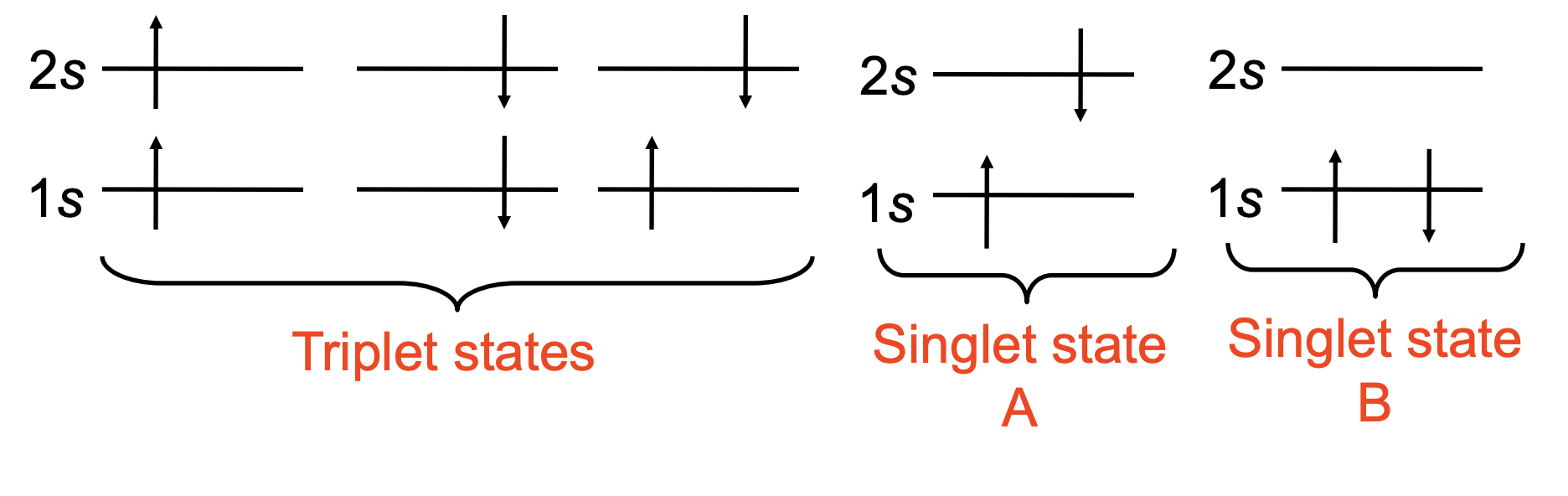
\hat{S}^2|\psi_{\text{singlet}}\rangle = 0 S ^ z ∣ ψ singlet ⟩ = 0 , S ^ 2 ∣ ψ singlet ⟩ = 0 Which is lower in energy? ¶ The triplet has electrons that are spatially antisymmetric , so they avoid each other, feel less Coulomb repulsion , and lie lower in energy .
The singlet is spatially symmetric, so electrons overlap more and lie higher in energy .
This is the origin of exchange stabilization .
Fig. 2 Singlet and triplet excited configurations of helium. The spatially antisymmetric triplet keeps the electrons apart and lies below the spatially symmetric singlet.
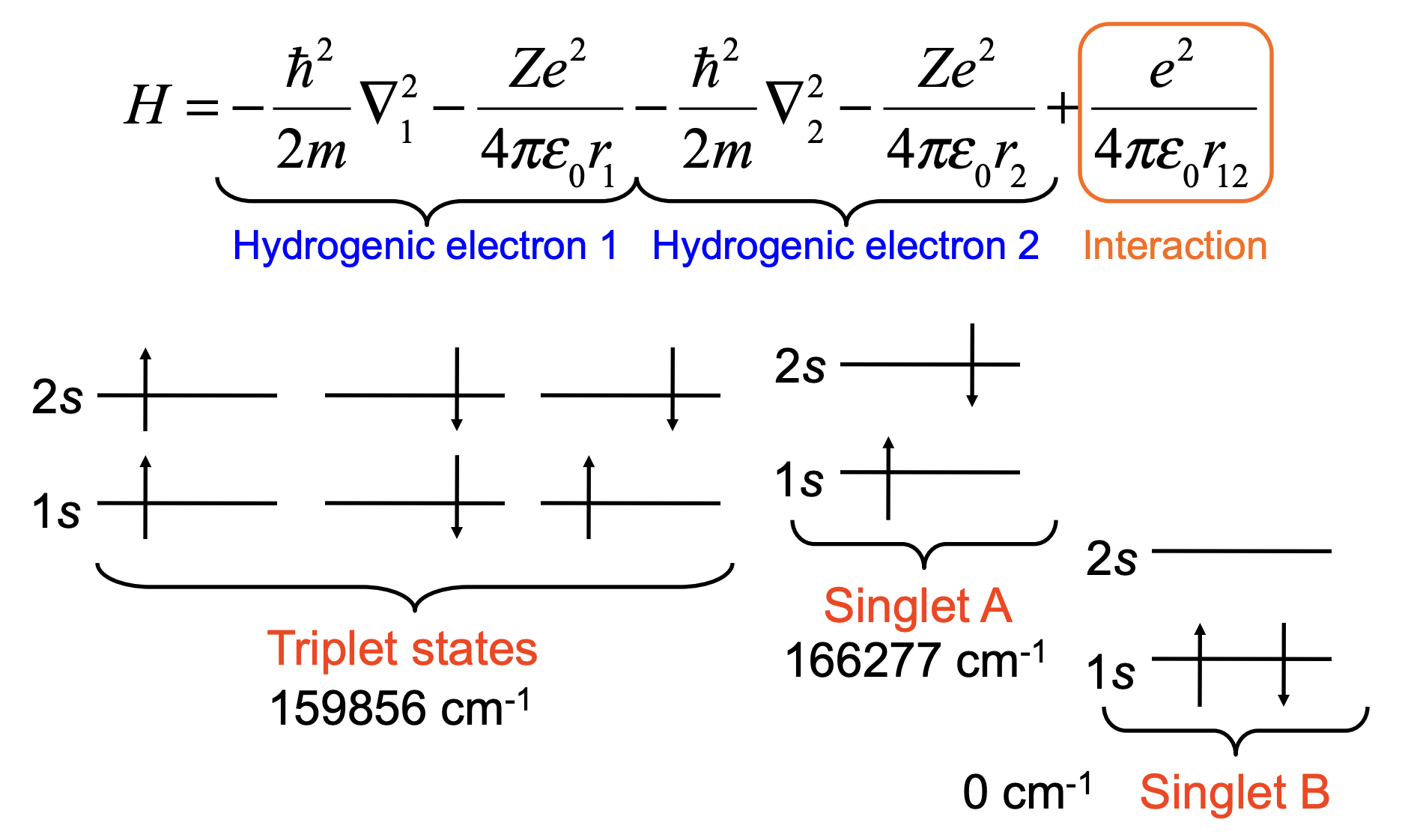
Energies of Multi-Electron States ¶ The Hamiltonian is
H ^ = H ^ 1 + H ^ 2 + H ^ 12 , \hat{H} = \hat{H}_1 + \hat{H}_2 + \hat{H}_{12}, H ^ = H ^ 1 + H ^ 2 + H ^ 12 , with H ^ 12 \hat{H}_{12} H ^ 12
I ( a ) = ∫ ϕ a ∗ ( r ) [ − ℏ 2 2 m ∇ 2 − Z e 2 4 π ϵ 0 r ] ϕ a ( r ) d τ I(a) = \int \phi_a^*(r)
\left[
-\frac{\hbar^2}{2m}\nabla^2
- \frac{Ze^2}{4\pi\epsilon_0 r}
\right]
\phi_a(r)\, d\tau I ( a ) = ∫ ϕ a ∗ ( r ) [ − 2 m ℏ 2 ∇ 2 − 4 π ϵ 0 r Z e 2 ] ϕ a ( r ) d τ J i j = ∫ ∣ ϕ i ( r 1 ) ∣ 2 e 2 4 π ϵ 0 r 12 ∣ ϕ j ( r 2 ) ∣ 2 d 3 r 1 d 3 r 2 , J_{ij} =
\int |\phi_i(r_1)|^2
\frac{e^2}{4\pi\epsilon_0 r_{12}}
|\phi_j(r_2)|^2 \, d^3r_1 \, d^3r_2, J ij = ∫ ∣ ϕ i ( r 1 ) ∣ 2 4 π ϵ 0 r 12 e 2 ∣ ϕ j ( r 2 ) ∣ 2 d 3 r 1 d 3 r 2 , always positive .
Energies of the 1 s 2 s 1s2s 1 s 2 s ¶ Triplet (antisymmetric spatial):
E triplet = I ( 1 s ) + I ( 2 s ) + J ( 1 s , 2 s ) − K ( 1 s , 2 s ) E_{\text{triplet}} = I(1s) + I(2s) + J(1s,2s) - K(1s,2s) E triplet = I ( 1 s ) + I ( 2 s ) + J ( 1 s , 2 s ) − K ( 1 s , 2 s ) Singlet (symmetric spatial):
E singlet = I ( 1 s ) + I ( 2 s ) + J ( 1 s , 2 s ) + K ( 1 s , 2 s ) E_{\text{singlet}} = I(1s) + I(2s) + J(1s,2s) + K(1s,2s) E singlet = I ( 1 s ) + I ( 2 s ) + J ( 1 s , 2 s ) + K ( 1 s , 2 s ) Thus the triplet state is lower in energy by 2 K ( 1 s , 2 s ) 2K(1s,2s) 2 K ( 1 s , 2 s )
Fig. 3 The Coulomb integral J J J K K K K K K K K K
Hund’s Rule and the Aufbau Principle ¶ Three simple rules govern how electrons fill orbitals in a multi-electron atom.
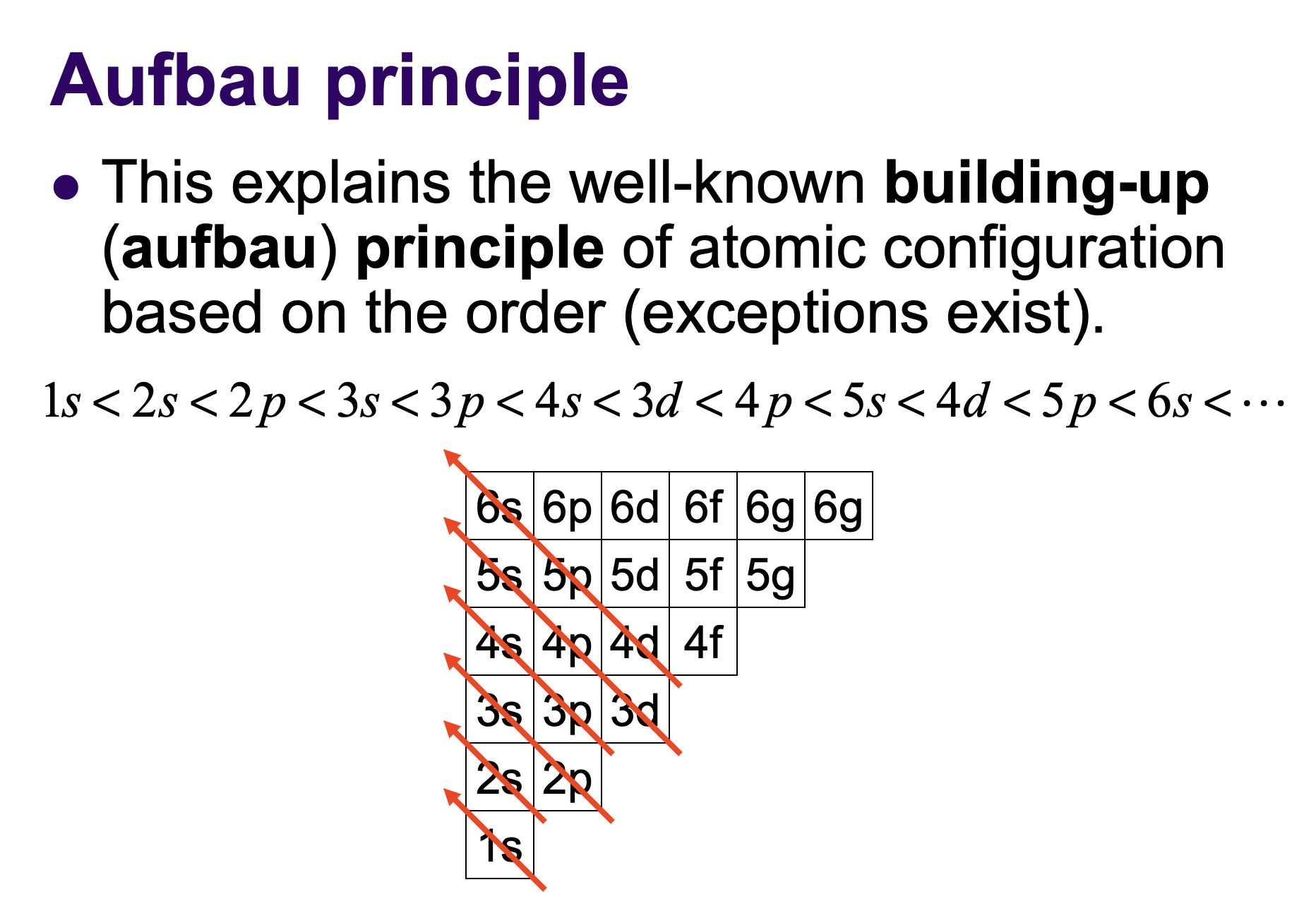
Fig. 4 Aufbau filling pattern for atomic orbitals: electrons enter orbitals in order of increasing energy.
Aufbau principle. Electrons fill orbitals in order of increasing energy.
Pauli exclusion principle. Each orbital holds at most two electrons, and they must have opposite spins.
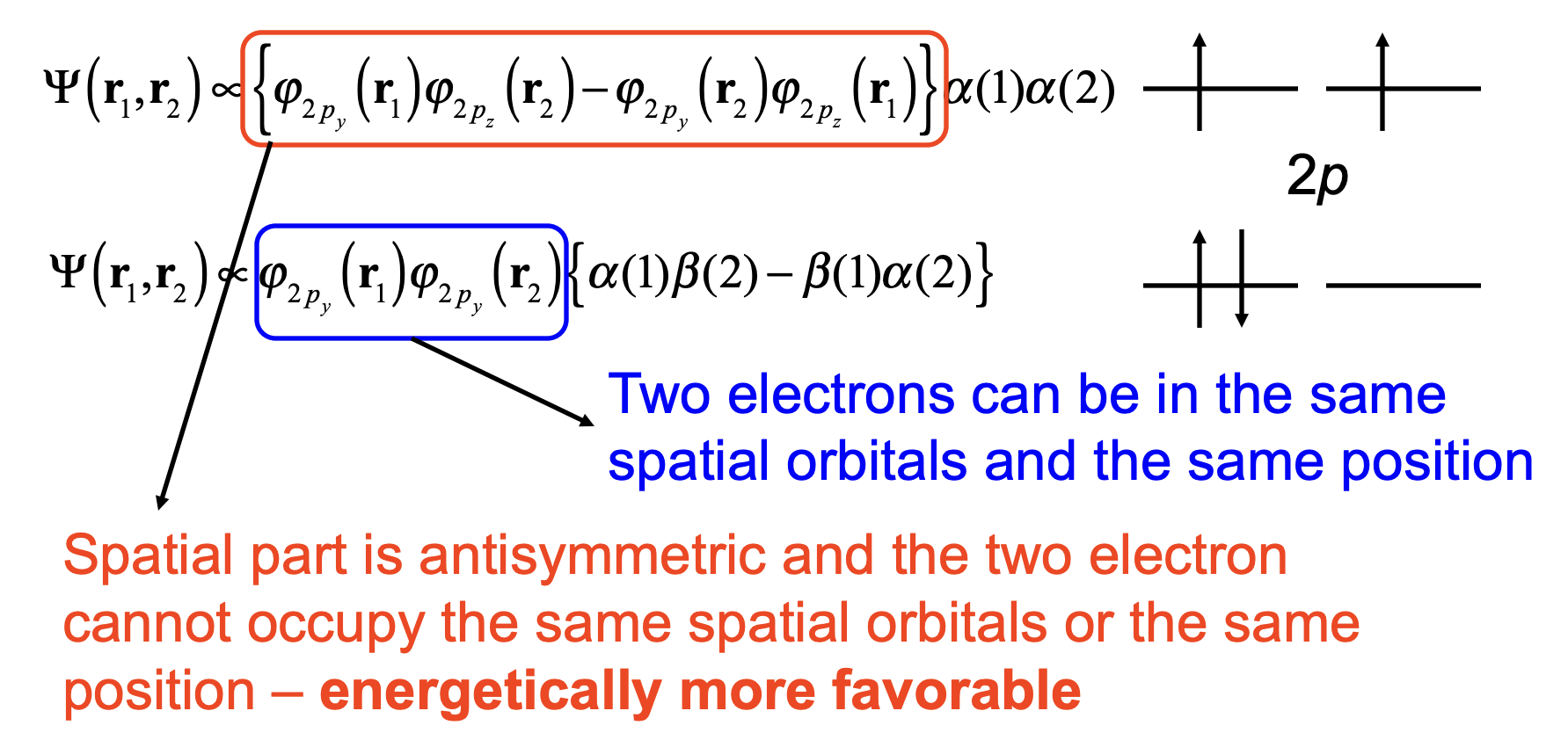
Hund’s rule. Electrons occupy degenerate orbitals singly with parallel spins before pairing. This reflects exchange stabilization, exactly the effect we saw splitting helium’s triplet below its singlet.
Fig. 5 Exchange stabilization of the parallel-spin (triplet) arrangement underlies Hund’s rule: parallel spins in separate degenerate orbitals minimize repulsion.