Consider one electron and one nucleus with charge Ze, where e is the magnitude of the electron charge (1.6021773×10⁻¹⁹ C) and Z is the atomic number. Examples of such systems are H, He+, and Li2+.
We can reduce the two-body problem to a one-body problem of an electron with reduced mass moving with respect to a fixed nucleus. Since the electron is much lighter compared to the nucleus, we can use the electron mass instead of the reduced mass, μ≈me.
We have a problem of one particle moving in a symmetric potential field in 3D. We expect to get 3 quantum numbers and anticipate some degeneracies due to this radial symmetry.
Kinetic energy operator in 3D is the same as for the particle in a box in 3D:
The Schrödinger equation for the H atom is a problem in full three dimensions with kinetic and potential energy terms. We also expect to get infinitely many eigenfunctions and eigenvalues since we have a bound electron.
Note that the Coulomb potential term above depends only on r (and not on θ or ϕ). The Laplacian can be written in terms of the angular momentum operator L^:
Plugging Rnl(r)Ylm(θ,ϕ) into the Schrödinger equation, applying the angular momentum operator, and cancelling the spherical harmonics from both sides, we end up with the radial part:
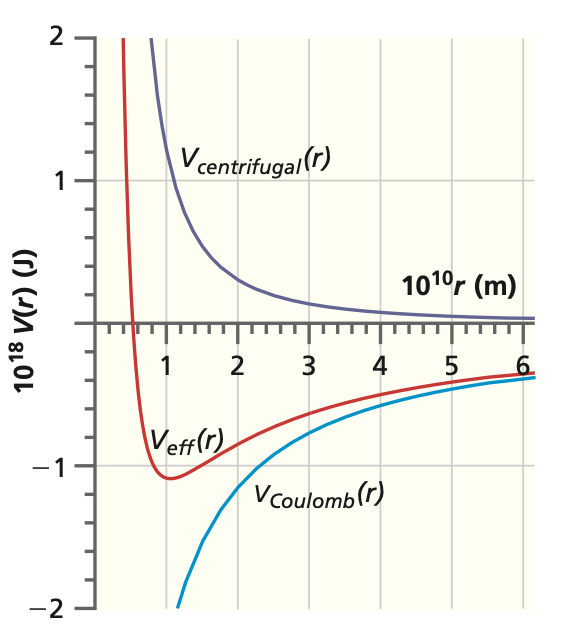
We find that the electron is moving in an effective potential generated by the attractive Coulomb interaction and the repulsive orbital kinetic energy.
The first (repulsive) term grows more rapidly with 1/r than the Coulomb potential, so it dominates at small distances if l=0. Both terms approach zero for large values of r. The resultant potential is repulsive at short distances for l>0 and is more repulsive the greater the value of l. The net result of this repulsive centrifugal potential is to force electrons in orbitals with l>0 on average farther from the nucleus than l=0 electrons.
Fig.1 Effective radial potential Veff(r) for the hydrogen atom. The attractive Coulomb term and the repulsive centrifugal term combine to push higher-l electrons farther from the nucleus.
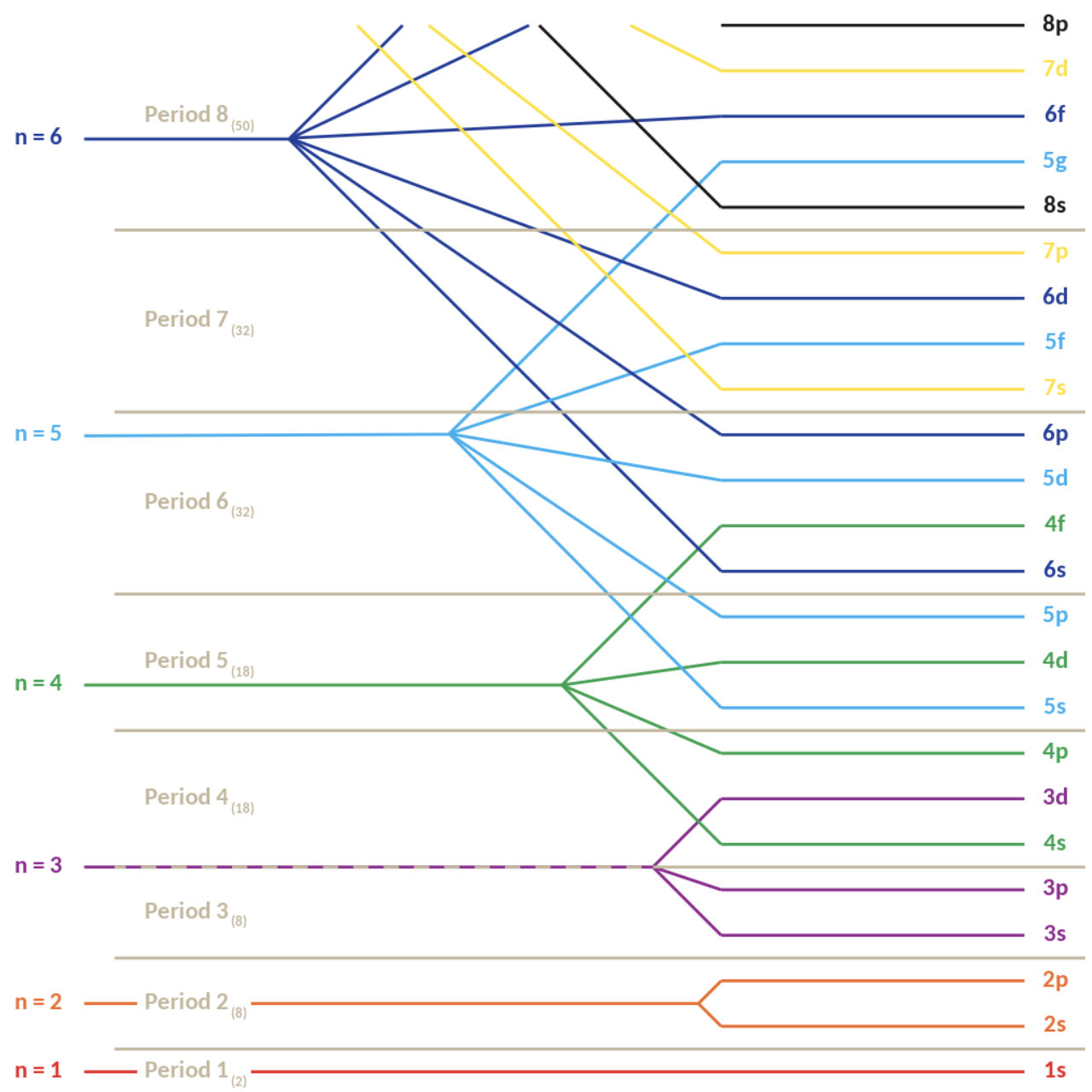
We notice that while the wavefunction depends on three quantum numbers (coming from quantization of the radial and angular coordinates), the energy depends only on the principal quantum number n. This is another example of energetic degeneracy that is due to the special spherical symmetry of the H-atom.
Fig.2 Energy levels of the hydrogen atom. All states with the same principal quantum number n share the same energy, an accidental degeneracy of the Coulomb problem.
where R is the Rydberg constant and we have assumed that the nucleus has infinite mass. To be exact, the Rydberg constant depends on the nuclear mass, but this difference is very small. For the H atom, RH=1.096775856×10⁷m−1.
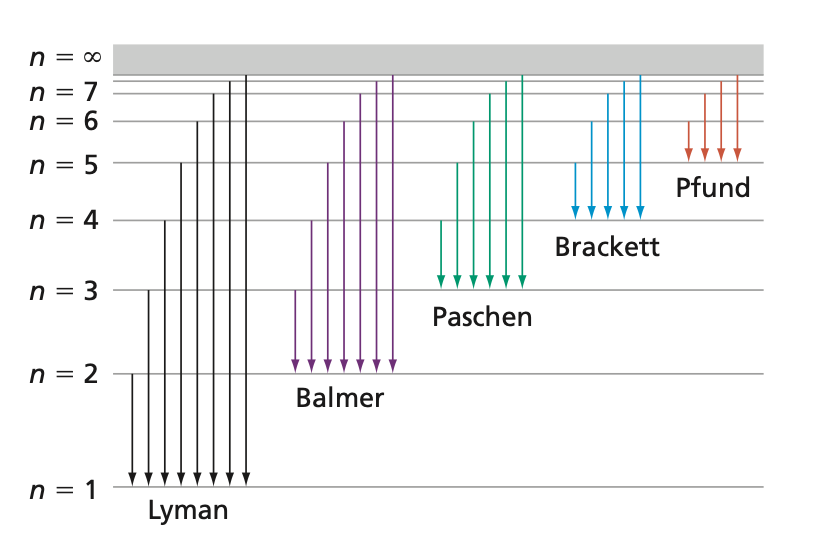
The H-atom energy expression can be used to calculate the differences between energy levels:
For a ground-state hydrogen atom (i.e., n=1), the above equation gives a value of 109678 cm−1 = 13.6057 eV. Note that the larger the nuclear charge Z is, the larger the binding energy is.
Fig.3 The Balmer series of the hydrogen atom: transitions ending on n1=2 that give rise to the visible emission lines of hydrogen.
The quantum numbers in hydrogenlike atoms take on the following values, dictated by the solution of the Schrödinger equation with boundary conditions imposed on the respective radial and angular parts.
For historical reasons, the following letters are used to express the value of l:
For n=1 we have only one wavefunction: R10(r)Y00(θ,ϕ). This state is usually labeled 1s, where 1 indicates the shell number (n) and s corresponds to orbital angular momentum l being zero.
For n=2, we have several possibilities: l=0 or l=1. The former is labeled 2s. The latter is the 2p state and consists of three degenerate states (for example, 2px, 2py, 2pz or 2p+1, 2p0, 2p−1). In the latter notation the values for m are indicated as subscripts.
There is one more quantum number that has not been discussed yet: the spin quantum number, ms=±1/2.
For one-electron systems this can take values ±21 (discussed in more detail later). In the absence of magnetic fields the spin levels are degenerate, and therefore the total degeneracy of the levels is 2n2.
We can use the wavefunctions from the table above to calculate various averages by using the definition of an average in quantum mechanics, ⟨f(r)⟩=⟨ψ∣f(r)∣ψ⟩: