Photoelectric effect challenges classical mechanical thinking.
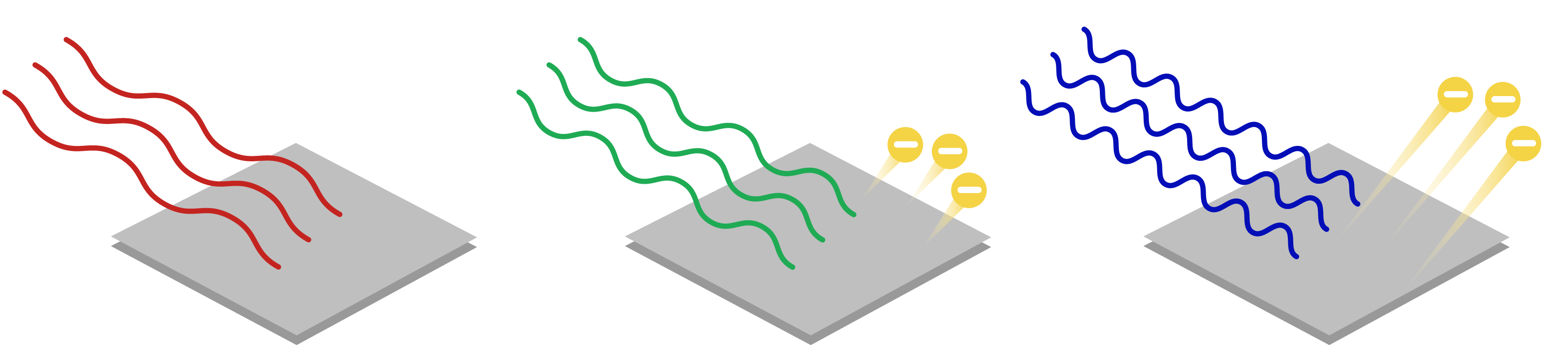
Figure 1:Effect of radiation on a material depending on frequency. Frequency increases from left to right.
When you shine radiation on a metal surface, above some threshold frequency electrons start flying off the surface.
Below this frequency no electrons are ejected, regardless of the intensity of the radiation.
This experiment challenged the classical way of thinking about radiation, according to which the energy of radiation is proportional to the amplitude of the wave, that is, its intensity or the brightness of the light.
Introducing Photon
Recall that to reconcile experiment with theory, Planck was already forced to introduce quantization of black bodies modeled as springs that can only assume discrete energies: giving off radiation with the same frequencies!
At that time, this discreteness introduced by Planck was thought to be nothing more than a temporary mathematical trick to fit the experimental curve.
Einstein, on the other hand, was more imaginative and saw in Planck’s prescription more than just a math trick. He suggested that light can behave like a stream of particles with discrete, countable energy packets, which he called photons. This view was instrumental in making sense of the photoelectric experiment.
Thus we see that both matter and radiation are quantized and given by the same relation of frequency times the Planck constant.
Kinetic energy: frequency vs intensity
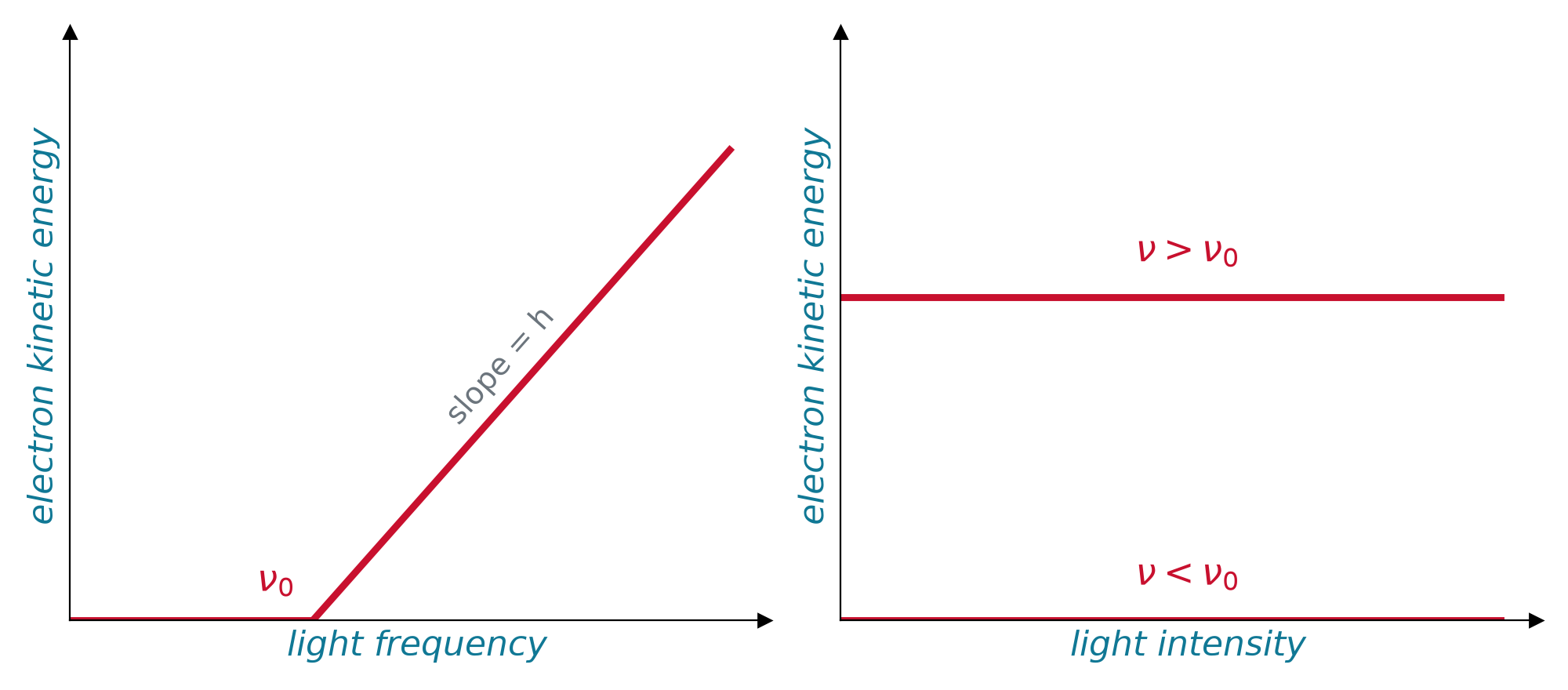
Figure 2:Dependence of electron kinetic energy on the frequency of radiation hitting the material surface (left) and on the intensity of light for frequencies below and above threshold (right).
Frequency determines whether electrons will be ejected: , but it does not affect the number of electrons (current)
Kinetic energy of an ejected electron is a linearly increasing function of the frequency of light with no dependence on the intensity:
Contrary to the wave theory of light, increasing the intensity (brightness) of light does not eject electrons when the frequency is below the threshold
Electric current: frequency vs intensity
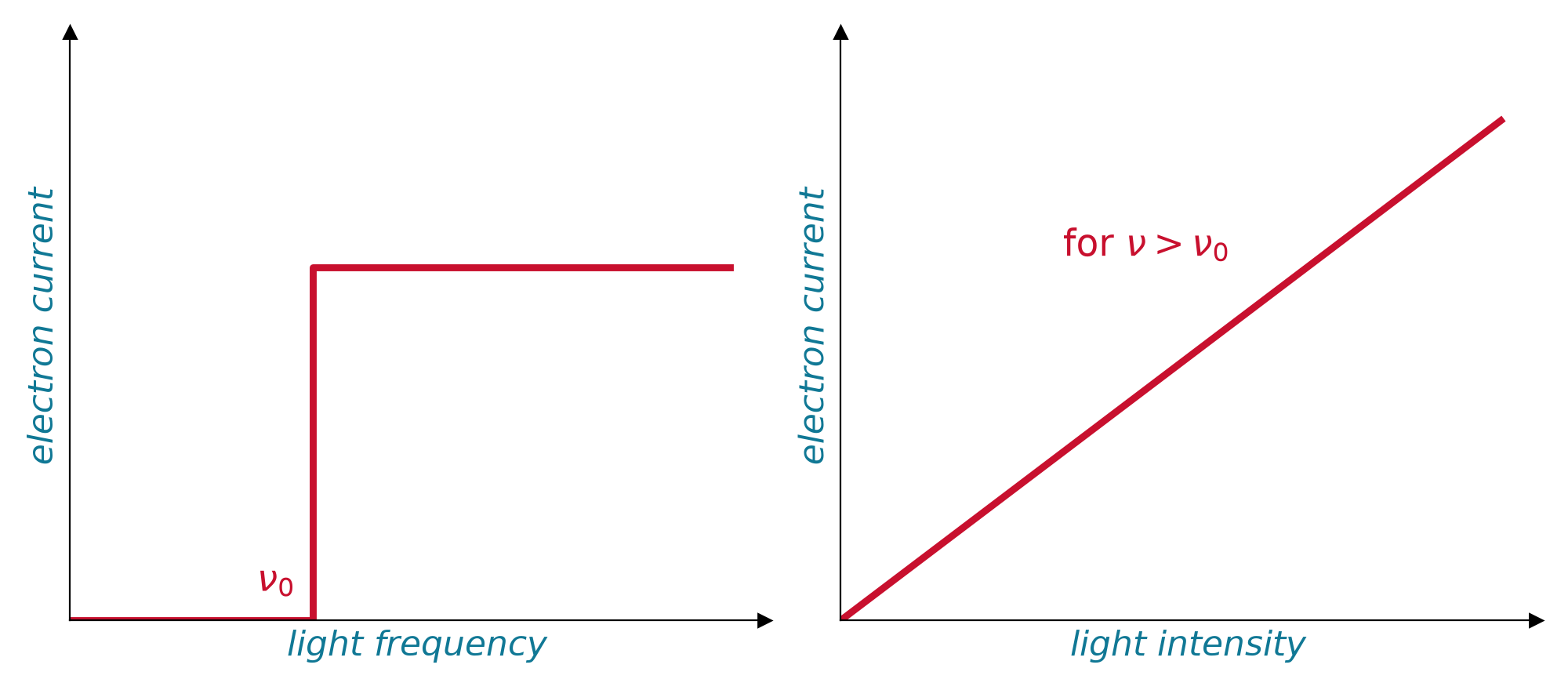
Figure 3:Dependence of electron current on the frequency of radiation hitting the material surface (left) and on the intensity of light for a frequency above threshold (right).
Once the threshold is reached , frequency has no effect on electron current (number of electrons)
Once the threshold is reached , increasing the intensity of light, on the other hand, increases the current linearly.
Photons explain photoelectric effect
Light consists of photons: tiny packets of energy carrying energy.
Intensity of light quantifies number of photons.
Frequency of light quantifies energy of photons.
If light radiates photons per second, then the total energy radiated per second is
Particle nature of light: 1 photon can “collide” with 1 electron and eject it if the photon has sufficient energy.
Applications of photoelectric effect
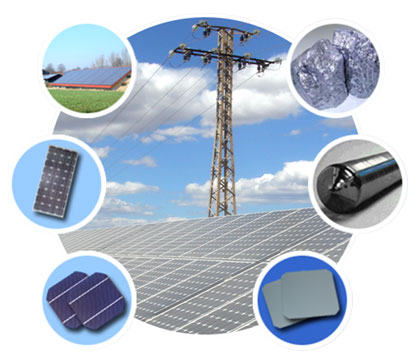
Figure 4:Besides its historical role in the establishment of QM, the photoelectric effect has many practical applications. It is relevant to the design of solar cells, photovoltaics, photoelectron spectroscopy, night vision, and more.
Explore photoelectric effect
Pick a metal and a wavelength. The line is Einstein’s equation for that metal: its slope is always , and only the intercept (the threshold ) moves when you change the metal. The marker shows the light you chose: a dot on the line when electrons come out, a cross on the axis when the photon energy falls short.
Problems
Problem 1: Threshold frequency
A certain metal has a work function of 4.5 eV. Calculate the threshold frequency () required to emit electrons from the metal surface.
Solution
Problem 2: Maximum kinetic energy of photoelectrons
Ultraviolet light with a wavelength of 250 nm is incident on a metal surface with a work function of 3.0 eV. Calculate the maximum kinetic energy of the emitted photoelectrons.
Solution
Problem 3: Photoelectric current and light intensity
Explain how the intensity of incident light affects the photoelectric current, assuming the frequency of the light is above the threshold frequency.
Solution
In the photoelectric effect, the intensity of the incident light is proportional to the number of photons striking the metal surface per unit time. If the frequency of the light is above the threshold frequency, each photon has sufficient energy to eject an electron.
As the intensity increases, more photons hit the surface, leading to the emission of more photoelectrons. Consequently, the photoelectric current, which is proportional to the number of emitted electrons, increases with the intensity of the incident light. However, the kinetic energy of the emitted electrons remains the same and is determined by the energy of the individual photons, not the intensity of the light.
Problem 4: Which metal is it?
Light of wavelength 300 nm shines on an unknown metal, and the fastest photoelectrons are stopped by a reverse voltage of 1.85 V (so eV). Find the work function and identify the metal from this list: cesium 2.14 eV, sodium 2.28 eV, zinc 4.33 eV, copper 4.70 eV. What is the longest wavelength that still ejects electrons from it?
Problem 5: From photons to current
A 2.0 mW beam of 400 nm light falls on a potassium surface (work function 2.30 eV). (a) How many photons hit the surface per second? (b) If one photon in twenty ejects an electron, what current flows? (c) How does the answer to (b) change if the intensity doubles? And if the wavelength is halved at the same power?
Problem 6: Visible light and cesium
Cesium has the lowest work function of the common metals, 2.14 eV. Find its threshold wavelength. Which colors of visible light can eject electrons from cesium and which cannot? Suggest why cesium-coated cathodes were the material of choice for early photocells and night-vision tubes.
Problem 7: The missing time delay
In the wave picture an electron would have to soak up energy gradually from the light wave. For a very dim source of intensity 10-10 W/m, estimate how long an atom of cross-sectional area 10-20 m would need to collect the 2 eV required to escape. Experimentally, photoelectrons appear within nanoseconds of switching on the light, however dim. What does this tell you about how light delivers its energy?