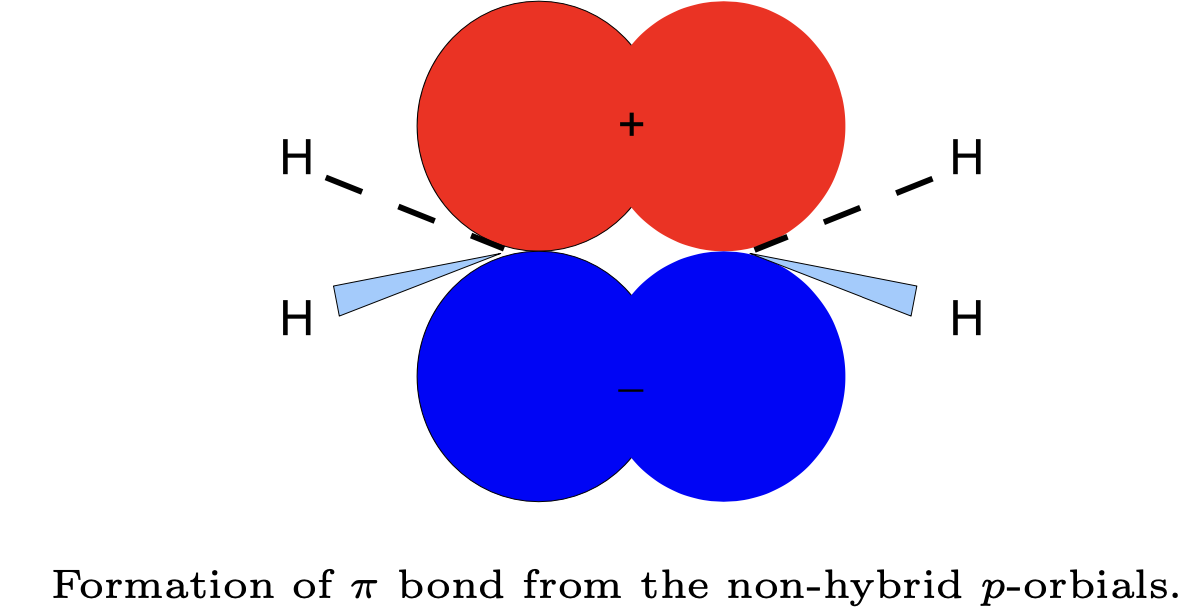
Molecules with extensive π bonding systems, such as benzene, are not described very well by valence bond theory because the π electrons are delocalized over the whole molecule. The σ and π bonds are illustrated below for ethylene (C2H4, with sp2 carbons):
Fig. 1 The σ framework and the delocalized π system of ethylene (C2H4).
We have chosen the z-axis along the internuclear axis. Because both σ and π bonding occur between the two carbon atoms, we say that this is a double bond. The hybrid orbitals here also explain the geometry. For triple bonds, one σ and two π bonds are formed.
Huckel molecular orbital theory assumes that the π electrons, which are responsible for the special properties of conjugated and aromatic hydrocarbons, do not interact with one another, and that the total wavefunction is just a product of the one-electron molecular orbitals. The π molecular orbital of the two carbons in C2H4 can be written approximately as:
where ϕ1 and ϕ2 are the 2py atomic orbitals for carbons 1 and 2, respectively. Using the variational principle gives the following secular determinant:
∣∣H11−ES11H21−ES21H12−ES12H22−ES22∣∣=0 with Hij=∫ϕi∗Hϕjdτ and Sij=∫ϕi∗ϕjdτ
In Huckel theory, the Coulomb integral α and the resonance integral β are regarded as empirical parameters. They can be obtained, for example, from experimental data. Thus, in Huckel theory it is not necessary to specify the Hamiltonian operator. Expansion of the determinant leads to a quadratic equation for E, with solutions E=α±β. In general, it can be shown that β<0, which implies that the lowest orbital energy is E1=α+β. There are two π electrons, and therefore the total energy is Etot=2E1=2α+2β. Do not confuse α and β here with electron spin.
These orbitals resemble the H2+ LCAO MOs discussed previously. This also gives us an estimate for one of the excited states, where one electron is promoted from the bonding to the antibonding orbital. The excitation energy is found to be 2∣β∣, which allows, for example, the estimation of β from UV/VIS absorption spectroscopy.
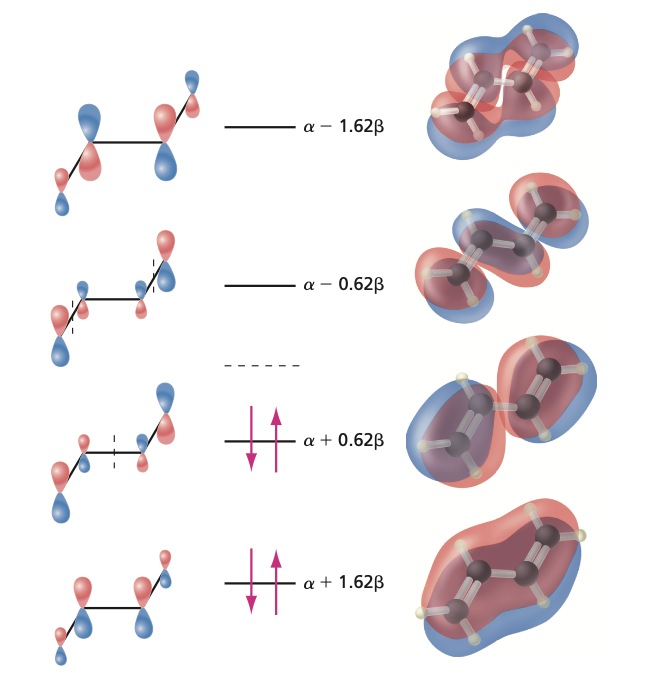
Let us calculate the π electronic energy for 1,3-butadiene (CH2=CHCH=CH2) using Huckel theory. First we write the secular determinant using the rules given earlier. To do this, it is convenient to number the carbon atoms in the molecule:
A localized solution where the π electrons are shared either between atoms 1 and 2 or between atoms 3 and 4. This implies that the β parameter should not be written between nuclei 2 and 3.
A delocalized solution where the π electrons are delocalized over all four carbons. This implies that the β parameter should be written between nuclei 2 and 3.
Here it turns out that scenario 2 gives a lower energy solution, and we study that in more detail. In general, however, both cases should be considered. The energy difference between scenarios 1 and 2 is called the resonance stabilization energy. The secular determinant is:
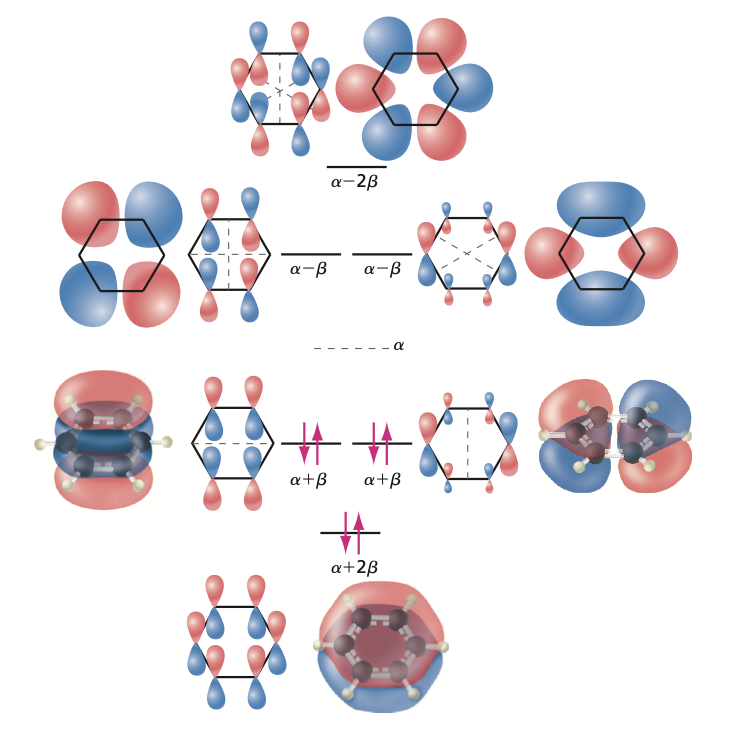
Fig. 3 The six Huckel π molecular orbitals of benzene. The doubly degenerate pairs reflect the high symmetry of the ring.
The six π electrons fill the lowest three levels (E1 and the degenerate pair E2=E3), giving a total π energy of 6α+8β. Compared with three isolated ethylene double bonds (6α+6β), benzene is stabilized by an extra 2β, which is the origin of its aromatic stability.