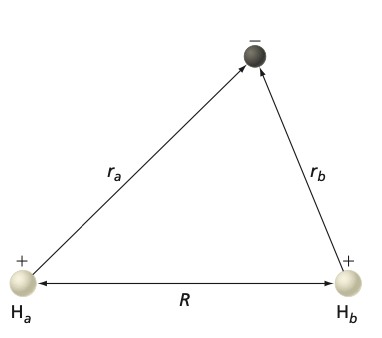
Fig. 1 Coordinates used to describe the H2+ molecule.
In the following, we will consider the simplest molecule H2+, which contains only one electron. This simple system demonstrates the basic concepts of chemical bonding. The Schrodinger equation for H2+ is:
where M is the proton mass, me is the electron mass, r1A is the distance between the electron and nucleus A, r1B is the distance between the electron and nucleus B, and R is the A to B distance.
Note that the Hamiltonian also includes the quantum mechanical kinetic energy of the protons. As such, the wavefunction depends on r1, RA, and RB.
where ψe is the electronic wavefunction that depends on the distance R between the nuclei and ψn is the nuclear wavefunction depending on RA and RB. It can be shown that the nuclear part can often be further separated into vibrational, rotational, and translational parts. The electronic Schrodinger equation can now be written as:
Because R is a parameter, both Ee and ψe are functions of R. Solving the electronic problem at a sequence of fixed nuclear geometries traces out the potential energy surface on which the nuclei move, which is the central idea that makes molecular electronic structure tractable.