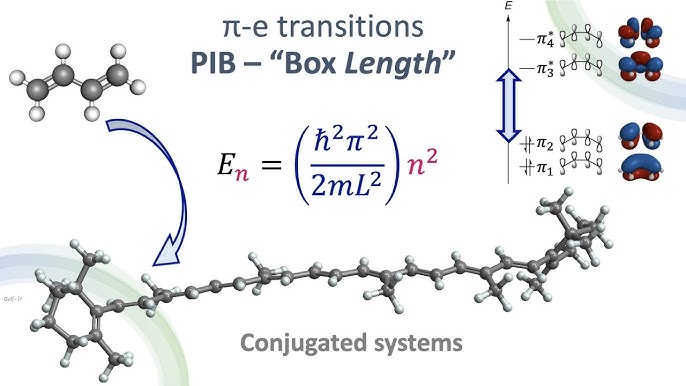
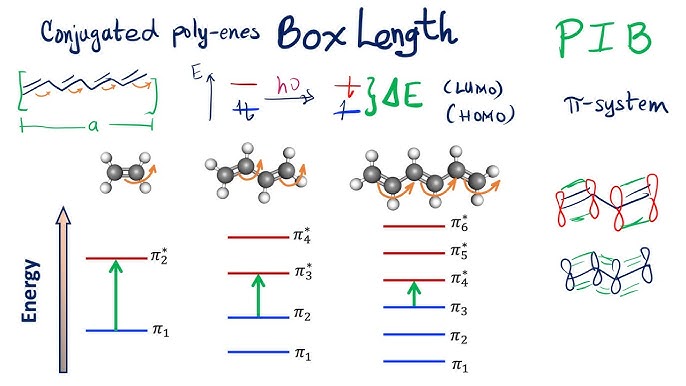
1D Particle in a Box: Often used for linear conjugated systems like butadiene or polyenes. The box length corresponds to the length of the conjugated chain, and the energy levels are used to predict electronic transitions that occur when light is absorbed.
2D Particle in a Box: For more complex systems like aromatic rings (e.g., benzene) or graphene fragments, the 2D PIB model helps to describe the movement of π-electrons confined to two dimensions.
Consider the 1D PIB model applied to butadiene (C₄H₆), where the four π-electrons are delocalized over the entire conjugated region. Find the wavelength for exciting one π-electron from the ground state to the next excited state.
Single bond (C–C) length: 1.54 Å
Double bond (C=C) length: 1.34 Å
In this problem, you are tasked with determining both the length of the molecule and the number of π-electrons in a conjugated system, specifically butadiene. This requires applying the quantum particle-in-a-box (PIB) model to the system.
Step 1: Determine the Length of the Conjugated Region
The conjugated π-electrons in butadiene are delocalized across the four carbon atoms, which form a conjugated chain. This conjugated chain can be modeled as a 1D box, with the length of the box corresponding to the length of the conjugated system.
In butadiene, the π-electrons are found in the double bonds between the carbon atoms. Each carbon in the conjugated system contributes one π-electron, and there are four carbons in the conjugated region. Therefore, there are 4 π-electrons in total.
By determining ΔE, you can find the corresponding wavelength of light absorbed by the molecule when an electron transitions between energy levels.
This approach is used to estimate the energies associated with electronic transitions in π-conjugated systems like butadiene, which can be experimentally observed through their absorption spectra. This also helps in understanding how molecular size and electron count affect electronic properties.
A conjugated diene molecule (e.g., butadiene) has a total conjugation length of 5 Å, approximated by the distance between the end carbons in the conjugated chain. Using the 1D particle in a box model, calculate the wavelength of light absorbed when a π-electron is excited from the ground state (n=1) to the first excited state (n=2). Assume the electron behaves as a particle of mass m=9.109×10⁻³¹kg and Planck’s constant is h=6.626×10⁻³⁴J s.
Solution 1
The energy difference between the ground state (n=1) and the first excited state (n=2) in a 1D particle in a box is given by:
Consider a polyene chain of 6 alternating single and double bonds, where each C=C bond length is approximately 1.35 Å and each C–C bond length is approximately 1.45 Å. Calculate the total conjugation length of the polyene molecule and the wavelength of light required to excite a π-electron from the n=1 to n=2 state using the 1D particle in a box model.
Solution 2
First, calculate the total conjugation length by adding up the bond lengths:
A linear conjugated molecule has 8 alternating single and double carbon-carbon bonds. The bond lengths are given as 1.40 Å for single bonds and 1.35 Å for double bonds. Use the particle in a box model to calculate the wavelength of light absorbed during a transition from the n=1 state to the n=3 state.
Solution 3
Calculate the total length of the conjugated chain by adding the single and double bond lengths. For an 8-bond system, you have 4 double bonds and 4 single bonds, so:
A conjugated triene molecule has a total conjugation length of 7.5 Å, derived from three alternating single and double carbon-carbon bonds. Calculate the wavelength of light absorbed when a π-electron transitions from the ground state (n=1) to the second excited state (n=3) in the 1D particle in a box model. Use the same constants as above.
Solution 4
Using L=7.5×10⁻¹⁰m, calculate the energy difference between n=1 and n=3:
A conjugated polyene chain consists of 10 carbon atoms connected by alternating single and double bonds. Each C=C bond is 1.34 Å, and each C–C bond is 1.54 Å. Find the total length of the conjugated system, and use this to calculate the wavelength of the transition from the n=2 to the n=3 energy level. Assume all π-electrons are delocalized over the entire length of the molecule.
Consider an electron in a 2D particle in a box, representing the π-electrons in a graphene-like fragment with dimensions Lx=2nm and Ly=1nm. Calculate the energy of the electron for the quantum numbers nx=1 and ny=2
Solution 6
The energy for a 2D particle in a box is given by: