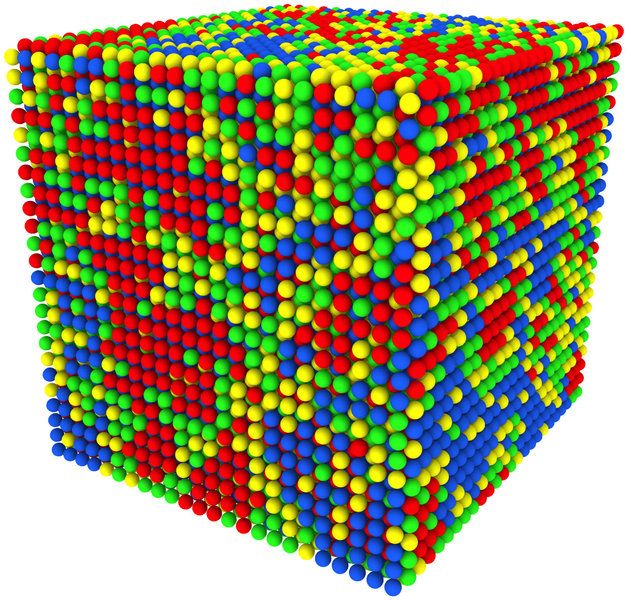


Mean Field#
What You Will Learn
The Mean Field Approximation (MFA) simplifies complex systems by replacing fluctuating variables with their average values.
When applied to functions of many interacting variables, MFA assumes that correlations can be neglected:
This approximation is foundational across many areas of physics, including:
Electronic structure theory (e.g., Hartree–Fock)
Liquid state theory (e.g., van der Waals)
Condensed matter physics (e.g., Ising and Heisenberg models)
MFA applied to the Ising Model#
In the Ising model, the mean-field approximation (MFA) decouples spin–spin interactions, reducing the system to a single macroscopic parameter: the average magnetization per spin, denoted by \( m \).
The factor of \( \frac{1}{2} \) avoids double-counting spin pairs, and \( q \) is the coordination number—for instance, \( q = 4 \) for a 2D square lattice and \( q = 6 \) for a 3D cubic lattice.
Derivation of the Mean-Field Hamiltonian
Consider the 2D Ising model where each spin \( s_i \) interacts with its \( q \) nearest neighbors:
Define the local mean field at site \( i \) as:
Under the mean-field approximation, replace neighboring spins with their average value:
The total Hamiltonian then becomes:
Taking the thermal average and accounting for double counting leads to the previously derived mean-field expression for \( \langle H \rangle \).
Self-Consistent Equation for Magnetization
Partition Function: After applying MFA, the system becomes effectively non-interacting, and the total partition function factorizes as \( Z = z^N \), where \( z \) is the partition function of a single spin. For \( s_i = \pm 1 \):
The probability that a spin is in state \( s_i \) is:
Average Magnetization: The mean value of a spin is then:
This self-consistent equation relates the average magnetization \( m \) to itself via the hyperbolic tangent function, capturing the thermal competition between spin alignment and disorder.
Free Energy of Mean-Field Ising Models#
Defining the Macrostate \( M \)
Consider a spin lattice of \( N \) sites, where each spin can point up or down. The total magnetization is given by:
Defining the magnetization per spin \( m = M/N \), the probabilities of spin-up and spin-down states are:
Entropy, Energy, and Free Energy
Entropy is given by the Shannon expression using the probabilities of spin states:
Energy in the mean-field approximation is the sum over spins in the presence of an average field:
Free Energy is the usual Legendre transform:
Dimensionless Free Energy per Spin (useful for analysis and plotting):
Finding the Critical Temperature \( T_c \)
The critical point is determined by the second derivative of the free energy:
Magnetization as a Function of Temperature
The equilibrium magnetization minimizes the free energy, leading to a self-consistency condition:
Rearranged as:
For zero external field (\( h = 0 \)), the equation simplifies to:
For small \( m \), expand \( \tanh^{-1}(m) \approx m + \frac{1}{3} m^3 \), yielding:
Solving this, we find the magnetization near the critical point behaves as:
Visualizing MF predictions#
The \(h=0\) MFA case
The equation can be solved in a self-consistent manner or graphically by finding intersection between:
\(m =tanh(x)\)
\(x = \frac{Jqm}{k_BT}\)
When the slope is equal to one it provides a dividing line between two behaviours.
MFA shows phase-transition!
import ipywidgets as widgets
from ipywidgets import interactive, interact
import matplotlib.pyplot as plt
import numpy as np
# Constants
J = 1 # Interaction strength
k = 1 # Boltzmann constant (set to 1 for simplicity)
def entropy(m):
# Handle log of zero by adding a small number to the argument
small_number = 1e-10
return -(1+m)/2 * np.log((1+m)/2 + small_number) - (1-m)/2 * np.log((1-m)/2 + small_number)
def free_energy(m, T):
# Calculate the free energy for given m and T
return -0.5 * J * m**2 - T * entropy(m)
def plot_free_energy(T):
# Magnetization range
m_values = np.linspace(-1, 1, 100)
F_values = [free_energy(m, T) for m in m_values]
# Plotting
plt.figure(figsize=(8, 5))
plt.plot(m_values, F_values, label=f'T = {T}')
plt.xlabel('Magnetization (m)')
plt.ylabel('Free Energy per Spin (F)')
plt.title('Mean-field Free Energy vs. Magnetization')
plt.legend()
plt.grid(True)
plt.show()
interactive(plot_free_energy, T=(0.1, 2, 0.1 ))
def mfa_ising_Tc(T=1, Tc=1):
x = np.linspace(-3,3,1000)
f = lambda x: (T/Tc)*x
m = lambda x: np.tanh(x)
plt.plot(x,m(x), lw=3, alpha=0.9, color='green')
plt.plot(x,f(x),'--',color='black')
idx = np.argwhere(np.diff(np.sign(m(x) - f(x))))
plt.plot(x[idx], f(x)[idx], 'ro')
plt.legend(['m=tanh(x)', 'x'])
plt.ylim(-2,2)
plt.grid('True')
plt.xlabel('m',fontsize=16)
plt.ylabel(r'$tanh (\frac{Tc}{T} m )$')
plt.show()
import plotly.graph_objects as go
import numpy as np
from scipy.optimize import fsolve
from scipy.optimize import root_scalar # Importing root_scalar
def compute_xcross(T, h_over_T):
def f(M):
Tc = 1.0 # Normalized temperature
h = h_over_T * T # Compute actual h from h/T and T
return M - np.tanh((M + h) / (T / Tc))
# Using symmetric interval for root finding to allow negative solutions
interval = [-2.0, 2.0]
# Check if a root is likely within the given range
if f(interval[0]) * f(interval[1]) > 0:
return 0.0 # If no root likely, return 0
# Find the root using bisection method within the specified range
result = root_scalar(f, bracket=interval, method='bisect')
return result.root
# Define ranges for h/T and T/Tc (from 0.2 to 1.5)
h_over_T_values = np.linspace(-0.2, 0.2, 101)
T_over_Tc_values = np.linspace(0.1, 1.6, 101)
# Create a meshgrid for T/Tc and h/T
H_over_T, T_over_Tc = np.meshgrid(h_over_T_values, T_over_Tc_values)
# Initialize an array for magnetizations
Magnetizations = np.zeros_like(H_over_T)
# Compute M for each (h/T, T/Tc) pair in the meshgrid
for i, T in enumerate(T_over_Tc_values):
for j, h in enumerate(h_over_T_values):
Magnetizations[i, j] = compute_xcross(T, h)
# Create a 3D surface plot using Plotly
fig = go.Figure(data=[go.Surface(z=Magnetizations, x=H_over_T, y=T_over_Tc,
colorscale='RdBu',
contours={
#'z': {'show': True, 'start': -1.0, 'end': 1.0, 'size': 0.1, 'color':'orange'},
'x': {'show': True, 'start': -1, 'end': 1, 'size': 0.05, 'color':'black'},
'y': {'show': True, 'start': 0.5, 'end': 1.5, 'size': 0.1, 'color':'black'}
})])
# Update plot layout
fig.update_layout(
title='3D Plot of Magnetization M vs normalized temperature and field; T/Tc and h/T',
scene=dict(
xaxis_title='h/T',
yaxis_title='T/Tc',
zaxis_title='M',
aspectmode='manual',
yaxis_autorange='reversed', # Reverse the Y-axis
aspectratio=dict(x=2, y=2, z=0.75), # Adjust these values as needed
camera=dict(
eye=dict(x=-4, y=-2, z=2), # Adjust camera "eye" position for better view
up=dict(x=0, y=0, z=1) # Ensures Z is up
)
),
autosize=False,
width=900,
height=900
)
# Display the figure with configuration options
fig.show()
Landau Theory#
Show code cell source
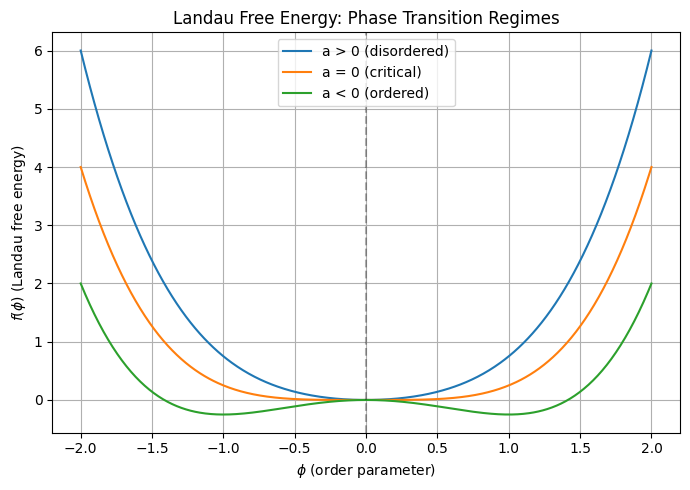
import numpy as np
import matplotlib.pyplot as plt
# ==== Free energy ====
def f(phi, a, b):
return 0.5 * a * phi**2 + 0.25 * b * phi**4
# ==== Range of phi ====
phi = np.linspace(-2, 2, 500)
b = 1.0 # fixed positive b
# ==== Plot for different 'a' ====
a_values = [1.0, 0.0, -1.0]
labels = ['a > 0 (disordered)', 'a = 0 (critical)', 'a < 0 (ordered)']
colors = ['#1f77b4', '#ff7f0e', '#2ca02c']
plt.figure(figsize=(7, 5))
for a, label, color in zip(a_values, labels, colors):
plt.plot(phi, f(phi, a, b), label=label, color=color)
plt.axvline(0, color='k', linestyle='--', alpha=0.3)
plt.xlabel(r'$\phi$ (order parameter)')
plt.ylabel(r'$f(\phi)$ (Landau free energy)')
plt.title('Landau Free Energy: Phase Transition Regimes')
plt.legend()
plt.grid(True)
plt.tight_layout()
plt.show()
Show code cell source
import numpy as np
import matplotlib.pyplot as plt
from matplotlib.animation import FuncAnimation
from IPython.display import HTML
# ==== Parameters ====
N = 128 # Grid size
dx = 1.0 # Spatial resolution
dt = 0.01 # Time step
steps = 1000 # Total time steps
save_every = 10 # Frame interval for animation
epsilon = 1.0 # Interfacial width parameter
# ==== Free energy parameters ====
a = -1.0 # linear coefficient (controls stability of φ = 0)
b = 1.0 # non-linear coefficient (typically > 0 to stabilize)
# ==== Landau free energy derivative ====
def f_prime(phi):
return a * phi + b * phi**3
# ==== Laplacian with periodic boundary ====
def laplacian(field):
return (
-4 * field
+ np.roll(field, 1, axis=0) + np.roll(field, -1, axis=0)
+ np.roll(field, 1, axis=1) + np.roll(field, -1, axis=1)
) / dx**2
# ==== Initialize field ====
phi = np.random.rand(N, N) * 0.2 - 0.1 # small noise around 0
# ==== Store frames ====
frames = []
# ==== Simulation loop ====
for step in range(steps):
mu = -epsilon**2 * laplacian(phi) + f_prime(phi)
phi += dt * laplacian(mu)
if step % save_every == 0:
frames.append(phi.copy())
# ==== Animation ====
fig, ax = plt.subplots(figsize=(5, 5))
im = ax.imshow(frames[0], cmap='bwr', vmin=-0.05, vmax=0.05)
ax.axis('off')
def update(frame):
im.set_array(frame)
return [im]
ani = FuncAnimation(fig, update, frames=frames, interval=50, blit=True)
plt.close() # avoid double display
HTML(ani.to_jshtml())